Learning how to study for a ham radio license exam is mostly about discipline, not difficulty. The Technician exam is 35 multiple-choice questions drawn from a public question pool, and you pass with 26 correct (74%). A first-time candidate with no radio background usually puts in 10 to 20 focused hours across two to eight weeks. No Morse code test is required for any current US class.
One thing changed recently: the FCC refreshed the Technician question pool effective July 1, 2026. If your study material was printed for the previous pool, some of it no longer matches what the volunteer examiners will ask. Everything below is built around the current pool.
Last updated for the 2026 exam cycle and the 2026-2030 Technician question pool.
Table of Contents
- 1What You Need
- 2Step-by-Step: How to Study for a Ham Radio License Exam
- 31. Understand the Exam Structure and License Levels
- 42. Gather the Official Exam Topics and Question Pool
- 53. Learn the Basics Before Memorizing Answers
- 64. Create a Repeatable Weekly Study Schedule
- 75. Practice With Exam-Style Questions
- 86. Review the Questions You Get Wrong
- 97. Take a Full Practice Test and Confirm Readiness
- 10Common Mistakes
- 11Frequently Asked Questions
- 12How long does it take to study for a ham radio license?
- 13How hard is it to pass a ham radio exam?
- 14What is the 3-3-3 rule for ham radio?
- 15Is HamStudy.org enough to pass the test?
- 16Do I need to know Morse code for a ham radio license?
- 17What is the best way to study for the ham radio license exam?
- 18Conclusion
What You Need
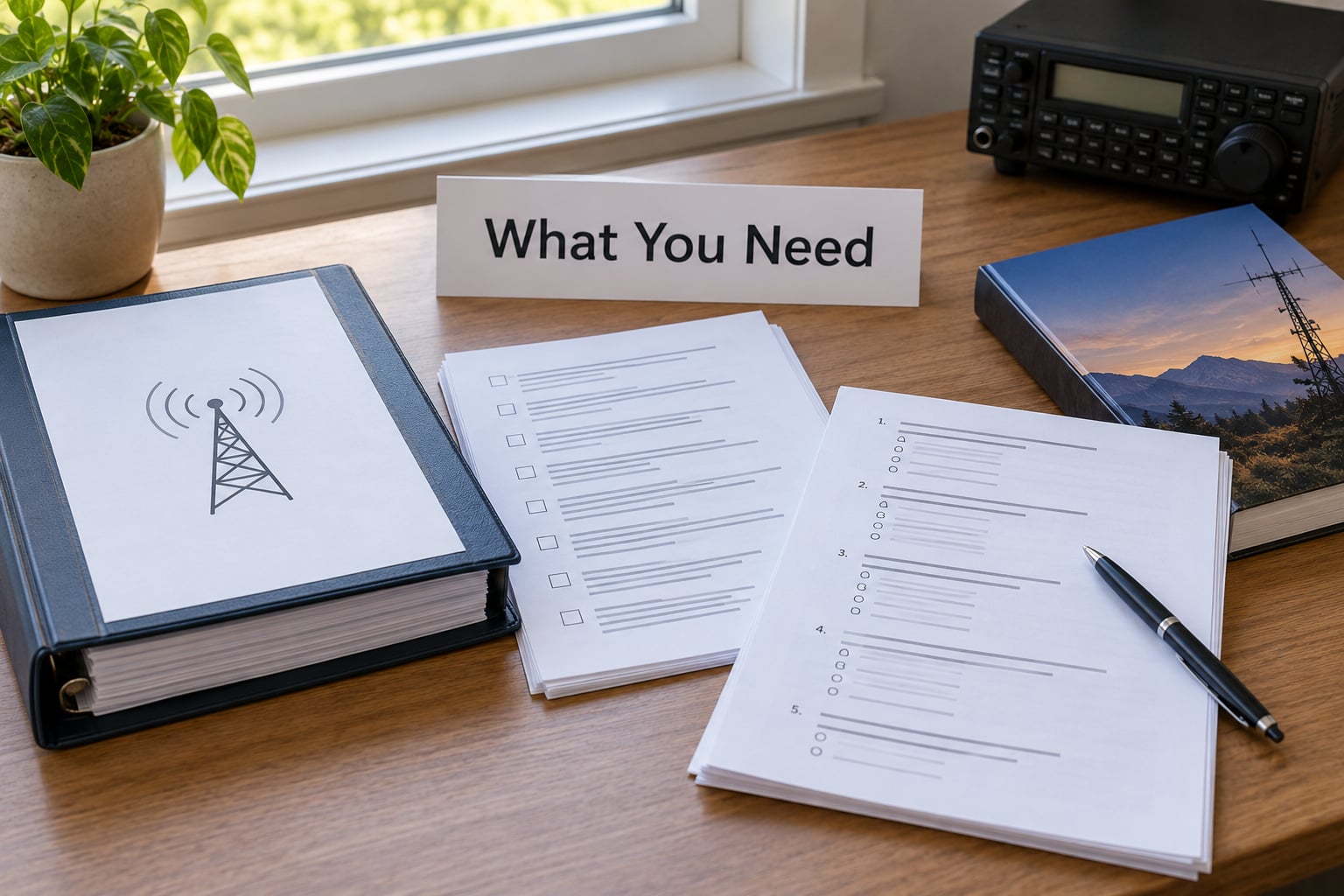
You need four things before you start, and none of them cost money. First, the current question pool from NCVEC, the volunteer coordinating body that maintains the pools for Technician, General and Extra. Second, a drilling tool that pulls random questions from that pool. Third, somewhere to write down every question you get wrong. Fourth, an exam date on the calendar, because an open-ended study plan rarely survives contact with a busy week.
Here is what each piece looks like in practice.
- The current question pool. Downloadable in PDF from the NCVEC site and republished by the ARRL. Check the effective date printed on the front before you start.
- A practice-question tool. HamStudy.org is the free default most people land on, and HamExam.org is the other well-regarded free option. Both build practice sessions straight from the live pool.
- A mistake log. A paper notebook or a single spreadsheet tab. One row per missed question: the question number, why you missed it, and the answer explanation.
- A test date. Volunteer examiner sessions are listed by the ARRL and by local clubs. Booking first and working backward from that date is what turns a vague plan into a schedule.
- A pencil and a basic calculator. No phone calculator, no graphing calculator. The volunteer examiner will not allow one at the desk.
Step-by-Step: How to Study for a Ham Radio License Exam
1. Understand the Exam Structure and License Levels
The exam is not a mystery test. Every question you could be asked is published in advance, and the pass mark is lower than most people assume. Here are the numbers that matter.
| Exam fact | Technician (Element 2) | General (Element 3) | Extra (Element 4) |
|---|---|---|---|
| Questions on the exam | 35 | 50 | 50 |
| Correct answers needed | 26 | 37 | 37 |
| Pass percentage | 74% | 74% | 74% |
| Rough study hours | 4 to 6 | 8 to 10 | 10 to 12 |
| What it unlocks | Full access to the 6-meter and 2-meter bands, plus a slice of HF | Most HF bands | Everything below 30 MHz |
That 74% figure trips people up. The FCC sets the pass mark at 74% and rounds down, so on a 35-question exam you need 26 correct. Plenty of study sites round it to 75%, which sounds harder than it is.
The three license levels are cumulative. Most people start at Technician and stop there for a while, because Technician alone opens the VHF bands that new operators use most. General adds the HF bands. Extra adds everything else, including satellite and satellite-gate operating, and it requires a General license first.
One practical note: many clubs run back-to-back sessions, so you can sit Technician and General on the same morning if you schedule both and pay both session fees. Plenty of candidates do this. It is only sensible if you have already put in the General study hours, though.
2. Gather the Official Exam Topics and Question Pool
Get the pool that is live right now, not the one your materials were written against. The FCC requires NCVEC to revise roughly two-thirds of every pool on a rolling three-year cycle, which is why pools refresh on a schedule and why an old book goes stale without announcing it.
The Technician pool is roughly 300 questions. The General and Extra pools are larger, in the range of 600 to 700 each. Download the pool, then divide it by topic rather than reading it front to back. The pool groups questions into sub-groups covering regulations, operating procedures, electrical theory, radio wave propagation, station identification, call signs and the amateur bands.
Each question also carries a question number. Question numbers map to a sub-group, so a practice report that breaks your misses down by sub-pool tells you exactly which topic to study next. That number mapping is the whole reason the pool is numbered.
3. Learn the Basics Before Memorizing Answers
Memorizing the pool works right up until the exam, then evaporates. Understanding the underlying material is what lets you answer the reformulated questions that show up in the 34% of the exam that is not a straight copy of the pool. You need a working grasp of frequencies, bands, propagation, station identification, operating procedures and basic electricity first.
For electricity, that means Ohm’s law (V equals I times R), power (P equals I times V equals I squared times R), and enough decibels to reason about antenna and feed line loss. For propagation, it means knowing which bands carry which kind of signal: HF for long distance, VHF for local and repeater work. For station identification, it means knowing how to give your call sign, at what power level, and how often.
Two pool items look far more mysterious than they are. The 3-3-3 rule means knowing the three most common operating frequencies in each of the three ham bands: the main calling frequency, the national calling frequency, and the local repeater frequency in the 2-meter band. It is pure memory work and takes about ten minutes to drill.
The golden rule is a different animal. People search for it constantly, and it is not a numbered pool question. What shows up in the pool is operating etiquette and the operator’s oath as it appears in the regulations. Learn the regulations from the pool itself rather than chasing a slogan.
No Morse code is required for any current US class. That question comes up constantly and the answer has been the same for years.
4. Create a Repeatable Weekly Study Schedule
Pick one of three tracks and finish it. Switching tracks mid-preparation is the most common way to end up not finishing.
| Track | Total focused hours | Weekly commitment | Best for |
|---|---|---|---|
| Two-week sprint | 10 to 12 | 60 minutes a day, 7 days | Someone with a booked date already in mind |
| Four-week plan | 16 to 20 | 45 minutes, 4 to 5 days a week | The most first-timers |
| Eight-week plan | 20 to 25 | 3 sessions a week, 45 minutes each | Anyone with a full schedule or a slow start |
A 30-minute session has a shape that works. Ten minutes of flashcards, ten minutes of reading the sub-pool you are working on, ten minutes of questions with answer explanations turned on. Doing the same thing at the same time each day beats a long weekend session.
Hold one session a week for practice tests and one for reviewing your mistake log. Week four is the checkpoint: if you are scoring below 85% on a timed practice test, move your exam date rather than digging deeper alone.
5. Practice With Exam-Style Questions
Turn on the explanation for every question, not just the wrong ones. The right answer with an explanation teaches you the rule; the same answer without one teaches you nothing beyond recall.
Time yourself once you are a few sessions in. The real exam is 35 questions in about 30 minutes at a club, and untimed drilling hides how fast your recognition actually is. Most people run out of confidence, not out of time, and practicing under a clock is what fixes that.
Track three numbers and nothing else: your overall score, your score on each sub-pool, and the size of your mistake log. A flat 80% score with a shrinking mistake log means you are ready. A rising score with a growing mistake log means you are guessing better, not learning.
6. Review the Questions You Get Wrong
This is the step that decides whether you pass on the first attempt or the third. Taking practice tests without reviewing your misses is closer to performance than studying, which is exactly why so many people take six practice tests and stall at the same score.
For every missed question, write one line: the concept being tested and the rule that makes the answer true. Not the answer letter. The concept. Thirty minutes of this review after each practice test is worth more than three hours of additional drilling.
Then rebuild from your log. Redo only the missed questions two days later, without notes. If you get them right, they go back in the rotation once a week. If you miss them again, you have found a gap in the underlying material rather than in your memory, so go back to the sub-pool and read it.
7. Take a Full Practice Test and Confirm Readiness
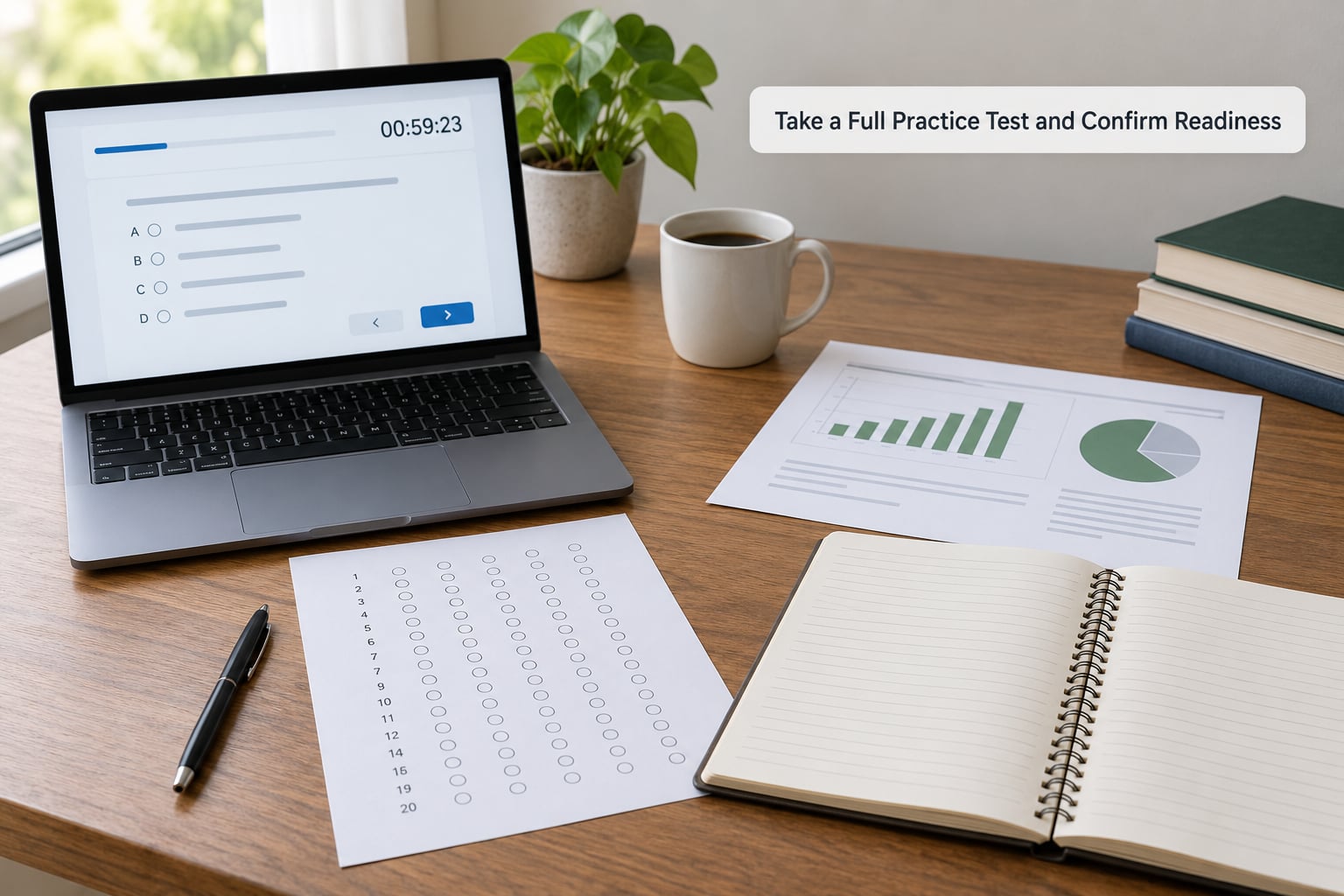
Run one full-length test under exam conditions: no notes, no pausing, no second-guessing the timer. On the Technician exam, aim for at least 90% on a full test before you book a session. That margin covers the questions the pool rewrites and the ones you will see for the first time.
Use the number as a gate rather than a goal. Three consecutive timed scores above 90%, with no sub-pool below 80%, and your mistake log is the right length to stop. One 90% and one 70% is noise, not a pattern.
Before the session itself, handle the paperwork early. Get your FCC Registration Number through the FCC ULS system or a CORES volunteer, because the session list is where your FRN gets connected to your application. Bring government photo ID. Bring a pencil and a basic calculator. Remote online exams exist and work well, but check the camera and connection requirements when you book rather than at test time.
Common Mistakes
Studying retired material. The July 1, 2026 Technician pool refresh is the clearest example. Check the effective date on any pool you download, and re-download rather than trusting a file you saved months ago.
Memorizing answers without the rule. Two-thirds of the exam comes straight from the pool, which rewards pure memory. The rest is reworded, and memorization alone scores maybe high 70s. That is below the line.
Treating practice tests as the study. A score that stops moving after four sessions means you are repeating the same misses at random. Review is the study; the test is just the measurement.
Cramming the weekend before. The pools are too large and the recognition too slow for that to work. The six-day record people report as their fastest pass came from flashcards and reading the pool continuously, not from a single marathon night.
Ignoring your weak sub-pools. Overall score hides the truth. You can hold 80% overall with 95% in regulations and 60% in propagation, and the exam does not care about your average.
Leaving exam day to chance. An unregistered FRN, a missing photo ID, or a phone-only calculator can cost you the session fee and another week of waiting. None of that is a knowledge problem, and all of it is avoidable.
Announcing the plan and then stalling. Plenty of candidates have promised friends they would be licensed by a date and then quietly rescheduled twice. Pick a track, put the sessions in the calendar like meetings, and keep the promise small enough to hit.
If you want the version with the best support, join a local club before you sit the exam. Club members running a class will tell you which sub-pools trip people up this cycle, and many clubs pair newcomers with an experienced operator, called an Elmer, who will answer questions while you study.
Frequently Asked Questions
How long does it take to study for a ham radio license?
Plan on 10 to 20 focused hours for the Technician exam, spread over two to eight weeks. Per-element estimates run about 4 to 6 hours for Technician, 8 to 10 for General and 10 to 12 for Extra. Short daily sessions of 30 to 45 minutes beat weekend cramming, because the material is recognition-based and needs spaced repetition. Most first-timers who pass report two to four weeks of steady work.
How hard is it to pass a ham radio exam?
Less hard than most people expect. The Technician exam is 35 questions drawn from a published pool, and you pass with 26 correct, a 74% score. About two-thirds of the exam is taken straight from the pool, so a candidate who drills deliberately has a large margin. Almost every failure comes from skipping the review of missed questions, not from the difficulty of the material.
What is the 3-3-3 rule for ham radio?
It means knowing the three most common operating frequencies in each of the three ham bands covered by the Technician pool. In practice, it is the 2-meter local repeater frequency, the national calling frequency and the main 2-meter calling frequency, all three memorized by ear on frequency. It is a memorization item in the pool, and drilling it takes about ten minutes.
Is HamStudy.org enough to pass the test?
For most candidates, yes. HamStudy.org is free, builds practice sessions from the current FCC question pool, and tracks your weak sub-pools and progress, which is the feature that makes it useful. Paid tools add convenience rather than content: offline study mode, no ads, printable decks and extra explanations. Start free, and pay only if you study somewhere without reliable internet.
Do I need to know Morse code for a ham radio license?
No. No current US amateur radio class has a Morse code requirement, including Technician, General and Extra. Morse code still shows up occasionally as an operating and identification topic in the pool, meaning you may be asked about sending speed limits or identifying a signal, but you are not tested on copying it. Lots of candidates burn study time on Morse they will never be asked for.
What is the best way to study for the ham radio license exam?
Work from the current question pool, broken into sub-pools by topic, and drill with flashcards or a practice app that shows answer explanations. Then keep a mistake log and review it after every session, which is the step most people skip. Take one timed full-length practice test a week and study the explanations for every miss, not just the wrong answers. Join a local club if you can.
Conclusion
The short version of how to study for a ham radio license exam: pick your license level, download the question pool that is live now, and book an exam date before you start studying. Then pick one of the three tracks, keep a mistake log, and stop when three timed practice tests land above 90%.
Most people get the first month roughly right and the review step wrong. Fix the review and the pass rate takes care of itself.