To use an antenna tuner correctly, check the antenna system for loose connections first, key the transmitter at the lowest power the rig offers, then work the tuner in small steps while watching forward and reflected power on the meter. A first match takes about two minutes; the hours go into the antenna work that decides whether the signal ever leaves the wire.
Here is the part almost every guide gets wrong. An antenna tuner, also called a transmatch or antenna coupler, transforms whatever impedance your antenna system presents back to 50 ohms so the radio sees a load it was built to drive. It does not change the SWR between the tuner and the antenna, and it cannot make a lossy antenna efficient. Everything below assumes you understand that distinction.
Below is the sequence we follow at the bench, in the order that keeps the transmitter alive.
Table of Contents
- 1What You Need
- 2Step-by-Step: How to Use an Antenna Tuner Correctly
- 31. Check the antenna system before tuning
- 42. Start with low transmit power
- 53. Set the radio to the correct frequency and mode
- 64. Adjust the tuner gradually
- 75. Verify the match at operating power
- 86. Recheck after changing frequency or antenna conditions
- 9Common Mistakes
- 10Frequently Asked Questions
- 11Can an antenna tuner make a bad antenna work?
- 12What is a safe SWR for transmitting?
- 13Do I need an antenna tuner for receiving?
- 14How often should I retune an antenna tuner?
- 15Why does my SWR change when I increase power?
- 16What should I do if the tuner will not find a low SWR?
- 17Conclusion
What You Need
You need six things, and only one of them is the tuner.
- The tuner itself. Check its frequency range covers every band you plan to work, and that its power rating exceeds what your amplifier will put out. A 100 W tuner driven by a 400 W amplifier is how tuners die.
- The transceiver. Note whether it has a power control and whether that control is continuous or stepped.
- The antenna and its feed line. Know the coax type and roughly how long the run is, because loss on a long lossy feed changes the impedance the tuner sees.
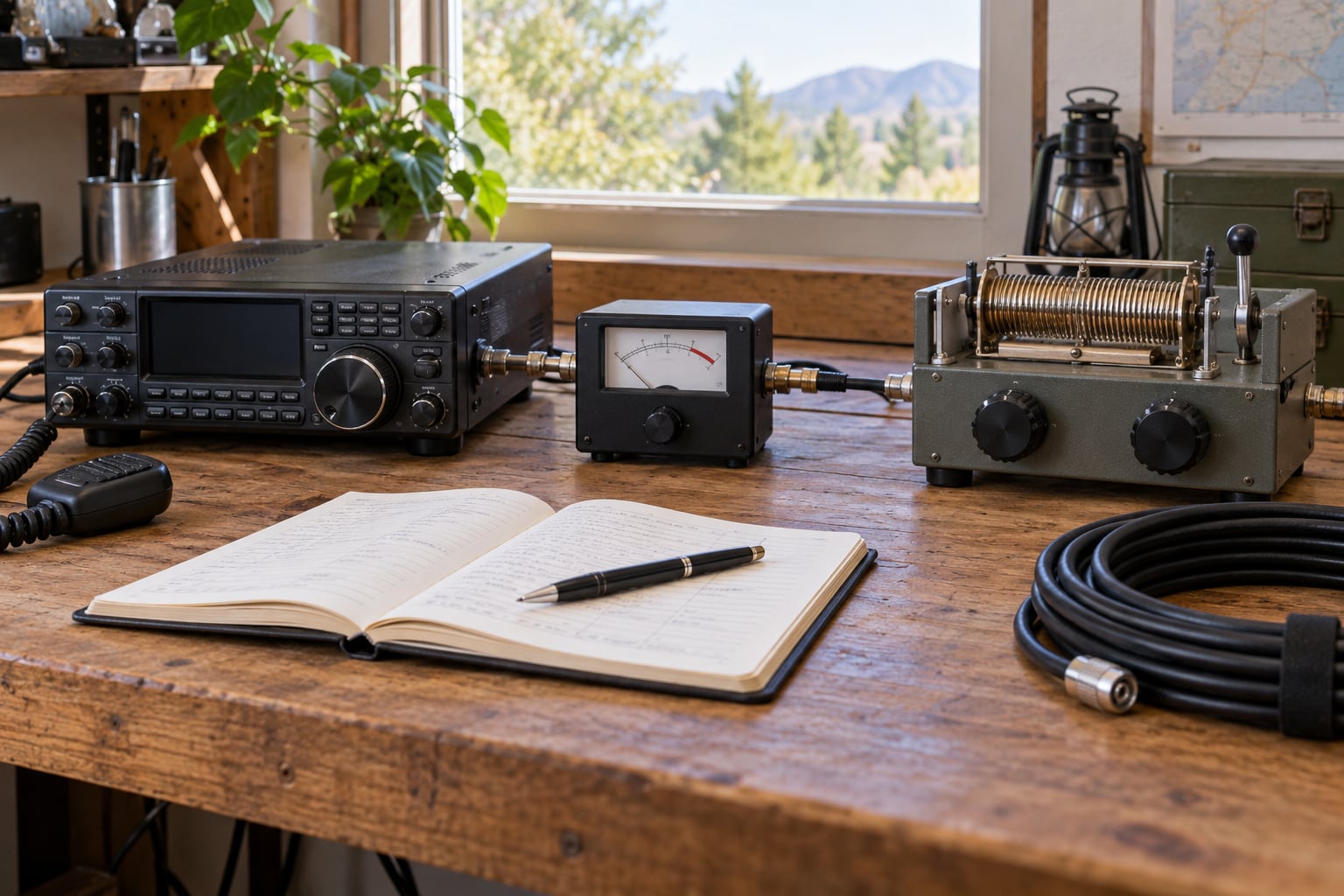
- An SWR/watt meter. Some transceivers have one built in, and using it is fine. Many do not, and an external directional wattmeter is the single most useful addition to a station that will be tuned often.
- Coaxial jumpers of the right connector type for the meter, the tuner and the radio.
- The tuner’s manual. Genuinely. Tuning ranges and recommended starting positions differ enough between models that guessing wastes time.
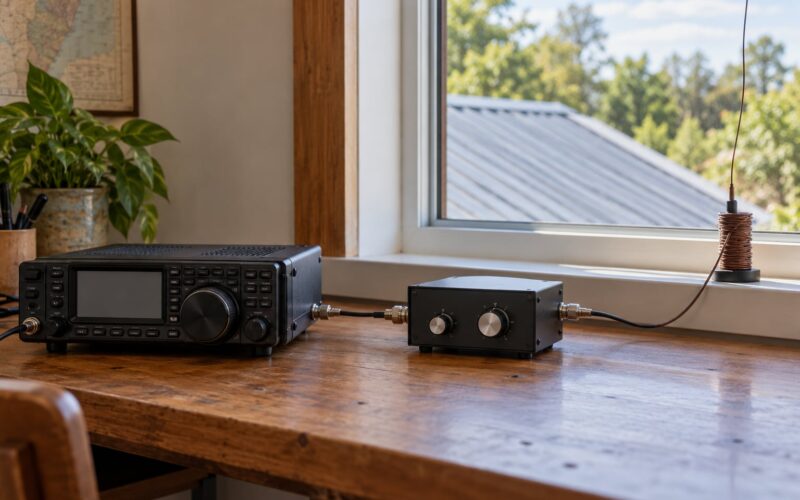
The RF path runs in one direction: transceiver, then SWR/watt meter, then tuner, then antenna. The meter belongs between the radio and the tuner, because what you want to know is what the radio is looking at.
If you use a linear amplifier, put the tuner after the amplifier and after its low-pass filter, so the amplifier always sees a matched load on its input side. A tuner in front of an amp means the amp is asked to swallow whatever mismatch exists, and the amp becomes the component that fails first.
Step-by-Step: How to Use an Antenna Tuner Correctly
1. Check the antenna system before tuning
Erratic SWR almost always means a bad connection, not a bad tuner. Check the antenna hardware, the coax run, and every connector: finger-tight is not enough, and a corroded PL-259 or SO-239 under a connector will read differently every time you wiggle it.
Look for water inside the coax near the antenna, crushed cable where it passes a window frame, and a loose or cracked insulator. Confirm you are actually on the band you think you are. A tuner cannot match an antenna that is cut for 7 MHz while you are transmitting on 14 MHz, and it will happily let you try.
Worth doing once: check SWR with the tuner completely out of the path, straight to the antenna. That number is your baseline. If it is already 1:1, you probably do not need the tuner on that band.
2. Start with low transmit power
Tune at 5 to 10 watts, or the lowest your rig will produce. The tuner is absorbing real RF while you work the controls, and a mistuned network at full power puts that energy into components rated for far less of it.
Test the radio and feed line into a dummy load first, at low power, if you have one. A clean output there tells you any strange behaviour on antenna is the antenna system rather than the transmitter.
What ready looks like: the meter shows forward power rising steadily and reflected power staying low while you speak or key briefly. If reflected power climbs every time you transmit, stop and go back to step 1.
3. Set the radio to the correct frequency and mode
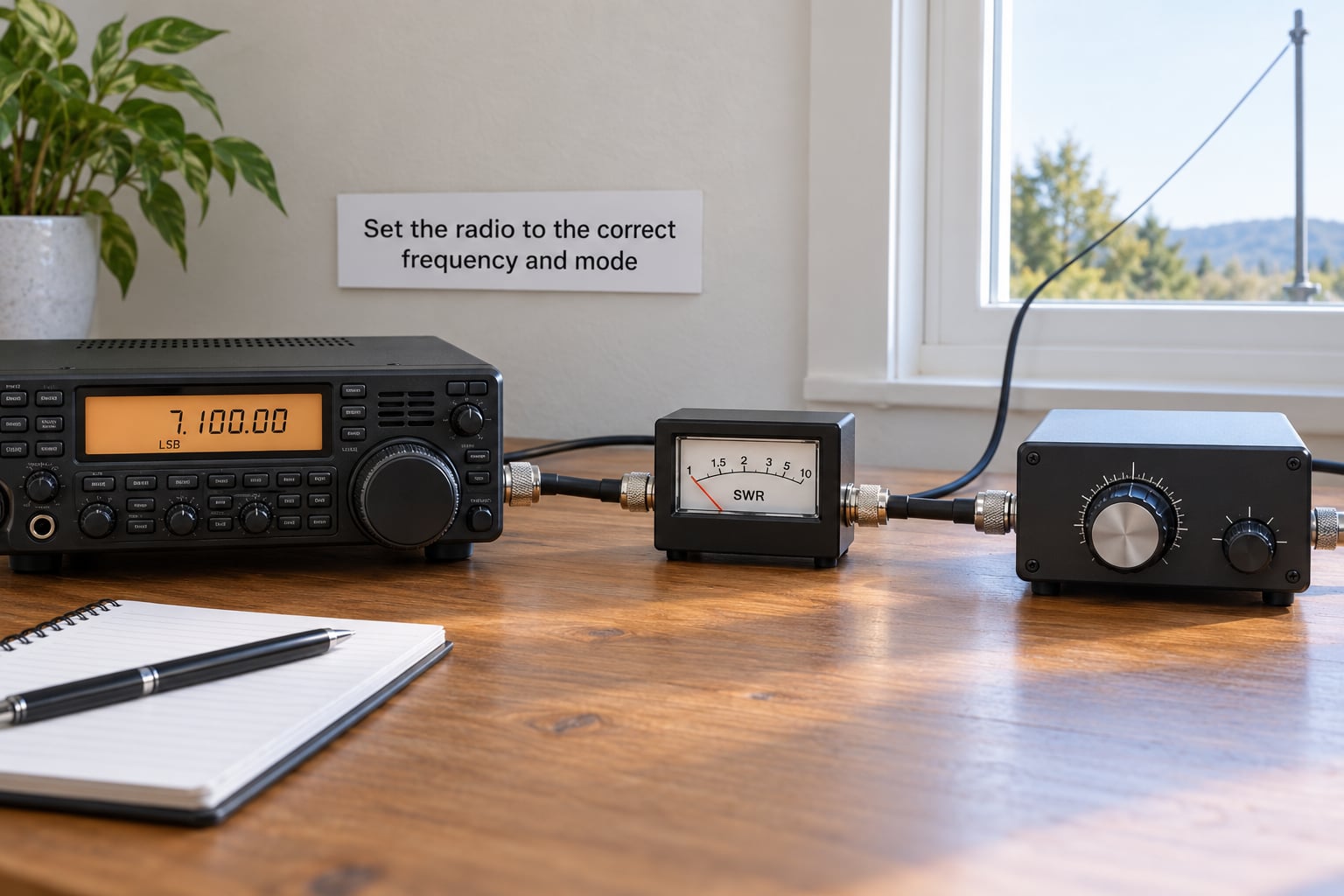
Set the frequency you intend to operate on and pick a mode that suits it. FM or AM carrier is fine for a match, and CW at low power works when the radio lacks a voice mode at low output.
Give the radio a moment to stabilise after changing frequency. Then confirm the tuner is designed for that band and that power. A tuner rated from 3.5 to 30 MHz is fine across the HF bands, but nothing rated for HF will help you on 50 MHz, and pushing a 100 W tuner with 150 W of RF invites arcing inside the case.
4. Adjust the tuner gradually
Move one control at a time, in small steps, and watch the meter after every step. With a roller-inductor tuner, un-key the radio before moving the roller, then re-key and read the meter. Touching the roller or the inductor switch under power is how operators end up with a flash across the switch contacts and a dead band.
Watch reflected power as closely as forward. If the reflected needle jumps sharply while forward drops, back off the control you just moved and go the other way.
Do not trust the knob markers. On a great many manual tuners the pointer position does not correspond to the actual plate spacing of the variable capacitor, so “start in the middle” is often wrong. The check that works: with the tuning capacitor at minimum, its moving plates should be roughly half meshed with the stationary plates. If they are fully closed or fully open, your reading of the dial means nothing.
Stop when the SWR settles at its lowest stable value. A reading of 1.5:1 where it stays steady is a fine operating point; chasing the last decimal rarely helps and costs you time.
5. Verify the match at operating power
Only now increase power, in stages, re-reading SWR at each step. If the match holds, the tuner is doing its job. If SWR drifts upward as power rises, drop back down and keep tuning at the lower level, because a network that will not hold under load will not hold when you go to contest power.
Keep key-down periods short while you are making adjustments. A tuner dissipates whatever the network cannot pass, and heat is the enemy of variable capacitors, roller bearings and insulation alike. Touching the case to check for warmth is a reasonable habit; a case too hot to hold for a second is a network that is too lossy for that antenna.
Also watch the numbers, not just the ratio. Reflected power climbing while forward power holds steady means the tuner is absorbing a lot and giving the antenna little. Back the power down and retune.
6. Recheck after changing frequency or antenna conditions
Write your settings down. Frequency, inductor tap, antenna capacitor, transmitter capacitor, resulting SWR. Operators who log this on the shack wall get back to a good match in seconds; operators who do not, re-tune from scratch every time.
Retune whenever the band, the mode, the antenna, the feed line or the immediate surroundings change. Nearby buildings, a wet field, a different ground connection and a swinging wire antenna will all move the impedance under you.
You do not have to retune with every step across a band, only at the edges of your usable range. A worked example from an ARES procedure: on 40 m, a tuned match held SWR below 1.5:1 from 7.259 to 7.292 MHz, about 60 kHz of the 300 kHz band. That is the safe tuning range for that setting, and outside it you go back to the meter.
If you would rather not transmit at all while finding that range, use an antenna analyzer such as a NanoVNA. Sweep it, read the minimum directly, set the tuner to those positions, then switch to the transmitter to confirm. It is the most recommended method in the ham radio forums and the one that appears in almost no published guide.
Common Mistakes
Tuning at full power. The fix is dull and effective: drop to 5 to 10 W, get the match, then climb. If your radio has no low-power control at all, use CW, use a separate attenuator or a dedicated low-power exciter, or buy a tuner with an internal dummy-load switch.
Running a tuner above its rating. Match the tuner’s power rating to the highest power you will ever put through it, with margin. A tuner rated well above your output is not waste, it is cheap insurance against arcing and burned roller inductors.
Ignoring loose connections. If the SWR reading jumps around or changes when you touch a connector, stop tuning and fix the connector. A tuner can only work with a stable load.
Changing bands without retuning. A setting that gave 1:1 at 7.1 MHz can be 3:1 at 7.25 MHz. Retune at the edges of your usable range and log it.
Reading low SWR as a good antenna. A tuner hides the mismatch from the radio, not from physics. If your signal reports are poor and your SWR is fine, the problem is the antenna or the feed line, and no amount of tuning will fix it. Shorten or lengthen the antenna to move its resonance, or better, fix the antenna and use the tuner only where it earns its place.
Keying while turning the roller or touching the case. Un-key first, adjust, then key again.
Believing the knob markers. Verify actual plate meshing instead, and ignore the printed scale.
Chasing a 1:1 that does not exist. Some antennas and feed lines simply cannot present a match the tuner’s range covers. Below roughly 1.5:1, stop and accept it.
One more worth knowing, since the question comes up constantly: a tuner does very little for reception. It may change the noise floor and let your receiver reach slightly lower on some frequencies, but it does not add signal. On receive, the antenna’s efficiency is what matters, and the tuner is not part of that.
Frequently Asked Questions
Can an antenna tuner make a bad antenna work?
No. A tuner makes the radio happy, not the antenna. It presents 50 ohms to the transceiver regardless of what the antenna is doing, so the SWR reading looks fine while the antenna itself still loses most of your power as heat in a lossy wire or a poor connection. If your signal reports are weak with a low SWR, the fix is the antenna, the feed line or the connectors, not more knob turning.
What is a safe SWR for transmitting?
Below 2:1 is generally safe on modern solid-state transceivers, and 1.5:1 or better is where most people aim. Older vacuum tube amplifiers were less forgiving, and many manuals specify a maximum reflected power or a maximum SWR at their output. Above 3:1, stop transmitting and fix whatever is wrong. Read your amplifier manual and treat its stated limit as the rule, not a general guideline.
Do I need an antenna tuner for receiving?
Usually not. On receive, what matters is antenna efficiency and the feed line loss between antenna and receiver, and a tuner sits in that path adding loss of its own rather than removing it. A tuner can help on receive in one narrow case: when it tunes out a reactive mismatch far down the feed line and improves the match enough to recover signal. That happens, but it is an exception, and the fix is usually a better antenna.
How often should I retune an antenna tuner?
Retune when the frequency, band, mode, antenna, feed line or nearby surroundings change, and check again at the edges of your usable range. Across the middle of a band a good match usually holds, so you do not need to touch the controls for every contact. Log your settings and you will find most bands need one setting on one end of your operating range and another at the other end.
Why does my SWR change when I increase power?
Three causes account for most of it. The network may be close to its limit, so the extra power pushes losses and heating up. The meter itself may not have enough element sensitivity at low power, so a reading taken at 5 W is unreliable and the higher reading is the accurate one. Or the connection is heating and changing resistance. Retune at low power with a meter known to be accurate there, then check again at operating power.
What should I do if the tuner will not find a low SWR?
Work the diagnosis in order. Check every connector and the coax for damage, then measure SWR with the tuner removed to get a true baseline. Confirm you are on the band the antenna is cut for and that the tuner’s range covers it. Verify the capacitor plates are moving by watching plate meshing rather than the dial. If it still will not match, the antenna or feed line is outside what the tuner can reach, and that is an antenna problem.
Conclusion
Start with the antenna system, not the tuner. Check connectors, coax and hardware, then key the radio at 5 to 10 watts and work the tuner in small steps while watching forward and reflected power. Write the settings down, recheck at the edges of the band, and climb to operating power only after the match holds.
A tuner improves the match at your radio and nowhere else. It cannot repair a faulty or lossy antenna, and if the signal reports stay poor after a clean tune, the honest answer is that the antenna is the work still waiting to be done.