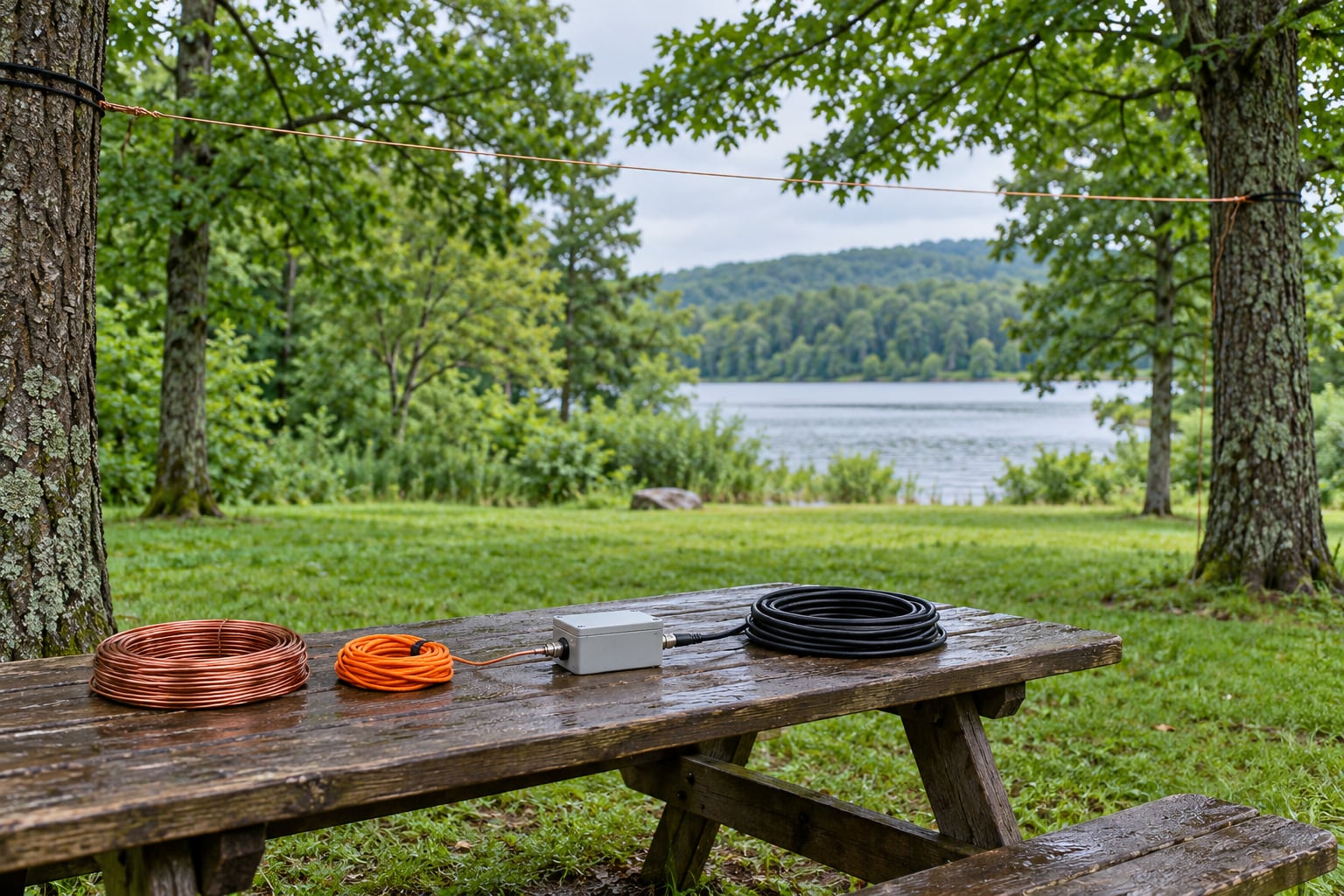
To deploy an end fed antenna in a park, pick a site away from power lines and playgrounds, run a thin wire from one support to a second one at about 2 metres or more, feed it through a 49:1 unun, lay a short counterpoise on the ground, and trim the wire until SWR reads under 2:1 on your band of choice. A whole setup from pack to first transmission takes roughly an hour, most of it walking around the site before you raise anything.
I run portable activations from picnic tables and park benches, and the end fed half wave (EFHW) is the antenna that keeps working when nothing else fits. It needs one support instead of two, folds into a jacket pocket, and you can trim it in the field with a pocket analyser. This guide walks through the whole sequence, from what goes in the bag to how you get the wire down again without leaving anything behind. Updated for 2026.
Table of Contents
- 1What You Need to Deploy an End Fed Antenna in a Park
- 2Step-by-Step
- 3How to deploy an end fed antenna in a park safely
- 4Choose the operating site before raising anything
- 5Set up the radio and protection equipment
- 6Raise and secure the antenna
- 7Tune and test the end fed antenna
- 8Operate while monitoring the site
- 9Break down the antenna without damage
- 10Common Mistakes
- 11Frequently Asked Questions
- 12Can I attach an end fed antenna to a tree in a park?
- 13Do park rules usually allow temporary antenna supports?
- 14How high should an end fed antenna be for portable operation?
- 15Do I need a tuner for a park end fed antenna?
- 16How do I keep rain from damaging my radio and feedline?
- 17How should I coil the antenna wire before packing it?
- 18Conclusion: Make the First Deployment the Simple One
What You Need to Deploy an End Fed Antenna in a Park
The list below covers a standard 40m/20m portable build. Some items change depending on your band plan and how you intend to run the station.
- Antenna wire. Roughly 22 metres of lightweight stranded copper for a single-band 40m wire, or about 31 metres if you want a cut that also lands near the 20m harmonic. Heavier gauge stretches less and sags less, at the cost of pack weight.
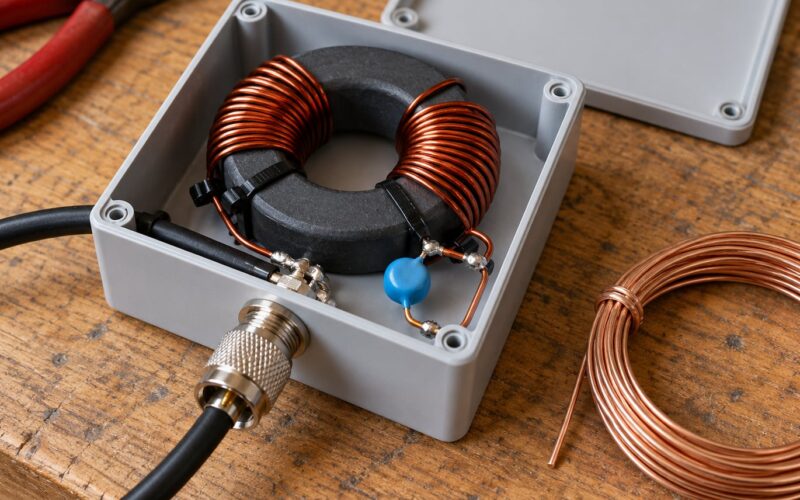
- Matching unit. A 49:1 unun for wide multiband use, or a 9:1 for a single fundamental band. A binding post or spring clip connection beats a screw terminal when your hands are cold and the wire is raw.
- End insulator. Small and cheap, but it stops the field from migrating down the wire and into the radio.
- Rigging line. Two 15 metre lengths of 2 mm paracord. One carries the wire, one is your throw line.
- Support. Two lightweight cord locks or a telescopic mast as a backup, plus two tent stakes or ground anchors.
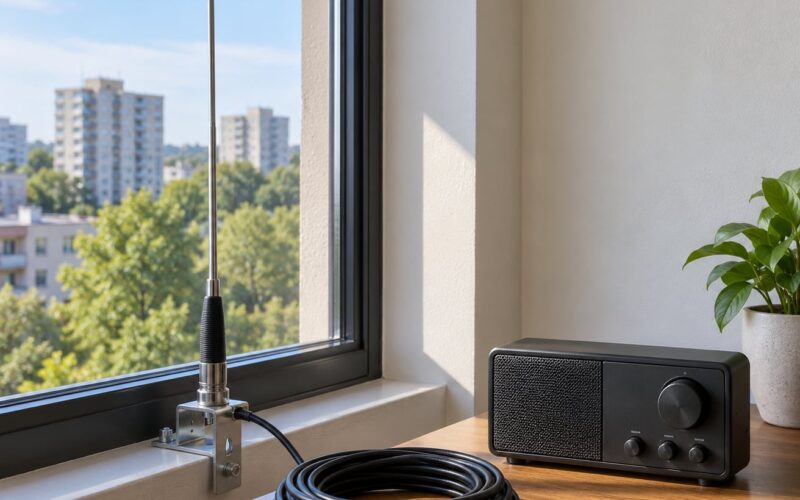
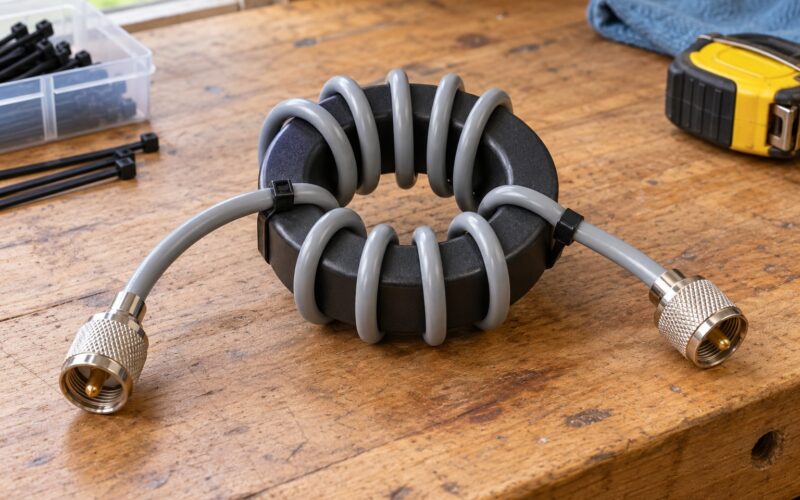
- Coax. Around 7 metres of RG58 is plenty for a park deployment. Add 6 to 10 turns through a small ferrite choke if the rig sits near the feedpoint.
- Power. A battery pack plus the correct DC cable for your rig. The cable is the item people leave at home most often.
- Tuning gear. A small antenna analyser if you intend to trim on site, and a tuner if you plan to work bands the wire does not cover.
- Weather and site kit. A small groundsheet or pack cover, gaffer tape, a sharp wire cutter, gloves, and a bin bag for your own litter.
- Paperwork. Your station licence and a note of the site’s rules. Photo the antenna position before you rig it so you can rebuild the same setup next visit.
A 9:1 unun suits a wire cut and tuned for one band. Move to 49:1 when you want the same wire to cover 40m, 20m, 15m and 10m through harmonic operation.
Step-by-Step
How to deploy an end fed antenna in a park safely
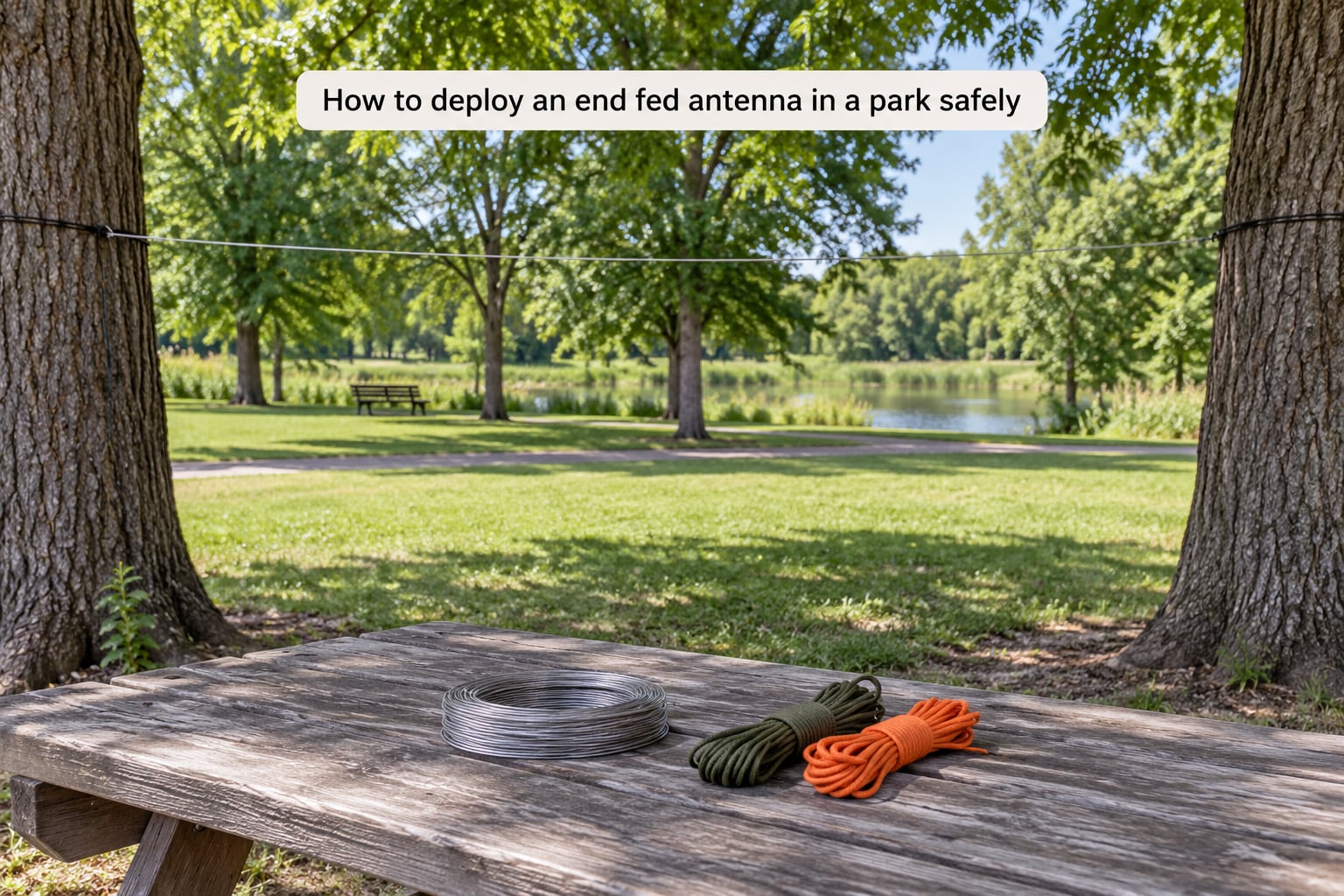
The whole sequence is: check the site, walk the perimeter, throw the support line, hang the wire, rig the counterpoise, connect the feedline, tune at low power, then monitor. Each step has something you can look at to confirm it worked before you move to the next one.
Choose the operating site before raising anything
Stand at each end of your intended span and look up before you unpack. The first rule is simple: never rig anywhere within about 10 metres of power lines, and never at all if the span would cross one. Stay well back from playgrounds, swing sets, sports fields, roads and any place people walk without expecting a wire overhead.
Then check what is under the wire. Underground services, irrigation lines and lamp post footings limit where your stakes can go, and a stake into a buried cable is a bad afternoon. Walk the ground between the two supports and look for roots, rocks, compacted soil and any slope that would let your line drift downhill over a path.
Look at the surrounding environment as an antenna problem, not a scenery problem. Chain-link fences, metal light poles, playground equipment and buildings all couple into the wire and pull its resonance around. Damp soil under a counterpoise is helpful. A dry gravel strip under one is not.
Confirm the support heights match reasonably. Two trees of similar height give a level span and a predictable feedpoint height; one tall tree and one short one give you a sloping wire that radiates less predictably and puts the feedpoint somewhere awkward.
You are finished scouting when you can answer three questions without moving: where does the wire start, where does it end, and where does a visitor have to walk. If any answer is unclear, move. You will get an observable result here: a clear span, no overhead hazards, and a path that stays open.
Set up the radio and protection equipment
Place the rig before the antenna, on the dry side of the station area. A picnic table works; a damp bench or a patch of wet grass does not. Keep the radio off the ground and out of any direct drip line from a tree.
Run the coax to the feedpoint with a slack loop near the connector so a tug on the cable does not pull against the SO-239 connector itself. Inspect both ends before you connect anything: look for a bent centre pin, a corroded shell and any braid poking out past the jacket. A connector failure in a wet field is common and avoidable.
Connect the power last, and only after the battery is confirmed charged. Do not improvise a power connection from a vehicle accessory socket or a DC-DC converter you have not tested; the polarity and the noise behaviour both matter.
Keep a tuner in the bag and use it deliberately. A tuner that fixes the match on a badly mistuned wire hides the problem and robs you of transmit power. Tune the wire first, then reach for the tuner only if you want a band the wire does not cover.
The observable result: the rig is powered, the meter reads a sensible DC voltage, and the coax lies flat with a service loop instead of pulled tight.
Raise and secure the antenna
Work in this order: throw the line, secure the near end, walk the wire out, secure the far end, then tension. Reversing those steps means dragging a loose wire through a tree canopy, which is how lines get left behind.
Tie the throw line to a weighted object, step back far enough that the arc clears the branches, and send it up. Once the line is over, pull the working end across and lower your paracord into the fork. Tie the antenna wire to the cord with a bowline rather than a slip knot, so a gust cannot part it.
Seat the cord over the branch, never around the trunk. Nothing should encircle a tree: no girdling line, no nails, no wire wrapped through the bark. Use loose or wide slings that rub rather than bite, and leave enough slack that the line moves with the branch instead of against it.
Choose a workable height and accept it. About 2 metres above ground is realistic between park trees and still gives a usable antenna. Six to ten metres is where the antenna becomes genuinely good. Under 2 metres you are trading signal strength for convenience, which is a reasonable choice for a short activation and a poor one for an hour of contesting.
Keep the radiator as far from fences, lamp posts and metal surfaces as the site allows. A few metres of separation is often the difference between a clean match and a wire that tunes differently every time the wind moves it.
When tension feels right, lock the cord and slack the remainder into a coil and hang it near the support. A tight line transmits better, but a line that snaps in a gust ends the activation and strands hardware in a tree.
The observable result: the wire spans cleanly at a workable height, hangs roughly level, and moves with the breeze without tugging at the anchor.
Tune and test the end fed antenna
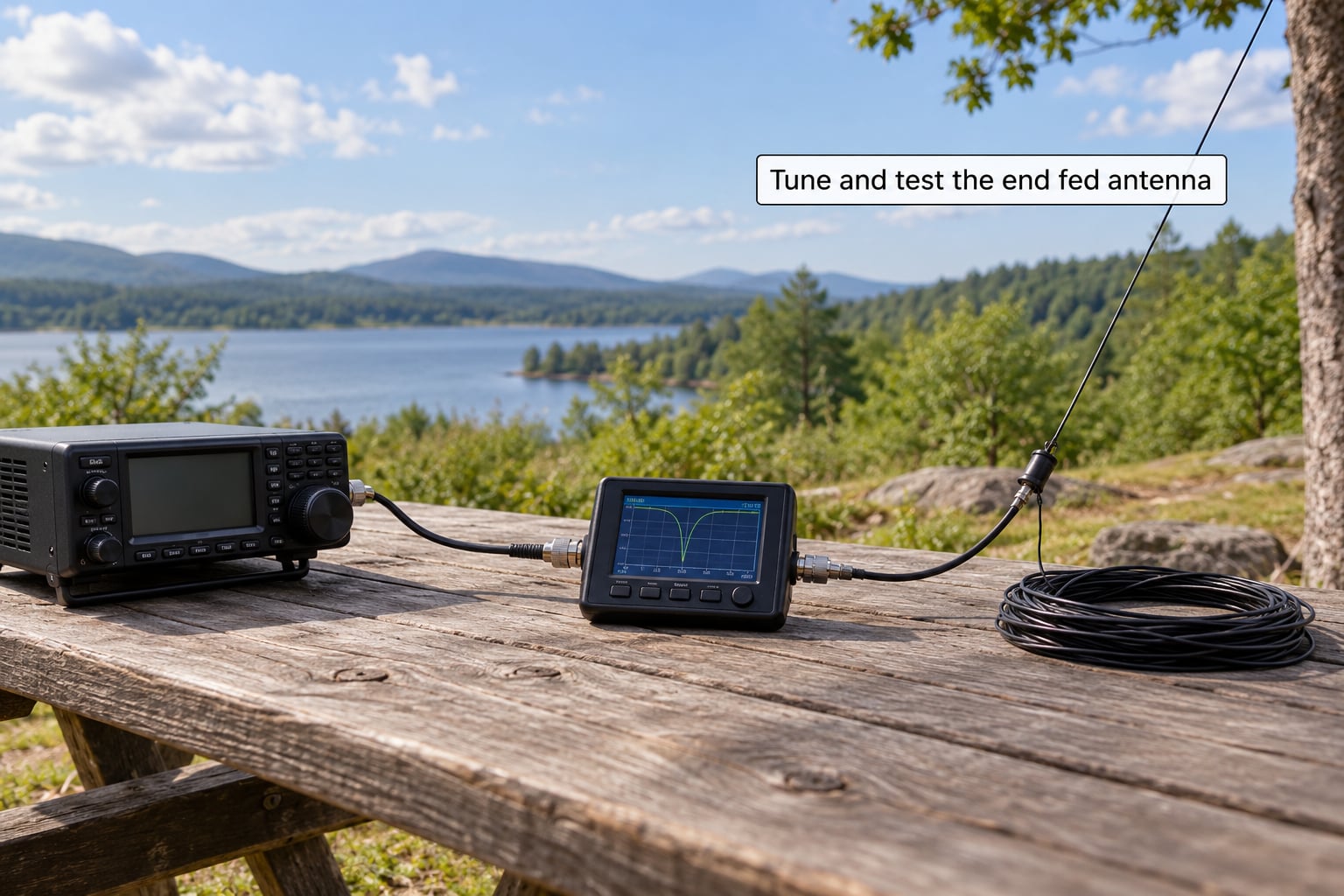
Start transmitting at the lowest power your rig will produce. A watt or two is plenty to read SWR and enough to keep a mistake from cooking a matching unit.
Lay a counterpoise first: one or two lengths of wire running away from the feedpoint under the tensioned section, roughly a quarter wavelength of your fundamental band, laid flat on the ground. It is the RF return path. Without it, the coax jacket becomes the return, RF travels down the cable, and you get hot microphones and hot rig electronics.
Now measure. If you have an analyser, look for the resonance dip and note the frequency. If you only have the rig’s SWR meter, find the lowest point across the band and count the reflections.
Trim a little, measure, repeat. Cut a few centimetres, reconnect, look again. Do not guess a large cut. Record each cut length and the resulting frequency in a notebook or on your phone, because the same cut in the same spot will behave differently the next month.
An SWR under 2:1 on your priority band is a good field result. Under 1.5:1 is excellent and rarely worth extra time in the field.
Expect the harmonic bands to behave worse than the fundamental. A wire cut perfectly for 40m usually tunes sloppily on 20m because of the end effect on an end-fed geometry, where the unun itself adds reactance at the second harmonic. Trim it in on the band you care most about and accept some fudge elsewhere, or shorten the wire and let 20m become the clean band.
If readings jump around while you watch them, you are seeing wind sway move the wire near conductive objects. Note the reading in calm conditions and move on. You will see the number again if this is your regular spot.
The observable result: a stable low SWR reading on your chosen band, taken at low power with nothing overheating.
Operate while monitoring the site
Set a plan for when you stop. Weather is the usual reason: if you see lightning, get away from the wire and the mast immediately, and do not wait to finish a contact.
Wind is the subtler one. If the wire starts to move in a way you did not expect, or you hear a support creaking, lower the antenna before something breaks. A snapped section of wire or a lost pole section is not worth the last contact of the day.
Watch your battery and your public. Keep an eye on remaining charge against the power you are drawing, and keep the station small enough that nobody has to walk around you. If someone asks what you are doing, explain it plainly. Most curiosity turns into conversation, and the occasional complaint is about noise from a speaker, not about an antenna in a tree.
Choke the coax if the rig is hot, the microphone is hot on transmit, or the SWR reading is jumping as you speak. Six to ten turns through a small ferrite choke on the coax right at the radio fixes most of that.
Lower the antenna and pack up if a storm arrives, if the site becomes busy, if the battery drops below what you need for a clean shutdown, or if anything on the rig gets warm. Leaving early costs you a few contacts. Leaving in a panic costs you the antenna.
Break down the antenna without damage
Pack down in reverse order: unun off, counterpoise coiled, wire pulled down from the far support first, then the near support. Pulling from the far end means the wire comes to you instead of dragging across the ground behind you.
Coil the wire in a loose figure-eight, about the size of your forearm. Do not wrap it tight around your hand or around the unun body; a hard crease in stranded wire breaks conductors that you will not find until the next activation.
Count your hardware. Two cord locks, two stakes, one throw line, one wire, one unun, one counterpoise, one coil of coax. Put everything in one bag and close the bag before you leave the site rather than after you reach the car.
Check the ground where you worked. Litter, wire offcuts and cut paracord are the things park staff notice, and one clean site makes the next visit easy. Take your rubbish with you even if it is not yours.
The observable result: the same number of items that went in the bag came out of it, and nothing of yours remains in the park.
Common Mistakes
Most bad park deployments are a handful of repeated errors. Each one has a simple fix.
- Attaching to an unsuitable tree. Pick a branch that runs out from the trunk, not one that is part of the tree’s structure, and never wrap a line around the trunk. If you cannot get the wire up without girdling, use a mast.
- Running the wire over a walkway. Walk the path before you raise anything. A wire at head height across a path is a trip hazard and the fastest way to lose park permission.
- Ignoring park rules. Read the signage or the parks department page before you unpack. Where a permit is required, get it first.
- Poor feedpoint positioning. The feedpoint should sit at a height you can reach comfortably and away from the ground. If you are crouching under a fence to make a connection, move the antenna.
- Excessive power during tuning. Trim and measure at a watt or two. Nobody needs more than that to read a dip, and the unun does not need the stress test.
- Tangled lines. Keep the throw line and the working cord separate in the bag. Crossing them during a throw costs you five minutes and most of your patience.
- No counterpoise. Lay one or two wires under the tensioned section. It costs nothing and it stops RF from reaching your voice and your rig.
- Incomplete cleanup. Coil before you leave the support, not at the car. Leave the site cleaner than you found it.
A few field habits pay off. Walk the site twice before you unpack anything. Carry a spare cord lock, because that is the piece most likely to fail. Record your cut lengths and your final SWR every activation, and the second visit to a site becomes a ten-minute setup instead of an hour. If your wire reaches a resonant dip below the band, shorten it; if it resonates above, lengthen it. Operators who publish their numbers make their own setups repeatable, which matters more than any single perfect configuration.
Frequently Asked Questions
Can I attach an end fed antenna to a tree in a park?
Usually yes, with care. Use a branch and a sling of cord or webbing that rubs rather than cuts, and never wrap anything around the trunk. Nothing should girdle the tree, and no nails or screws. Check whether the site forbids it, take off any line when you leave, and photograph the tree first so you can put it back exactly as it was.
Do park rules usually allow temporary antenna supports?
Most parks allow brief amateur radio operation from a public space, but many restrict where you can set up and some require a permit for group or event activity. Stakes, guy lines and anything that alters the site may be treated differently from simply sitting with a radio. Read the signage or the parks department page before you unpack, and put everything you put in the ground back in the ground before you leave.
How high should an end fed antenna be for portable operation?
About 2 metres above ground is realistic between park trees and gives a usable antenna. Six to ten metres is where it becomes genuinely good, and under 2 metres you are trading signal strength for convenience. Height matters less than being resonant: operators regularly report more contacts on a resonant wire at 2 metres than on a full-length antenna half a wavelength up.
Do I need a tuner for a park end fed antenna?
Only if you want bands the wire does not cover. Trim the wire until SWR reads under 2:1 on your priority band and the rig will load happily without a tuner. Reach for a tuner when you move to a harmonic band, change support height, or operate from a different site. A tuner masking a badly mistuned wire just wastes transmit power.
How do I keep rain from damaging my radio and feedline?
Keep the rig under a pack cover or small groundsheet, off the ground and out of any drip line from a tree. Inspect both coax connectors for a bent centre pin or corrosion before you connect. Allow the feedpoint to hang free so water runs off the end, and dry and recheck connectors after rain. Wet coax is a common cause of high and erratic SWR that looks like an antenna fault.
How should I coil the antenna wire before packing it?
Loose figure-eight, roughly the size of your forearm. Never wind it tightly around your hand, around the unun body or around the mast, because a hard crease breaks stranded conductors that you will not notice until the next activation. Keep the end insulator on the coil so it cannot snag, and separate the wire from the paracord in the bag so the two do not tangle on the next setup.
Conclusion: Make the First Deployment the Simple One
How to deploy an end fed antenna in a park comes down to six things done in the right order: check the rules, inspect the site for overhead and underground hazards, establish a clear boundary around the station, support the wire at a workable height without harming anything, tune at low power until SWR settles under 2:1, and leave the location cleaner than you found it.
Start small. Bring one wire, one cord lock spare, one throw line and a charged battery with the right cable. Get one site working properly and write down your cut lengths. The second visit to the same tree will take a quarter of the time, and that is where portable operating turns into something you actually enjoy doing all afternoon.