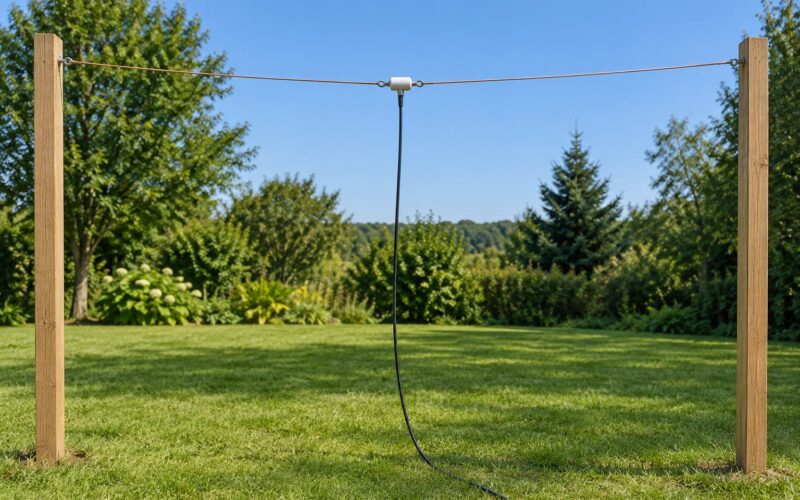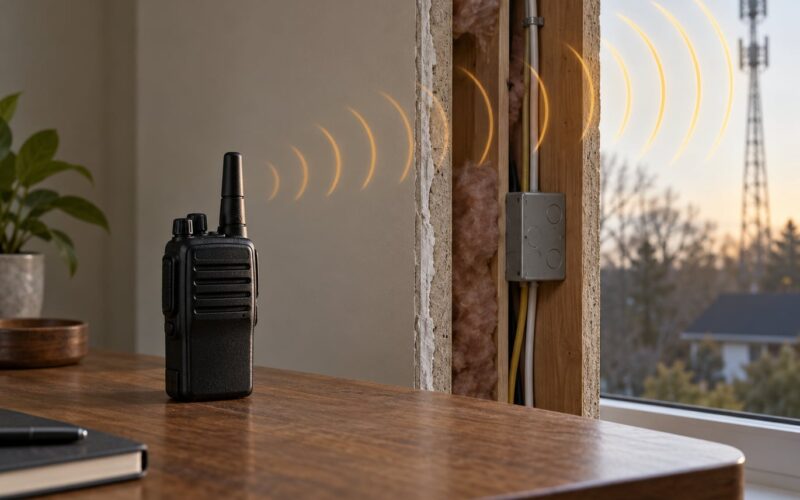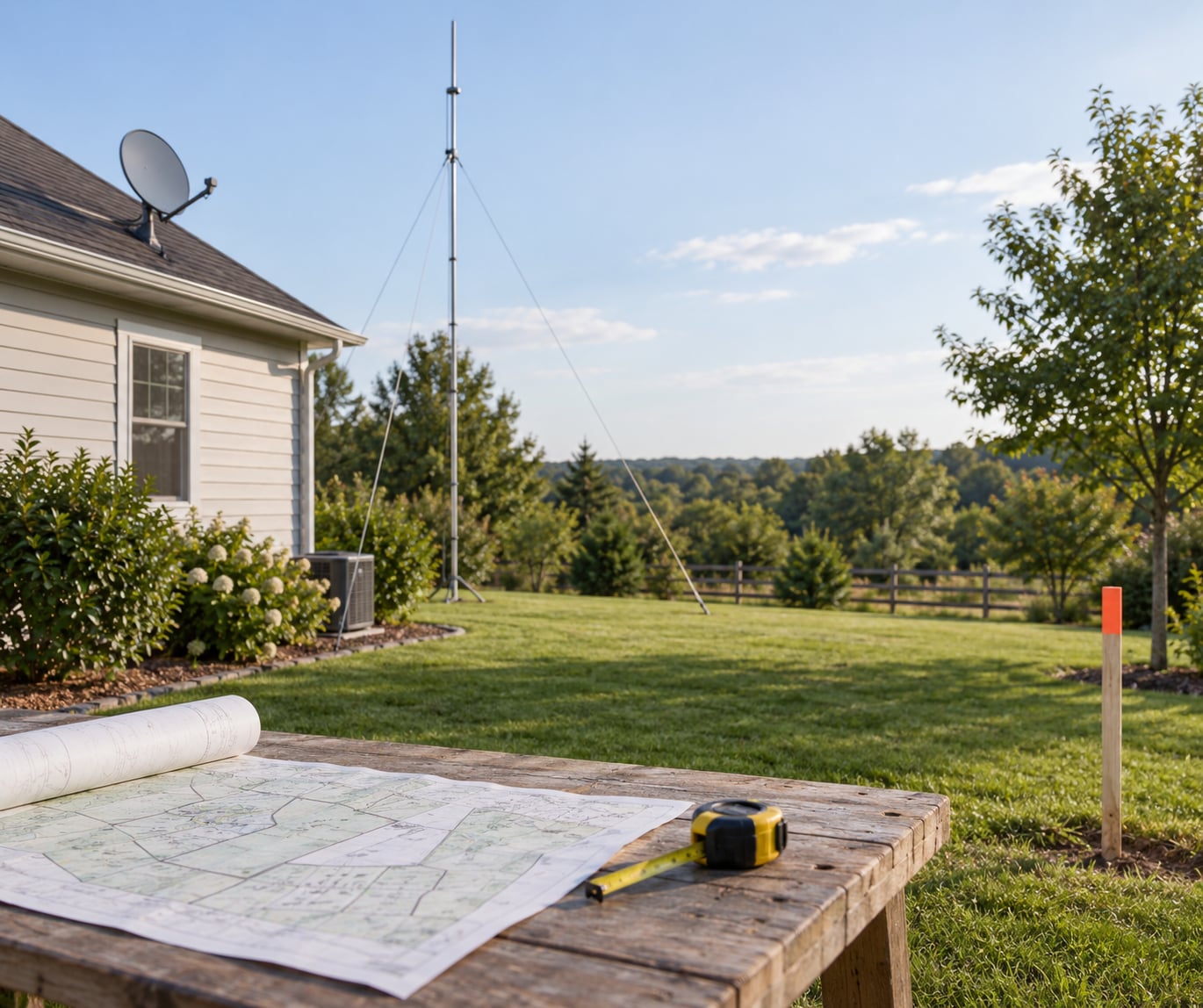
If you want to know how to find out if you need a permit for an antenna, work through four separate layers: federal notification, a local building permit, local zoning or site plan review, and any HOA or lease restriction. There is no national rule that covers backyard antennas, so the answer lives in your county or city code. The check itself takes an afternoon, and most of that time goes into one phone call.
Two mistakes cause most of the trouble here. Some operators assume a ham license makes their tower exempt everywhere, and some assume anything over a few feet triggers a full permit review. Neither is true, and the gap between those two assumptions is where fines, stop-work orders, and tear-down demands come from.
This is general information, not legal advice. Municipal rules change often, so treat your local building and planning offices as the authoritative source. Last reviewed October 2026.
Table of Contents
- 1What You Need Before You Check Anything
- 2Step-by-Step: How to Find Out If You Need a Permit for an Antenna
- 3Step 1: Identify the Property and Proposed Antenna
- 4Step 2: Check Your City or County for Antenna Regulations
- 5Step 3: Ask the Building Department About a Permit
- 6Step 4: Review HOA or Lease Restrictions Separately
- 7Step 5: Complete Any Required Application
- 8Step 6: Get Written Confirmation Before You Install
- 9Common Mistakes to Avoid
- 10Frequently Asked Questions
- 11Do I need a permit for a ham radio antenna?
- 12What if I already have a tower or mast installed?
- 13Do I need a permit for a small whip antenna or a portable antenna?
- 14Can I install an antenna on my roof without permission?
- 15What should I do if the city and county give different answers?
- 16Conclusion
What You Need Before You Check Anything
Before you contact anyone, pull together the details an office will ask for. This is an information check, not permission to install, and having the numbers ready usually saves a second call.
- Property address and parcel number. The parcel number is on your property tax record and tells you which jurisdiction actually has authority.
- Antenna type and support structure. Whip, discone, beam, small dish, TV antenna, or large satellite dish. Then the support: roof tripod, wall bracket, mast, pole, or tower.
- Total height above ground level (AGL). Measure from the ground, not from the roof, since that is the number the codes use.
- Mounting method and penetrations. Roof mount, tripod, ground pole, or a new concrete foundation. Guy wires and their anchor points count too.
- Frequencies and services involved. Amateur, broadcast, scanner, FRS or GMRS, TV reception, satellite.
- Ownership details. Owner’s name, contact information, and, if you are licensed, your call sign and license class. Some jurisdictions ask for a copy of the license as part of the application.
- A rough site plan. A hand sketch showing the structure, the building, the property lines, nearby structures, and direction and distance to the nearest property line is enough to start.
Step-by-Step: How to Find Out If You Need a Permit for an Antenna
Step 1: Identify the Property and Proposed Antenna
Write the proposal down in one place: address, parcel number, antenna and support type, total height AGL, mounting location, and planned service. Officials evaluate the proposal as written, so vagueness slows things down.
Height is the number most codes turn on, and the thresholds vary a lot. A Los Angeles County hobbyist reported that a small backyard tower appeared to need no permit but did require a ministerial site plan, which is a review for compliance rather than a discretionary approval. Forum threads from other counties describe 25 foot poles passing without a permit, while others report limits of 50 or 75 feet. Treat any table you find online as a starting point for your own code, not as the rule.
| Trigger | What it usually means | Who decides |
|---|---|---|
| Short structure, roughly 25 ft or less AGL | Often exempt from a building permit, though zoning and HOA rules can still apply | County or city building department |
| 25 to 75 ft AGL | The range where jurisdictions differ most; some require a permit, some set the cutoff at 50 or 75 ft | Building department plus planning or zoning |
| Taller than 200 ft AGL, or near an airport flight path | FCC Antenna Structure Registration is required, with FAA obstruction marking and lighting under 47 CFR Part 17 | FCC and FAA, not a local permit |
| Airport approach surface or overlay district | Possible FAA obstruction evaluation, and some districts restrict towers outright | FAA and the planning commission |
| Historic district, coastal zone, or conservation area | An extra review layer on top of the usual permits | Planning commission or state historic office |
| Property with a homeowners association or a lease | Private approval, entirely separate from government approval | HOA board or your landlord |
Step 2: Check Your City or County for Antenna Regulations
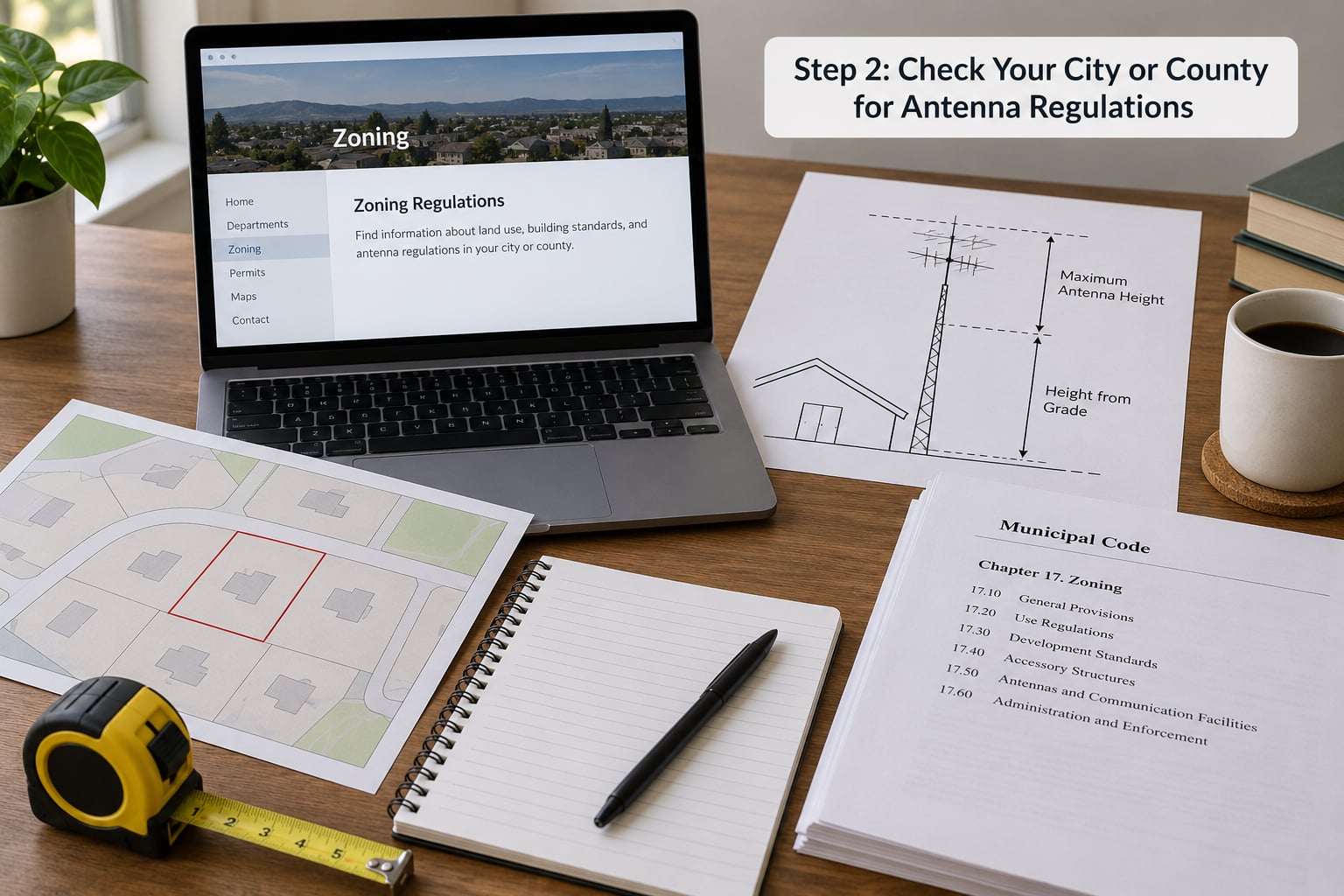
Start at your jurisdiction’s official website and search for antenna, communications tower, accessory structure, zoning, building, electrical, and permit. Unincorporated areas usually fall under the county; inside city limits, the city has authority, and a city can adopt different rules than the county around it.
Compare your proposal against dimensional, height, setback, and screening rules. Then separate two questions that get tangled together: zoning asks whether you may build the structure there, and a building permit asks whether the structure is safely constructed. A zoning approval does not substitute for a building permit, and a building permit does not override a setback rule.
Then check the federal layer. Antenna Structure Registration is the FCC system for structures that are taller than 200 feet above ground level or that may affect the flight path of a nearby airport. To search it: open the FCC ASR registration search, enter your state, then your city, then look up the nearest registrations, and finally search by address or by coordinates from a mapping tool. Nearby registrations tell you what is already in the air around you, and nothing more. It is a registry, not a permit.
You may also want an obstruction evaluation if you are near an airport, and marking plus lighting under FAA Advisory Circular 70/7460-1 for tall structures. Both are separate from local permitting, and neither one lets you skip the local check.
Step 3: Ask the Building Department About a Permit
Search results and forum threads are not an answer. The county building department is. Ask a specific question with specifics, because a vague question gets a vague reply.
A script that works: “I am planning a 50 foot guyed mast with a beam on it, mounted on a tripod on the roof of my house at 123 Example Street, roughly 55 feet above ground level. Does this need a building permit, a zoning permit, or both? Is there a height threshold that applies to residential accessory structures? Does the roof penetration need separate approval? Can you send me your answer in writing?”
Also ask how far the structure must sit from the property line, whether a foundation requires engineering, how long review takes, what documents the application needs, and whether anyone has to be notified. Ask for the answer by email so you have a dated record.
If you are unsure which office to call, start with the building department. Forum users frequently report being bounced from planning to building and back, and the building inspector can usually tell you which layer applies.
Step 4: Review HOA or Lease Restrictions Separately
An HOA is not a government body, and municipal approval does not override its documents. Read your CC&Rs, declaration, architectural rules, and any lease before you order steel. HOA approval also does not replace a municipal permit, which is the reverse of the mistake people make most often.
Two federal protections get cited here constantly, and neither does what people think. PRB-1 is limited preemption of local government zoning, not a defense against a private homeowners association. OTARD, at 47 CFR 1.4000, protects satellite dishes and television reception antennas from unreasonable restrictions, and it excludes amateur radio antennas. Several states have their own statutes on HOA antenna rules, including Texas, Florida, and Arizona, so the answer still depends on where the property sits.
Grounding and bonding are a separate question again. That comes out of the electrical code and the manufacturer’s instructions, not out of the permit office.
Step 5: Complete Any Required Application
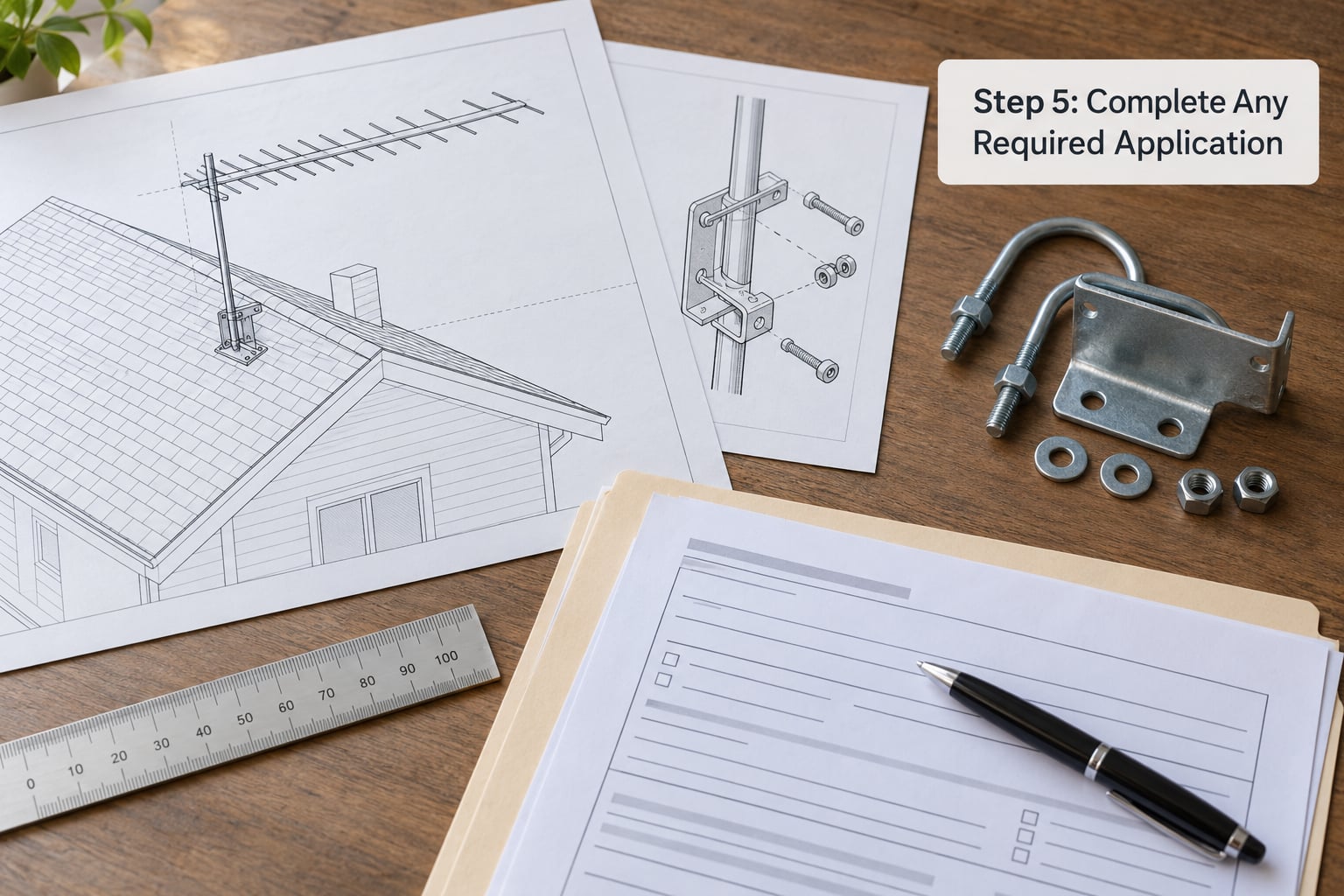
Common requests include a site plan, elevation drawings, manufacturer specifications, structural calculations from a licensed engineer for tall towers, mounting and guying details, photographs of the location, neighbor notices, and contractor information. Some portals ask for proof of a valid amateur radio license as part of the filing.
| Permit type | What it covers | When you meet it |
|---|---|---|
| Building permit | Structural safety of the tower, mast, mount, and any foundation or roof penetration | Most new support structures above the local height threshold |
| Zoning or site plan review | Height, setbacks, lot coverage, and whether the use is allowed in your district | Any structure near a dimensional limit |
| Ministerial site plan | A compliance check on drawings, with no discretion to deny | When the code requires review but the project already complies |
| Special or conditional use permit | A structure that is allowed only on a case-by-case finding | Towers in districts that restrict them, often with a public hearing |
| Height variance | Approval above the allowed height | When a public hearing is required and findings are made on the record |
| Retroactive permit | Approval after the fact, often with engineering and an inspection | You already built without checking |
Ordinary consumer whips, attic antennas, and most small rooftop antennas often follow a much lighter path than a tower, a large dish, or a new foundation. That is not a rule you can rely on. The local official makes that determination on your specific proposal, and it is the one answer worth getting in writing.
Step 6: Get Written Confirmation Before You Install
Keep whatever the agency gives you: a permit number, a written determination, the approved drawings, any inspection requirements, and every condition they attached. If the answer is no permit required, save the email that says so, with the date and the address on it.
An empty search on the county portal is not proof of anything. It may mean nobody ever looked, or that the record sits in a system you have not found yet. Document the agency’s response instead.
One case worth knowing about: a RadioReference poster recalls putting up a 40 foot tower in 1989 with no permit, and a county building inspector coming out to confirm none was required, then explaining that a satellite dish would have needed one because of lightning risk. Same property, same year, two different answers depending on the structure. It is the clearest illustration of why you ask rather than assume.
Common Mistakes to Avoid
- Treating a license as an exemption. PRB-1 tells municipalities to reasonably accommodate amateur radio, not that local rules vanish. A Nashville hobbyist reported being told towers are allowed but with rules attached, which is the normal shape of the answer. Fix: ask the building department for your address and height.
- Asking a neighbor instead of the authority. One person’s grandfather got away with it in 1989. Fix: a phone call to the building department takes ten minutes.
- Confusing zoning approval with a building permit. They answer different questions. Fix: ask both, in that order, in the same call.
- Overlooking the HOA or the lease. A board can fine or require removal under private rules, and a permit number does not stop that. Fix: read the CC&Rs and submit to architectural review before ordering anything.
- Installing before approval. That is how retroactive permitting starts, and retroactive permits usually require engineering plus an inspection. Fix: finish the confirmation step first.
- Forgetting electrical and climb safety. Roof work and coax runs fall under electrical codes and fall-protection rules regardless of permits. Fix: hire a licensed electrician for power and bonding, and use proper fall arrest for any roof work.
Frequently Asked Questions
Do I need a permit for a ham radio antenna?
Sometimes. Your call sign protects your operation, not the structure. A local building permit is typically required for a new mast, pole, or tower above your jurisdiction’s height threshold, and zoning review can add setback and screening rules. Some areas also ask for a copy of your license with the application. Ask the county building department for a written determination using your address and total height above ground level.
What if I already have a tower or mast installed?
Ask for a retroactive permit, and expect more paperwork than a new application would have needed. Jurisdictions commonly ask for structural calculations, a site plan, and an inspection of the existing install, and a county building inspector may want to verify the guying and the foundation. Do it before a neighbor complaint or an HOA letter turns it into an enforcement issue. Fines and removal orders are easier to avoid than to unwind.
Do I need a permit for a small whip antenna or a portable antenna?
Almost never. Hand-held whips, mobile antennas, and portable setups do not involve a support structure, so no building permit applies. A small rooftop whip or an attic installation usually falls under the same exemption as other minor accessory structures, though local rules vary. The test is whether you are erecting a mast, pole, tripod, or tower that rises above the ground. If the hardware lives in your hand or in the attic, you are fine.
Can I install an antenna on my roof without permission?
Only if your local code exempts the structure and no HOA or lease rule applies. Roof penetrations and any new framing are exactly what a building permit covers, since the concern is structural and weatherproofing rather than the signal. Check whether the roof is governed by a separate district rule, and remember that FCC ASR registration above 200 feet applies no matter what the city says. Get the determination in writing before anyone climbs up there.
What should I do if the city and county give different answers?
Find out which one actually has jurisdiction, using your parcel number rather than your mailing address. Inside city limits the city governs, and unincorporated areas fall to the county, so you may have been talking to an office with no authority over you. Once you identify the right one, ask that office the same question in writing and keep the answer. If the two written responses still conflict, ask the jurisdiction with authority for a supervisor review.
Conclusion
Document the proposed install, find the office with authority over your parcel, ask the permit-specific question with your address and height in hand, and get the answer in writing before you order steel or climb onto a roof. That is the whole method behind how to find out if you need a permit for an antenna, and it costs you one afternoon instead of a dispute later.