To get your technician license for ham radio, you pass a 35-question closed-book exam drawn from the FCC’s Technician question pool and get 26 answers or better. Register for a free FCC Registration Number, study Element 2, then sit the test at a session run by a volunteer examiner team. Most people pass with 10 to 20 hours of study.
Two fees show up along the way, and this is where most beginners get confused. The FCC charges its own federal examination fee, and the testing team that administers your session may charge an additional session fee on top of it. Neither is optional, and they are not the same thing.
A Technician license is valid for ten years and opens every amateur band above 30 MHz, which is where repeaters, FM voice, digital modes and most satellite work live. It is also the only way to transmit on amateur frequencies in the US at all.
Everything below reflects US rules and was last checked against FCC and ARRL information in October 2026. Fees, question pool dates and session procedures change, so confirm anything you are about to act on with the FCC or your chosen exam team.
Table of Contents
- 1What You Need
- 2Step-by-Step
- 3Step 1: Confirm That You Are Eligible to Apply
- 4Step 2: Find an Official Ham Radio Exam Session
- 5Step 3: Register and Pay for the Exam
- 6Step 4: Study the Valid Technician Exam Pool
- 7Step 5: Pass the 35-Question Technician Exam
- 8Step 6: Complete Your Amateur Radio License Application
- 9Step 7: Receive Your Call Sign and Start Operating
- 10Common Mistakes
- 11Frequently Asked Questions
- 12How hard is it to pass the amateur radio Technician exam?
- 13How many questions must I get right to pass the Technician exam?
- 14Can I retake the Technician exam if I fail?
- 15How long should I study for the Technician license exam?
- 16Do I receive a call sign before my ham radio license is active?
- 17Conclusion
What You Need
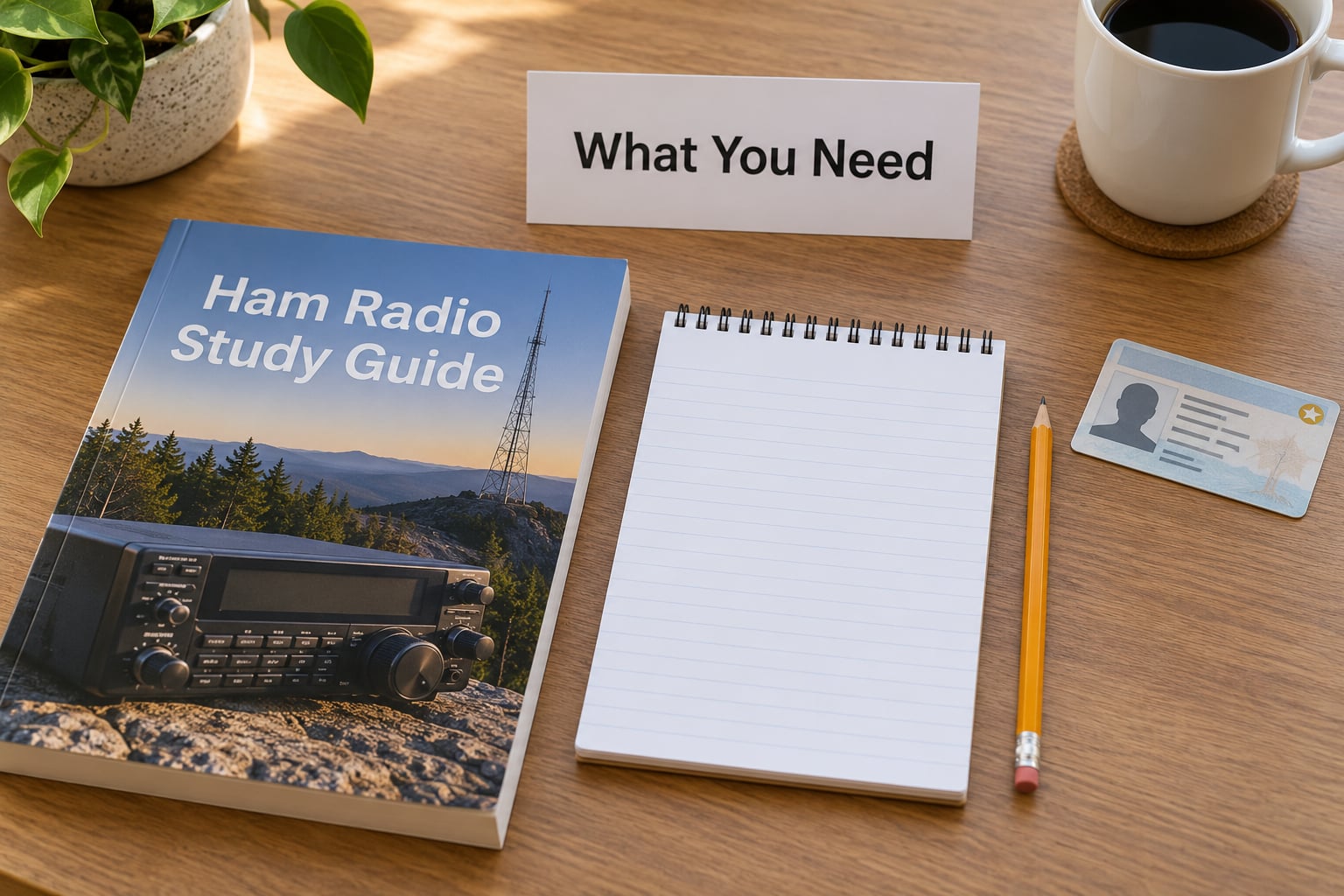
You need fewer things than people expect. None of this is expensive or complicated, and most of it you can line up in a single evening.
- Eligibility: be 13 or older. There is no upper age limit, and applicants under 13 need a parent or guardian to sign the application.
- A US mailing address where you actually receive post. The FCC uses it for license correspondence.
- Government-issued photo ID, such as a driver’s license, state ID or passport. The name on it must match your FCC records.
- An FCC Registration Number (FRN) — a free identifier the FCC assigns so it can track your license. You get one in the FCC’s Universal Licensing System.
- A Social Security number to complete FRN registration.
- Study material: a current study guide plus a practice exam app. Good free options exist, so buying something is optional.
- Payment covering the federal examination fee and your exam team’s session fee, which varies by team.
Two things to sort out early: register for your FRN before you sit down to study, and join a local radio club. Clubs run a large share of exam sessions, and the members are the people who will answer your questions for the next several years.
Step-by-Step
Here is how to get your technician license for ham radio in order, with a way to tell at each stage that it actually worked.
Step 1: Confirm That You Are Eligible to Apply
US amateur licenses are issued to citizens of the United States and to lawful permanent residents. Anyone in those categories who is at least 13 can apply.
Citizens of certain other countries who already hold a valid amateur radio license at home may qualify for recognition of that license under international agreements between countries. That path runs through FCC Form 605 and is handled through a Volunteer Examiner team rather than the normal exam process, so contact the team before you pay anything for sessions you are not eligible to take.
If you are under 13, a parent or guardian signs for you and stays involved in the licensing paperwork until you reach the age where you can sign yourself. Once you are eligible, move on to finding an actual exam date.
Step 2: Find an Official Ham Radio Exam Session
Exams are run by Volunteer Examiners, who are licensed amateurs authorised to administer the FCC test. Those examiners are grouped under a Volunteer Examiner Coordinator, or VEC. ARRL and W5YI are two of the large national coordinating organizations, and there are several regional ones.
Sessions come in two forms. In-person sessions meet at a club, a community college or a public library, usually on a weekend. Remote online exams run over video with online proctoring. Both are legitimate, and both award the same license.
Sorting a real session from a paid intermediary is a recurring question on r/HamRadio and forums.radioreference.com. The check is simple: a real listing names the VEC, shows a session fee breakdown, and lets you pay that fee to the coordinating organization itself. Be wary of sites that sell a “guaranteed pass” package and handle your FCC fees for you.
Before you register, confirm the date and start time, the total fee, whether photo ID is checked, what the re-take policy is, and whether you could add the General exam in the same session if you pass Technician.
Step 3: Register and Pay for the Exam
Registration is usually a web form or an email to the examining team. You supply your name exactly as it appears on your photo ID, your mailing address, email and phone number.
The federal examination fee and the team’s session fee are separate, and the team collects both at the session. Nobody should ever ask you to hand the FCC fee to an unrelated third party. If a website offers to “process” your FCC payment, that is not how the system works.
Look for a confirmation message listing the date, location or login link, the fee breakdown and the arrival time. No confirmation, no test. If you need to reschedule, tell the team early so the slot can go to someone else.
Step 4: Study the Valid Technician Exam Pool
The Technician exam questions come from an official pool maintained by the National Conference of Volunteer Examiner Coordinators, and the pool is periodically revised. Download the current version and check which cycle it belongs to before you start memorising anything.
Free resources are genuinely good: the KB6NU study guides, practice exams on HamStudy.org and HamExam.org, and the ARRL Technician Class manual if you prefer a printed book. Apps work well too, as long as the app updates when the pool changes.
Focus your time on rules and operating concepts rather than memorising numbers. Call sign areas for US states and Canadian provinces, band plans, repeater offsets, frequency privileges, emergency communications procedure and basic electrical theory carry most of the questions.
Take practice exams until your scores sit consistently in the high 80s or 90s. Track which categories you keep missing and re-read only those. Old pool PDFs and outdated app versions are the most common waste of study time.
Step 5: Pass the 35-Question Technician Exam
The Technician written exam, called Element 2, is 35 multiple-choice questions with a passing standard of 74 percent. That works out to 26 correct answers. Sessions typically allow roughly two hours for the written portion.
It is closed book. No notes, no phones, no study guides and no answer apps on the desk. You get scratch paper and a pencil, and an ID check before you sit down. Calculators, radios, watches with computer storage and smart glasses are all a bad idea to bring to the table.
When you finish, the examiners mark your paper in front of you. You walk out knowing the result, and most teams will let you sit the same element again later the same day at no charge if you need to — ask when you register, since it depends on the schedule and the examiners’ time.
Pass or fail, the team submits your results to the FCC electronically through the CS-D and VDES filing systems. That handoff is what starts the licensing clock.
Step 6: Complete Your Amateur Radio License Application
Two different parties handle this half of the process, and keeping them straight saves weeks.
The Volunteer Examiner team conducts the exam and files the results. Depending on the team, they may also prepare and submit your license paperwork for a separate service fee.
You handle the rest. Log in to the FCC’s Universal Licensing System with your FRN, confirm that your name, address and email match your application character for character, and complete the identity verification questions that compare your records against your ID. Some applicants are asked to upload qualification documents.
Name mismatches are the single most common cause of delay. If the system shows a name you have never had, or an address that is not yours, fix it in the system and tell the examining team the same day rather than waiting.
Step 7: Receive Your Call Sign and Start Operating
The FCC assigns your call sign once it has your results and grants the license. The two arrive together; you do not get a call sign first and a license later. Until that happens, your application sits as pending in the licensing database.
In practice, most applicants see their grant and call sign within a few days to about two weeks of the exam, though remote online sessions can add a few days because the results are filed on a schedule. Until the grant appears, do not transmit.
Once it lands, log in and make sure your account details are right, join a club, find a repeater covering your area, and check your local band plan before your first transmission. Identifiers are required on every transmission once you operate, and getting your first antenna right saves a lot of frustration afterwards.
Common Mistakes
Almost every licensing problem traces back to one of these. They are all avoidable with a bit of preparation.
- Studying from outdated material. Check the pool date before you start. A guide built on a retired pool teaches you questions that no longer appear and skips ones that do.
- Skipping the FRN. Registering first avoids a trip to a testing team that cannot process your paperwork on the spot.
- Paying the FCC fee through an unrelated website. The federal fee is collected through your exam session. Intermediaries adding a layer between you and the FCC are the reason online testing gets called a scam.
- Booking the session before practice scores are ready. Practice results in the high 80s or 90s are the signal to book, not a hunch about how much you know.
- Letting your name on the ID differ from your FCC records. Middle names, suffixes and old surnames cause more rejections than anything else on the list.
- Misunderstanding the passing score. It is 26 out of 35, and the examiners mark the paper before you leave, so there is no benefit to guessing the result afterwards.
- Transmitting before the grant appears. Practising on a service radio without a license is a different matter entirely.
- Expecting the call sign the same day. Nothing is wrong if it takes a couple of weeks; what matters is that the application was filed correctly.
Two habits cover most of the rest: join a club early, and confirm every detail against the FCC’s own licensing system rather than a forum post. Clubs run the sessions, so being there early also gets you a better slot and a mentor for the first few contacts.
Frequently Asked Questions
How hard is it to pass the amateur radio Technician exam?
Most first-time applicants pass after a few weeks of steady study. The Technician exam is 35 multiple-choice questions and you need 26 right, and the pool covers basic rules, frequencies, call sign areas and operating practice rather than advanced theory. Practice tests scoring in the high 80s usually translate into a comfortable pass on test day.
How many questions must I get right to pass the Technician exam?
Twenty-six. The Technician written exam has 35 questions drawn from the official pool, and the passing standard is 74 percent, which works out to 26 correct answers. Anything fewer is a fail. Examiners mark your paper at the table, so you learn the result before you leave the room.
Can I retake the Technician exam if I fail?
Often, yes. Many examiner teams will let you sit the same element again later in the same session at no additional charge, as long as the room and the examiners still have time. Ask about the re-take policy when you register, because some teams limit it to one extra attempt and others follow a fixed schedule.
How long should I study for the Technician license exam?
Ten to twenty hours of focused work is the range most people report passing in, spread over several weeks rather than crammed into one weekend. Regular short sessions beat a single long night, and r/amateurradio users commonly describe 15 to 30 minutes a day as enough. Book the session once practice tests sit in the high 80s.
Do I receive a call sign before my ham radio license is active?
No. The call sign is assigned only after the FCC has your results and grants the license, so the award and the call sign arrive together rather than in steps. Your application shows as pending until then, usually a few days to about two weeks. Transmitting before the grant appears is against the rules.
Conclusion
Start with five things this week. Confirm you are eligible and register for your free FCC Registration Number. Find an official exam session and ask who the coordinating team is before you pay. Download the current Technician question pool and check its cycle date. Begin short daily study sessions using the free guides and practice exams. Then line up your photo ID and payment so nothing stands between you and the exam room.