Here is the short version. The ham radio technician exam is a 35-question multiple-choice written test administered in the United States by Volunteer Examiners, and you pass by getting 26 of the 35 right. There is no formal time limit, no penalty for wrong answers, and no penalty for guessing. Bring one government-issued photo ID and a pen. That is the whole test.
Everything else people worry about before their first session is logistics, and most of it is handled for you when you register. This guide walks through the exam the way it actually happens, from the parking lot to the moment your call sign shows up in the FCC database.
Registration is the only step that needs paperwork ahead of time, and setting up an FCC Universal Licensing System account takes about fifteen minutes. After that it is study time and one morning with a pencil.
Table of Contents
- 1What Is the Ham Radio Technician Exam?
- 2How the Ham Radio Technician Exam Is Structured
- 3What Topics Are Covered on the Ham Radio Technician Exam?
- 4What to Expect on the Ham Radio Technician Exam Day
- 5Arriving
- 6Check-in and identification
- 7The room and the script
- 8Getting your booklet
- 9Working through the questions
- 10Submitting and scoring
- 11What ID and Documents Do You Need?
- 12How the Ham Radio Technician Exam Is Scored
- 13How to Prepare for the Ham Radio Technician Exam: A Realistic Study Plan
- 14Start with the official question pool
- 15Use one app or book as your spine
- 16Take practice exams under real conditions
- 17Schedule the exam sooner than you think
- 18A realistic timeline
- 19What Happens After You Pass?
- 20What If You Do Not Pass?
- 21Frequently Asked Questions
- 22Is the ham radio technician exam hard?
- 23How many questions are on the ham radio license test, and how many do I need to get right?
- 24Do I need a calculator for the ham radio technician exam?
- 25Can I take the ham radio technician exam online?
- 26How long does the ham radio technician exam take?
- 27What happens if I fail the ham radio technician exam?
- 28How soon do I get my call sign after passing?
- 29What to Do First
What Is the Ham Radio Technician Exam?
The Technician class license exam is the entry-level amateur radio written examination in the United States, run under the authority of the Federal Communications Commission. It is the first of three license classes: Technician, General, and Amateur Extra.
Passing it is the only legal step between you and transmitting on amateur frequencies. No separate application, no membership requirement, no sponsor. You take the test, the examiners report your result to the FCC, and once your call sign is issued you are a licensed operator.
Almost anyone can sit for it. There is no minimum age, and applicants as young as five have passed with a parent or guardian signing the application. A large share of first-time takers are retirement-age or career-changers who wandered into a club meeting, saw a room full of people talking to each other across the country, and thought it looked interesting.
What passing gives you is full access to the amateur bands above 30 MHz, which is where most of the practical activity happens: repeaters, local simplex, FM voice, packet, APRS, satellite, and digital modes. It also opens several HF segments, though General opens those properly. The entry-level HF access is why many people upgrade within a year.
If emergency communications is the reason you are reading this, Technician is the goal, and public service oriented groups like ARES and RACES operate almost entirely on the privileges it grants.
How the Ham Radio Technician Exam Is Structured
Here is what to expect on the ham radio technician exam in plain numbers.
| Detail | What to expect |
|---|---|
| Number of questions | 35 multiple-choice questions drawn from a published question pool |
| Answers per question | Four, with one correct answer |
| Passing score | 26 correct out of 35, roughly 74 percent |
| Time limit | None formal. Most people finish in 20 to 30 minutes |
| Materials | A sealed question booklet and a self-marking answer sheet |
| Penalty for wrong answers | None |
| Identification | One government-issued photo ID |
| Calculators | Your own are not permitted; some sessions provide a basic one |
| Retakes | Allowed, often the same day if a spare booklet exists |
| Delivery | In person or through an authorized remote online session |
The questions all come from an official pool published by the National Association for Amateur Radio. The Technician pool contains about 60 questions covering nine subelements, and your exam is 35 of them. Nobody writes new material for your session. That is a useful thing to know when you are sitting there convinced you will see something new.
The examiners are volunteers. A Volunteer Examiner team, usually three or more people from a local club, administers the session under FCC rules. They are not there to trick you. Their job is to hand out the booklets, keep the room quiet, grade the sheets, and report results.
Exam fees are set by the VEC that sponsors the session rather than by the FCC, so they vary. Your registration confirmation will state it.
What Topics Are Covered on the Ham Radio Technician Exam?
The pool breaks into nine subelements. Roughly two-thirds of what you are asked is FCC rules and operating practice, which surprises people who expect an engineering exam.
| Subelement | Covers | Typical share |
|---|---|---|
| Introduction and FCC rules | Licensing structure, the amateur service purpose, basic rule knowledge | About 4 questions |
| Operations and policies | Station identification, third-party traffic, prohibited conduct | About 6 |
| Technical basics | Radio theory vocabulary, dB, sine waves, frequencies and wavelengths | About 8 |
| Applied operating and procedures | Repeaters, simplex, calling procedures, band plans | About 7 |
| Electrical theory | Components, DC and AC, Ohm’s law at a basic level | About 9 |
| Units and measurements | Frequency, power, resistance, meters and their relationships | About 5 |
| Antennas and transmission lines | Antenna types, feed line, standing waves, SWR | About 9 |
| Propagation | Ionosphere, layers, skip, line of sight | About 5 |
| Electrical safety | Lightning protection, high voltage, RF exposure, grounding | About 7 |
The exact weighting on your session is not fixed, because the 35 questions are drawn from the pool rather than pulled from fixed buckets. Treat the table as a study guide, not a promise about the paper.
Two things worth setting straight before you start. First, the arithmetic is elementary: multiplication, division, and Ohm’s law at the level of a single formula. There is no calculus, no advanced physics. Second, a large share of the questions are memorization, particularly band edges and band plans, which is why people succeed by learning the pool properly instead of trying to derive it.
Antennas and transmission lines carry more weight than most new operators expect. That is good news if getting on the air with an antenna that actually works is the reason you are here, because a passing grade there tells you what you need to know before you hang a wire on a mast.
What to Expect on the Ham Radio Technician Exam Day
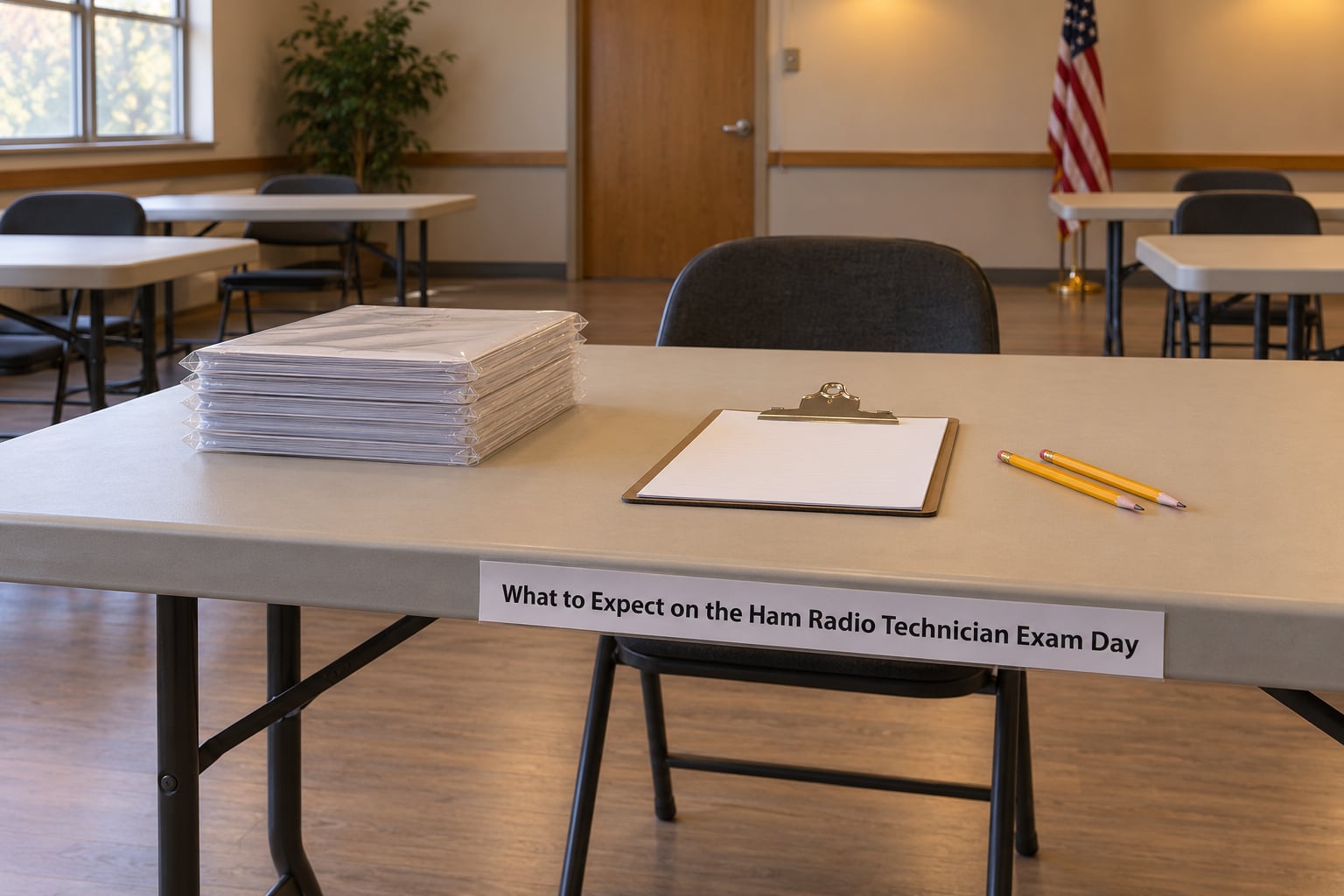
This is the part that surprises first-timers most, so here is the sequence end to end. Most sessions take place in a club meeting room, a church hall, a library annex, or a community center.
Arriving
Aim to be there 10 to 15 minutes early. Registration usually closes at the start time, and if you walk in at the moment the session begins you can be turned away even with a confirmed seat. Look for a sign for the VEC or club, a check-in table, and sometimes a stack of folding chairs.
Check-in and identification
A team member takes your name, checks you against the registration list, and looks at your photo ID. This is the part where some sessions also confirm that you have an FCC Registration Number. That number comes from your FCC Universal Licensing System account, and you need it before you register for the exam, not after.
The room and the script
Once you are checked in, you are seated. Examiners usually run the session from a script, partly because the FCC requires it. They explain the ID rule, the no-calculator rule, that there is no penalty for a wrong answer, that you may skip questions and come back, and roughly how much time the session will take. Phone use is not permitted during the test. Some sessions hand out a plain basic calculator or a small reference card; ask before the test starts if you are not sure.
Getting your booklet
An examiner hands you a sealed question booklet and an answer sheet. The booklet is not yours until you break the seal yourself, and you fill in your name, call sign if you have one, and the session details on the answer sheet before you start. On a pencil-marked answer sheet you shade bubbles with the pencil, which is why you bring more than one. Make sure your pencil marks are dark and complete, because the machine scoring the sheet can miss a light one.
Working through the questions
Thirty-five questions, four choices each, no penalty for wrong answers, and no clock. Read a question, eliminate the answers that are obviously wrong, and mark the one that is left even if it is a guess. Marking something costs nothing. Leaving it blank and running out of time is the only real mistake.
Skip anything that stalls you. Come back to the flagged ones after a pass through the easy ones. Many people finish in 20 to 30 minutes simply because the pool questions repeat.
Submitting and scoring
You hand in the booklet and the answer sheet together. The examiners grade it immediately with a scoring sheet or machine, in the room, while you wait. Some sessions return results on the spot and hand you a CSCE, the Certificate of Successful Completion of Examination. Others mail or electronically deliver it, which is why your registration should include a current email and mailing address.
That is the entire day. People come out of it surprised that it was so ordinary.
What ID and Documents Do You Need?
One government-issued photo ID with your name on it. A state driver’s license or state ID is the common choice. Passports and military IDs work. The name on the ID should match the name on your FCC Universal Licensing System account, since that mismatch is the single most common reason a session cannot process your result.
Before you register, make sure your ULS account is in order. You need a valid email address, your FCC Registration Number, and a mailing address. That account is also where you will claim your call sign, so setting it up before the exam saves trouble afterward.
What you do not need: no books, no notes, no phones, no watches with calculators, no previous license, no club membership, no recommendation from anyone. Study material stays at home or in your head.
Bring a couple of sharpened pencils. That is the entire packing list, and it catches almost everyone the first time.
Special cases are handled without much fuss. Applicants under 13 need a parent or guardian to sign the application. Some sessions are restricted to a specific audience, such as club members only or a military or MARS group, so read the session listing carefully. Visitors from other countries take the same exam, with the session sponsor handling the FCC registration details on your behalf.
How the Ham Radio Technician Exam Is Scored
You need 26 points out of a possible 37. That sounds odd until you know why. The test is 35 questions at one point each, which would make 35 available. The FCC adds a second point for each of four questions designated on your particular paper, so a perfect sheet scores 37.
Practically, that means you have a little more room than a flat 74 percent suggests. Answering 25 questions correctly plus one designated question correctly passes. Missing everything and guessing gets you nothing, and there is no negative marking, so a wrong answer costs exactly as much as a blank one.
That is why the standard advice from anyone who has run sessions is to answer every single question. There is no arithmetic argument for leaving blanks.
Scoring is on a curve across the whole group under the FCC’s standardized method, not a straight raw percentage, which is why the published threshold is expressed as points rather than a percentage.
How to Prepare for the Ham Radio Technician Exam: A Realistic Study Plan
Most people who pass did roughly a month of steady study, and many of them had no electronics background at all. On the amateur radio forums the consensus is blunt: the entry-level test is easy for most people, and roughly a month of study is enough.
Start with the official question pool
Download the current Technician question pool and work through it in order. Do not start with a random practice test. The pool is the actual source material, organized by subelement, and it tells you exactly what can appear.
Use one app or book as your spine
HamStudy is the free tool most people use, and for many it is enough on its own: it drills you, tracks weak subelements, and generates practice exams. If you prefer paper, the ARRL License Manual covers the same ground with more explanation. Pick one and stay with it rather than bouncing between five sources.
Take practice exams under real conditions
Full-length practice tests are where the learning happens. Sit down, no phone, answer 35 questions, and score yourself honestly. Repeat until you are consistently passing, then schedule the real session. Common candidates for retaking are a couple of wrong band-plan edges and one subelement you keep ducking.
Schedule the exam sooner than you think
Unscheduled study drifts. A date on the calendar with a fee attached is the thing that actually moves people through the pool.
A realistic timeline
| Timeline | Who it suits |
|---|---|
| Two weeks | You have electronics background or a prior license, and want the fastest path |
| One month | The most common route, and what most successful first-timers report |
| Two to three months | Better if you want to understand the material rather than memorize the pool |
Test anxiety is the most common complaint and the least justified. A repeated pattern on the amateur radio forums is people scoring below passing on practice tests right before the real exam, then clearing it comfortably on the day. Practice tests are usually harder than the real thing because they sample the whole pool, including questions you have not hit yet.
What Happens After You Pass?
Your examiners submit the result to the FCC, usually the same day. The next steps are mostly waiting and paperwork.
First, confirm your ULS account details are accurate and current, because that is where the license and call sign land. If your session handed you a CSCE, keep it. It is the physical proof of your result and it stays valid for 365 days from the date it was issued, so if something goes wrong with the filing you have a way to prove you passed.
The call sign assignment typically appears in the FCC amateur call sign database within a few business days, though it can take longer in some cases. You can watch for it on the ULS license search.
Once your call sign appears in the database, you are licensed and you can transmit. That is the moment the whole thing was for.
Before your first transmission, read the band plan for the band you want to use, learn your local repeater frequencies and tones, and listen for a few minutes first. On VHF and UHF that means picking a calling frequency, keying up briefly to check whether anyone is on it, and identifying yourself. Give your call sign first, then your name, then ask for anyone on frequency. Stations on the air nearly always expect your call before anything else.
A lot of first transmissions happen on a handheld with a factory antenna or a mag-mount in a driveway. That is completely normal and nobody minds. Getting a good antenna working is the natural next project, and understanding why comes back to the same subelements the exam tested.
What If You Do Not Pass?
Failing is ordinary and nobody treats it that way. The sheet comes back scored, the team tells you the result, and that is the end of it. You register for the next session and take it again.
There is no waiting period and no penalty. Most VECs and clubs will let you retake the same day if a spare sealed booklet is available, which many first-timers do after using their first attempt to calibrate.
Treat the score sheet as a study tool rather than a verdict. The examiners commonly hand it back, and it tells you which subelements cost you. If you dropped four questions in antennas, that is your study plan. If you lost them all on band edges, that is a memorization task you can finish in an evening.
Most people who need a second attempt pass on it.
Frequently Asked Questions
Is the ham radio technician exam hard?
No, not for most people. The test is 35 multiple-choice questions drawn from a published pool of about 60, and it leans toward FCC rules and operating practice rather than engineering math. Most applicants who study steadily for a month pass on the first attempt. The arithmetic on it is basic: a little multiplication, division, and Ohm’s law.
How many questions are on the ham radio license test, and how many do I need to get right?
The Technician exam has 35 questions and you need 26 points to pass. Because four questions on your paper are designated and worth a second point each, the maximum possible score is 37. Wrong answers cost nothing, so answer every question rather than leaving blanks.
Do I need a calculator for the ham radio technician exam?
You cannot bring your own. Personal calculators, phones, watches, and notes are not permitted in the exam room. Some sessions hand out a simple basic calculator or a small reference card, but do not count on it. The math involved is light enough that a pencil and careful reading will carry you through.
Can I take the ham radio technician exam online?
Yes. Authorized remote exam sessions let you test from home with a VEC proctoring over video. You still need an FCC Universal Licensing System account, a photo ID check on camera, and a quiet room with no other people. Availability varies by VEC and region, so check with your local club as well.
How long does the ham radio technician exam take?
There is no formal time limit, and most people finish the 35 questions in 20 to 30 minutes. Plan for 60 to 90 minutes door to door, which covers check-in, the examiner script, ID verification, and having your sheet graded. Nobody has ever been cut off for being slow.
What happens if I fail the ham radio technician exam?
Nothing dramatic. The examiner team scores your sheet and tells you the result, there is no waiting period, and no penalty on your record. You register for the next session and take it again. Ask to keep or have a photo of your score sheet, since it shows exactly which subelements cost you the pass.
How soon do I get my call sign after passing?
Your examiners report the result to the FCC at the end of the session, and your call sign is usually assigned and visible in the FCC amateur call sign database within a few business days. Some cases take longer. You can transmit once your call sign appears there. Keep your Certificate of Successful Completion of Examination, which is valid for 365 days.
What to Do First
Create your FCC Universal Licensing System account and write down your FRN. Then download the current Technician question pool, work through it, and take a full practice exam until you pass it twice in a row. Book the session at that point, not before.
Everything else is a short walk on the day: photo ID, a couple of pencils, arrive early, answer all 35 questions.