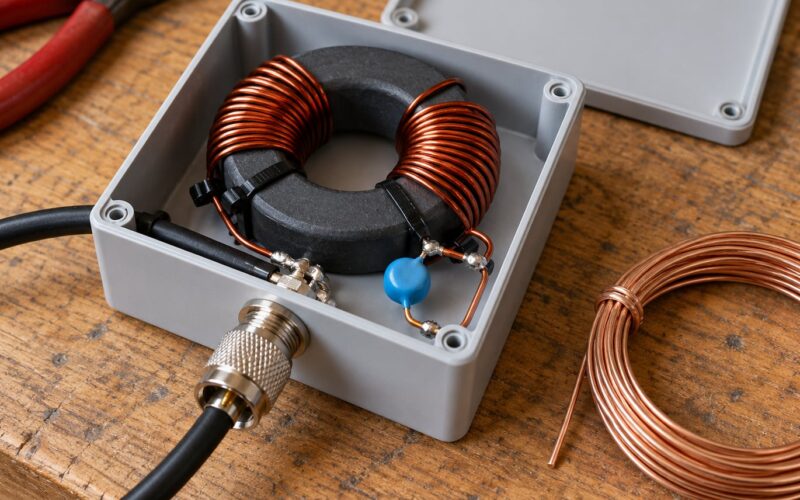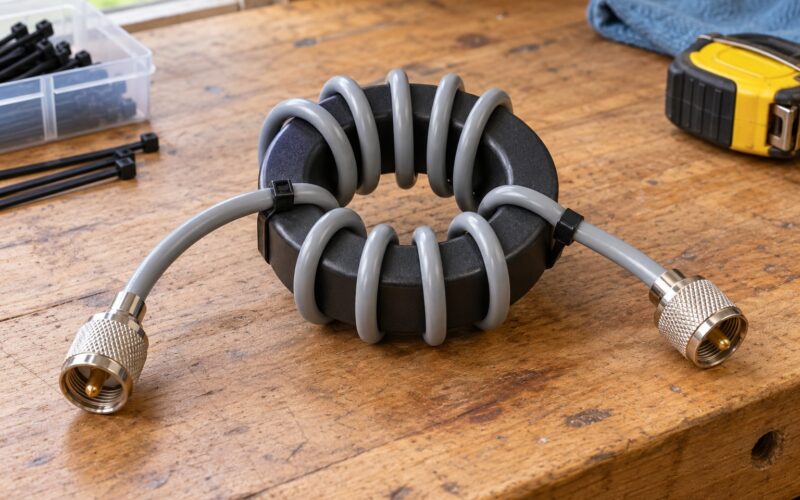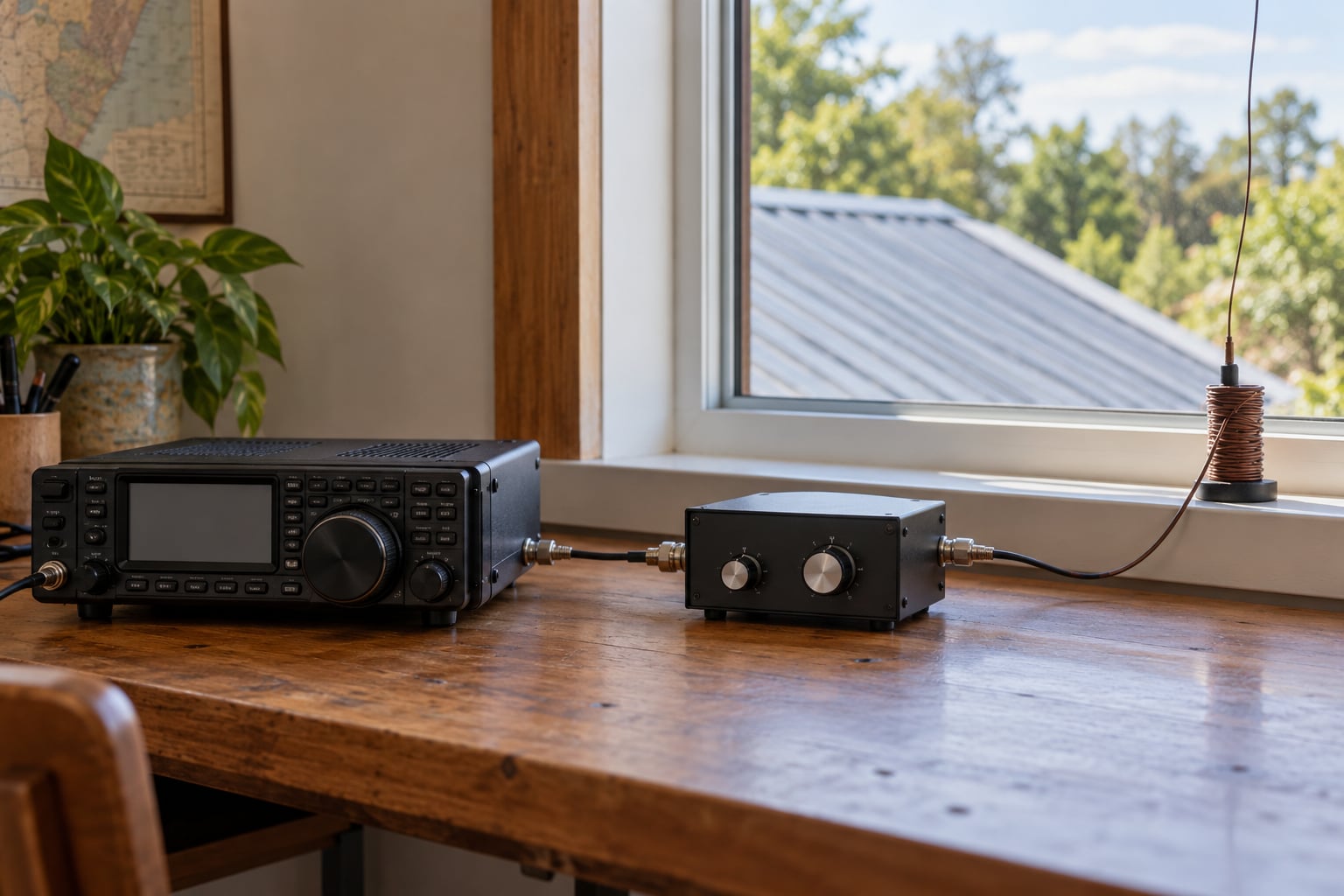
An antenna tuner does not improve a bad antenna. It changes the impedance your transmitter sees at one point in the feed line, and nothing beyond that point gets better. Power still disappears in a lossy coax connector, in an electrically short whip, or in a coil that turns RF into heat, and a tuner has no way to put any of it back.
That is why a station can show a beautiful 1:1 SWR all day and still not work a single new contact. The meter is telling the truth about the match at your radio. It says nothing about how much of the accepted power leaves the antenna as radiation.
Here is what a tuner really does, where the losses hide, and how to check whether your antenna is the problem before you buy another box of L and C.
Table of Contents
- 1What Does an Antenna Tuner Actually Do?
- 2Where the match actually happens
- 3The wheel-balancing comparison
- 4Why a Tuner Cannot Recover Losses in a Bad Antenna
- 5Radiation efficiency is a ratio of resistances
- 6Matched Power Is Not the Same as Radiated Power
- 7What Happens to Current and Voltage in a Poor Match?
- 8Common Problems a Tuner Can Mask
- 9How to Tell Whether Your Antenna Is Really Bad
- 10The five checks worth doing
- 11Measure the feed point before you match anything
- 12When an Antenna Tuner Is Still Useful
- 13How to Improve a Weak Antenna Instead
- 14Frequently Asked Questions
- 15Can an antenna tuner make a bad antenna work better?
- 16Does a tuner increase the range of my radio?
- 17Why does my antenna have a low SWR but weak signal?
- 18Should I use a tuner with a very short whip antenna?
- 19Does an antenna tuner amplify the received signal?
- 20How do I know whether my antenna or feed line is the problem?
- 21Bottom Line
What Does an Antenna Tuner Actually Do?
An antenna tuner is a passive network of inductors, capacitors, and often a transformer that transforms the impedance at its own terminals into the 50 ohms your transceiver’s output stage was designed to see. That is a conjugate match: the impedance looking back into the tuner is the complex mirror of the impedance looking forward out of it, so no wave is reflected at that junction.
Nothing else changes. The antenna still has the radiation resistance it had. The coax still has the loss it had. The pattern, the height above ground, and the return path are all untouched.
Where the match actually happens
This is the part people miss. A tuner at the shack matches the antenna to 50 ohms at the shack. Everything downstream of that point still sees its original mismatch, and if the standing wave ratio down the coax is 8:1, the cable has to carry that 8:1 for its whole length.
A tuner at the antenna feed point does the opposite job. It matches the feed line to the radio at the radio and leaves the line itself flat at 50 ohms all the way down. That arrangement is why experienced operators push the match toward the antenna rather than toward the desk.
The wheel-balancing comparison
Think about a car with a bald tire and a vibration in the steering wheel. You can add weights until the balancer reads green all the way around. The tire is still out of round, and the car still shakes at 60 mph. Weights fixed the report, not the tire.
A tuner and a SWR meter are the weights. Both are honest instruments doing their jobs, and neither one is looking at the thing that is actually wrong.
Why a Tuner Cannot Recover Losses in a Bad Antenna
Because losses are not impedance. A tuner is a transformer, not a power plant, and it cannot distinguish between a feed point impedance of 12 ohms and 12 ohms sitting behind a rusty connector that is eating half your signal.
Radiation efficiency is a ratio of resistances
Efficiency is the useful resistance divided by the total. Roughly, efficiency equals radiation resistance over radiation resistance plus coil loss plus conductor loss plus return-path loss plus matching loss. A tuner can only ever adjust the matching term. It cannot raise the numerator.
That numerator is why electrically short antennas stay weak no matter how good the match looks. The radiation resistance of a short monopole scales with the square of its height relative to wavelength, so halving a whip on 80 m quarters its radiation resistance. Nobody tunes that back.
The same logic applies to the losses around the antenna: a corroded UHF connector, coax with water in it, a radials-only-if-it-is-quiet ground, an attic wire with metal roofing next to it. Those losses sit in the denominator and a tuner is blind to all of them.
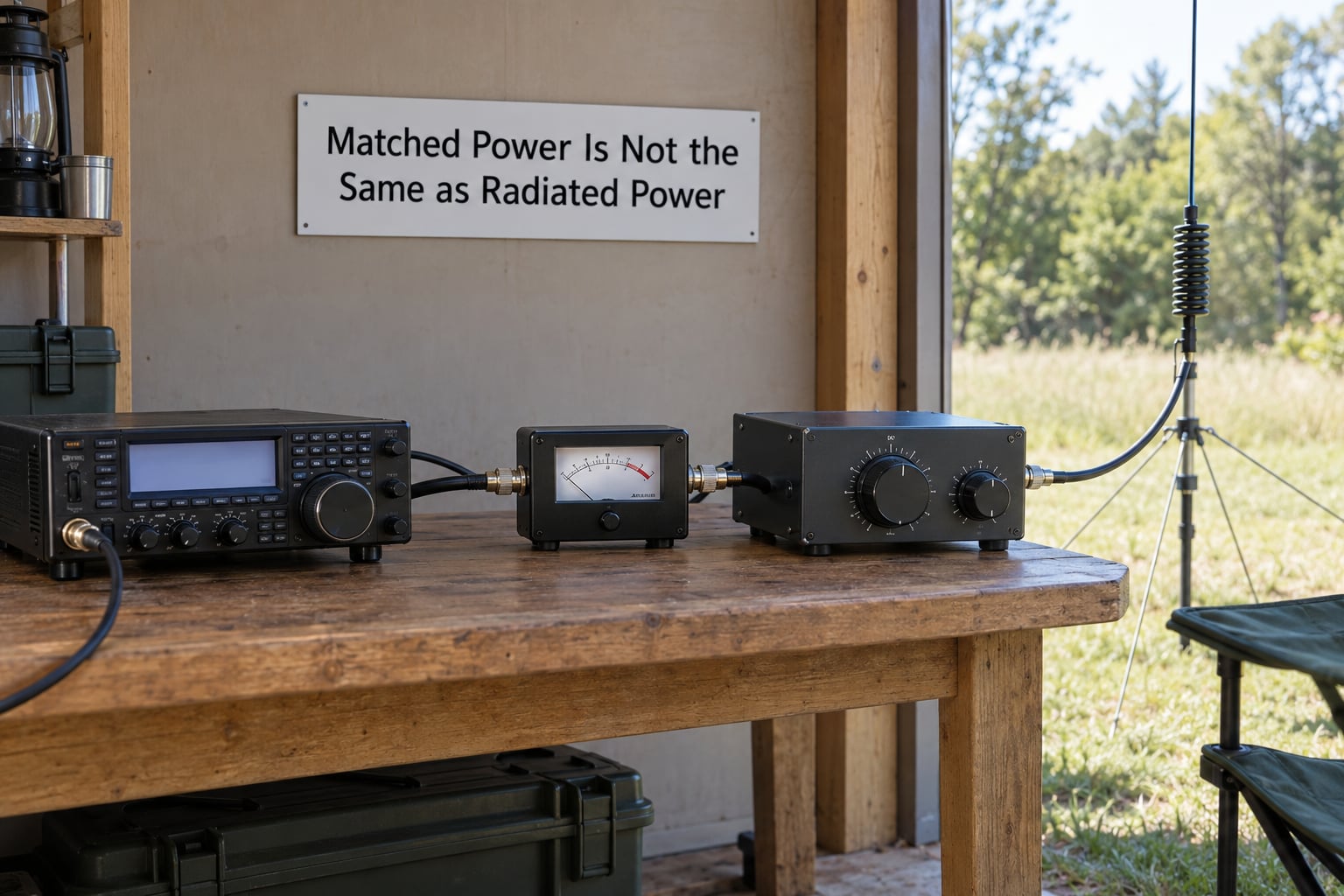
Matched Power Is Not the Same as Radiated Power
Four different numbers get confused on air, and only the last one matters to the station hearing you.
- Forward power — what leaves the transmitter.
- Reflected power — what bounces back because of a mismatch.
- Accepted power — forward minus reflected. This is what the amplifier thinks it is delivering.
- Radiated power — what actually leaves the antenna as an electromagnetic wave.
Say your rig puts 100 watts forward and reflects 4 watts, so 96 watts is accepted and your wattmeter reads a perfect match. If the coax run adds 1.5 dB of loss and the standing wave ratio along it is 5:1, roughly 0.8 dB of that disappears as extra cable loss, and the antenna itself is 60 percent efficient. You radiate about 20 watts. The 1:1 display never saw any of it.
Here is the part worth printing. The extra loss a mismatched line adds to otherwise good coax:
| Matched loss of the coax | 2:1 | 3:1 | 5:1 | 10:1 | 20:1 |
|---|---|---|---|---|---|
| 0.5 dB | 0.0 dB | 0.1 dB | 0.3 dB | 0.9 dB | 2.1 dB |
| 1.0 dB | 0.0 dB | 0.2 dB | 0.6 dB | 1.4 dB | 3.0 dB |
| 2.0 dB | 0.1 dB | 0.4 dB | 1.1 dB | 2.4 dB | 4.3 dB |
Read the bottom right corner and then imagine running RG-58 up a mast with a shack tuner at the bottom. That combination quietly throws away more signal than most people spend on the antenna.
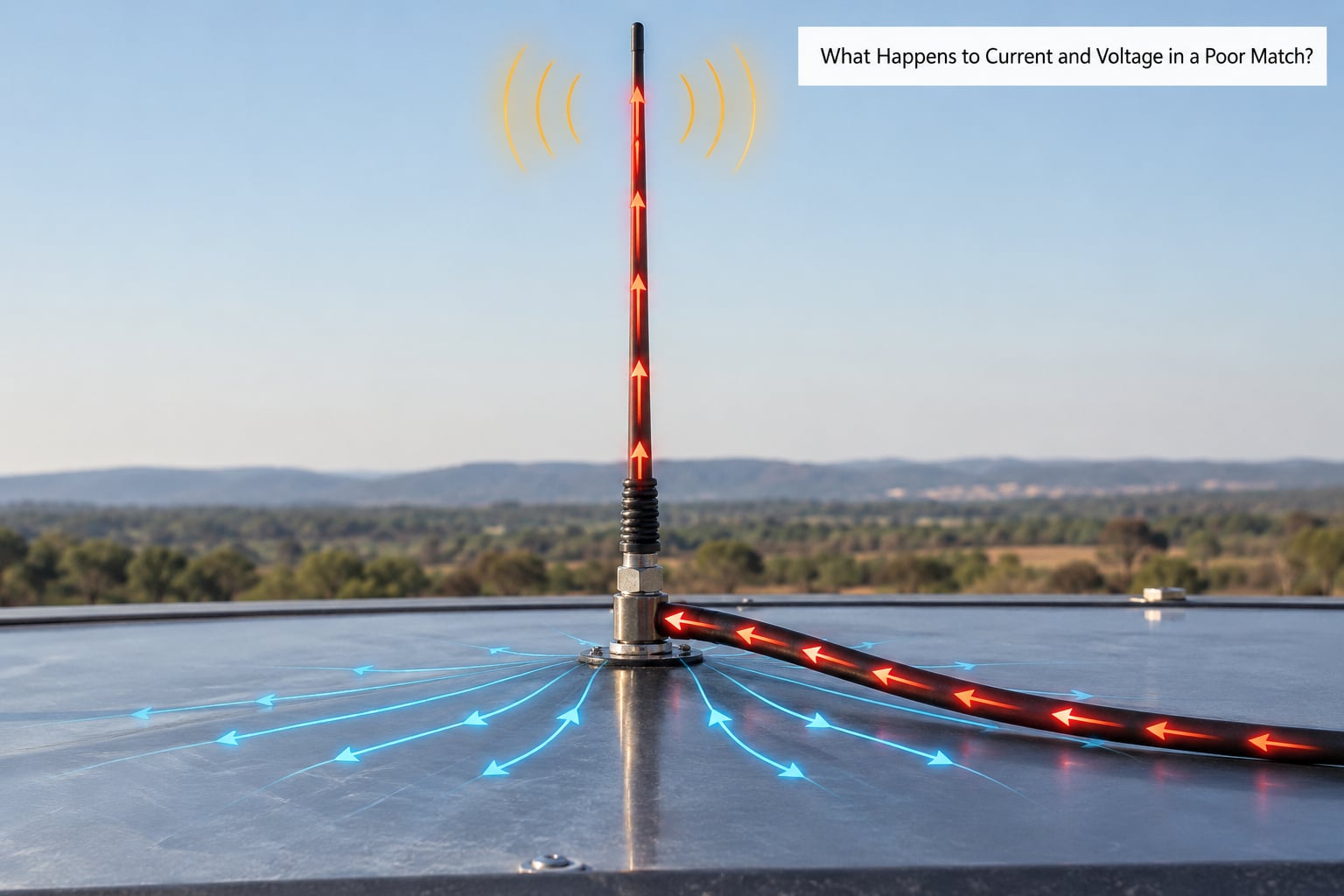
What Happens to Current and Voltage in a Poor Match?
Same SWR ratio, wildly different internal stress. A 5:1 standing wave can be 100 ohms at one feed point or 1,200 ohms at another, and the lossless version of either reads 5:1 on your meter.
At the high-impedance end, the coil carries low current but sees high voltage. That voltage is what arcs across capacitor vanes, what pits switch contacts, and what makes a hot coil. At the low-impedance end the current climbs instead, and that is what trips amplifier protection or burns a bandswitch.
There is a second effect that has nothing to do with matching at all. When a good antenna sits on a lossy feed line, RF current flows back along the outside of the coax shield. That common-mode current lights up your shack, makes the coax warm, and gets blamed on the tuner because the tuner is the new accessory in the chain.
Operators have also reported replacing an end-fed wire and tuner with a full-size dipole and being heard far more strongly by the same local stations, which is roughly a 20 to 40 dB difference nobody on the frequency believed was possible until they heard it.
Common Problems a Tuner Can Mask
Most of these sit upstream of the tuner, so the tuner happily matches whatever is left and hides the evidence.
| Symptom | Likely real cause | What fixes it |
|---|---|---|
| SWR reads 1:1, signal is weak | Antenna radiates poorly or aims the wrong way | Better placement, longer element, real radials |
| SWR changes a lot between bands | Element length is off, or the band edge moved | Cut to length, or accept multi-band compromise |
| Tuner coil gets hot | Power burning in the matching network | Move the match to the feed point, or lower loss upstream |
| RF in the shack, RFI, hot coax | Common-mode current on the outside of the shield | Common-mode choke, shorter run, better line |
| Amplifier trips or the rig folds back | Arcing inside the tuner at high feed point impedance | Fix the impedance at the antenna, not the fault |
| SWR looks fine on one connector, wild on another | Intermittent connector or damaged coax | Cut new coax, remake the connectors |
How to Tell Whether Your Antenna Is Really Bad
The diagnosis is not hard, it just gets skipped. Do these in order.
The five checks worth doing
Log the whole band, not one frequency. Ten watts into a dummy load through the same feed line gives you a clean picture of where the antenna is actually resonant. If SWR is 1:1 across three bands, you are looking at a broadband antenna and a lucky match, not a tuned one.
Inspect and remake every connector. Most “bad antenna” reports I have chased ended at a UHF connector that had been tightened with pliers. A proper crimp tool, a light touch, and a fresh piece of the right connector type cost almost nothing.
Swap in a known-good length of coax. Run a temporary 10 meter jumper straight to the feed point. If the picture changes dramatically, your feed line was part of the problem.
Touch the tuner after two minutes of transmit. Warm is fine. Very hot means RF is being consumed instead of radiated. This is the cheapest diagnostic in amateur radio and almost nobody does it.
Compare against a resonant antenna at equal power. Put a dipole up next to your setup, transmit identical power on both into the same local station, and have them report back. Field strength at equal accepted power is the only honest comparison there is. Contacts through changing propagation tell you nothing.
Measure the feed point before you match anything
Measure the impedance at the feed point with a vector network analyzer or a noise bridge. If it comes back at 700 ohms of mostly reactance, you are asking a shack tuner to absorb a high voltage that it was never rated for. That is the moment to stop matching and start rebuilding. It is also the step that actually settles why an antenna tuner does not improve a bad antenna: the problem started upstream, and the tuner was only ever asked to hide it.
When an Antenna Tuner Is Still Useful
Tuners get unfairly maligned. They earn their place in these cases.
Multi-band operation is the classic one. A wire that works acceptably on 40 m can be brought up to a usable match on 15 m with a couple of knobs, even if it will never win a contest against a stacked dipole.
A workable antenna that is simply off-resonance is another good use. Cut your dipole a little long, hang it where it needs to hang, and let the tuner take care of where on the wire the resonance happens to sit.
Restricted-space installations need one. An attic wire, a balcony rail, a hidden vertical: poor as radiators, but a tuner lets you keep your rig inside its output limits instead of throttling back to a few watts.
Broadband coverage is the fourth. Feed a 6 to 40 meter wire with high-quality open-wire line and a tuner, and you get usable coverage on every band between. Low-power QRP rigs are the exception where a tuner is nearly free of thermal loss.
A rough placement rule helps here. Up to about 4:1, a shack tuner handles it without drama. Past roughly 8:1, put the match at the antenna.
How to Improve a Weak Antenna Instead
Work outward from the antenna and fix real losses one at a time.
Get the antenna higher and clear of losses first. A dipole ten meters up in the open beats a dipole at attic-joist level next to a chimney, every time. Height and clearance raise radiation resistance, and no tuner touches that.
Install a proper return path. A quarter-wave of good radials or a counterpoise often does more for a low-band antenna than any equipment change. Without it, the missing current return turns your feed line into the antenna, which is exactly the situation where your meter still reads 1:1.
Choke the coax. A common-mode choke near the antenna keeps the shield from carrying RF and takes the RFI out of your shack.
Use better feed line, and shorter runs of it. Ladder line is the honest exception here: at a high standing wave ratio it actually beats coax, because its matched loss stays around 0.1 dB per 100 feet and the mismatch penalty barely touches it.
Last, match the antenna to the band. One resonant dipole per band beats one clever compromise antenna almost every time, and it never needs a tuner.
Frequently Asked Questions
Can an antenna tuner make a bad antenna work better?
Only in one narrow sense. A tuner can make a mediocre antenna usable enough to keep your transmitter inside its output limits, and it can shift a resonance onto your operating frequency. It cannot raise radiation efficiency, improve the pattern, or recover power lost in a lossy connector or coil. If your antenna radiates poorly, the weak signal is still weak after the match.
Does a tuner increase the range of my radio?
No. Your radio’s range on a given band is set by propagation and by how much signal actually leaves your antenna. A tuner only reduces reflected power so the amplifier delivers its rated output instead of folding back. If the radio was already running at full power through a tuner, tuning changes nothing about who hears you. If it was in protect or at low drive, it may unlock full output, which can feel like a range gain that is really just a power gain.
Why does my antenna have a low SWR but weak signal?
Because SWR only measures the impedance at your transmitter, not the radiation leaving the antenna. A perfect match can sit in front of a short whip, a wire in a lossy attic, a poor counterpoise, or a pattern aimed away from the station you are trying to reach. Test it directly: touch the tuner for heat, swap in known-good coax, and run a local A/B comparison against a resonant dipole at equal power.
Should I use a tuner with a very short whip antenna?
Use one if your rig needs the help, but expect little gain from it. A short monopole has low radiation resistance, and its efficiency is poor before any tuner enters the picture. Mobile operators generally find a loading coil positioned correctly outperforms a cabin tuner, and a remote base tuner beats both when the run to the whip is long. Match first, then work on the antenna itself.
Does an antenna tuner amplify the received signal?
No. A tuner is passive and symmetric. On transmit it presents a conjugate match to the transmitter. On receive, the network is still there between your line and the front end, adding its own small loss and rolling off the high end of the passband. Any tuner matched in a high-Q band will attenuate received signals away from that frequency. It helps reception only by keeping your antenna usable.
How do I know whether my antenna or feed line is the problem?
Swap the feed line first. Run a short known-good jumper to the feed point and re-measure. If the SWR picture changes, the coax or connectors were part of it. If nothing changes, measure the impedance at the feed point with a vector network analyzer or noise bridge. A few hundred ohms of pure reactance there tells you the problem is upstream at the antenna, not in the radio or the line.
Bottom Line
A tuner improves the match and nothing else. It fixes the relationship between your transmitter and your antenna, and it does not touch efficiency, pattern, height, or the losses buried in connectors and coax.
So before you trust another 1:1 reading, touch the tuner for heat, swap the feed line, measure the impedance at the antenna itself, and compare against a resonant dipole at the same power. If the difference is large, your antenna was the problem all along and the meter never could have told you.