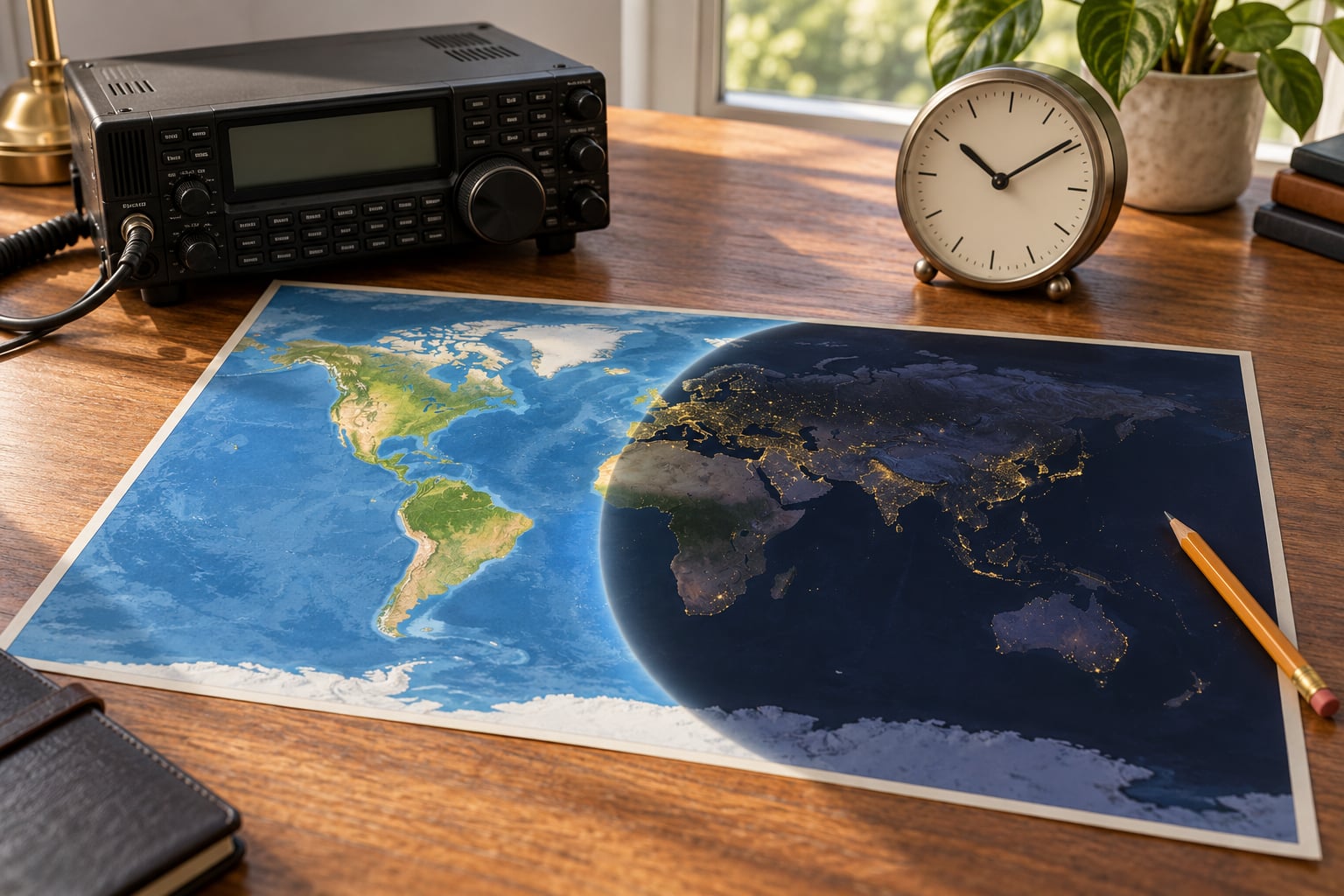
The best time of day to work DX on HF is the gray line, the short window at sunrise and sunset when the terminator sits between you and the station you want to reach. High bands such as 20 and 15 meters peak roughly two hours after sunrise through midafternoon, and 80 and 160 meters come alive an hour or two after full dark. UTC decides the rest.
That is the honest version. Any article that gives you a single magic hour is selling something, because the ionosphere does not care about your bedtime. It cares about where the sun is, where you are, which band you picked, and what the sun did ten minutes ago.
What follows is the working schedule I use: gray-line overlap math in UTC, a band-by-band window for every HF band, and the points where season and solar activity bend the plan. I write it for US operators because that is the conversion problem most people actually have, but the UTC windows travel anywhere.
Table of Contents
- 1What Is the Best Time of Day to Work DX on HF?
- 2HF DX at a Glance: Day, Night, and Twilight Windows
- 3Why Propagation Changes Through the Day
- 4Best Operating Windows by HF Band
- 5How to Plan the Best Time of Day to Work DX on HF
- 6A Practical US DX Schedule
- 7How Seasons and Solar Activity Change the Answer
- 8Targets, Noise, Equipment, and Operating Tactics
- 9Frequently Asked Questions
- 10Is early morning better than late evening for HF DX?
- 11When is the best time to work DX on 10 or 15 meters?
- 12Is sunset always the best time for HF DX?
- 13How do I convert my local time to UTC for gray-line operating?
- 14Can a poor antenna prevent me from hearing DX at the right time?
- 15Conclusion
What Is the Best Time of Day to Work DX on HF?

The short answer is the gray line, and after that comes darkness on the low bands and full daylight on the high bands. Your sunset overlapping someone else’s sunrise is the single most productive hour most days of the year. Everything else is band selection inside a longer window.
Four variables move that answer around, and all four can change it by hours:
- UTC. Propagation charts are drawn in UTC, and UTC does not observe daylight saving time. Your local offset shifts twice a year.
- Your target. Japan and Portugal open at completely different hours for a station in Ohio. The window is a relationship between two sunsets, not one.
- The band. 160 meters and 15 meters behave so differently that “best time to work DX” is not one answer.
- Solar and geomagnetic conditions. Flux sets your ceiling on the high bands. The A-index can shut everything down for a day.
Two more sit underneath those. Season changes how long the night lasts, and the noise floor changes whether you can hear a weak signal over static at all.
HF DX at a Glance: Day, Night, and Twilight Windows
Operators say “gray line” loosely. In practice it covers roughly 30 to 60 minutes when you are in twilight and the other end is in daylight, which is why nobody argues about the exact minute.
| Light condition | Typical duration | What the ionosphere is doing | Bands that favor it | Realistic expectation |
|---|---|---|---|---|
| Full daylight | Longest window | D layer absorbing hard, F2 layer strongly ionized | 20, 17, 15, 12, 10 meters | Solid continental and transatlantic paths, short skip, no low-band work |
| Civil twilight | About 30 minutes | D layer thinning, absorption dropping sharply | 40, 30, 20 meters | Low bands starting to reopen, gray-line absorption at a minimum |
| Nautical and astronomical twilight | Another 30 to 60 minutes | D layer essentially gone, F2 layer decaying but still usable | 80, 60, 40 meters | Long paths opening, best long-distance absorption |
| Full darkness | Night minus the tail of twilight | F2 layer decaying steadily, lower layers recombined and transparent | 160, 80, 60, 40, 30 meters | Longest paths, highest noise, steepest signal decline toward dawn |
The table is a rule of thumb, not a schedule. The ionosphere is layered and only partly predictable, and a good geomagnetic day will break the pattern in both directions.
Why Propagation Changes Through the Day
Two layers do most of the work. The D layer sits low and soaks up radio waves from below a certain critical frequency, and the F2 layer sits higher and reflects waves back down toward the ground.
Sunlight ionizes the D layer during the day, so it absorbs low frequencies hard. That is why 80 and 160 meters sound dead at noon even with a good antenna and a quiet receiver. After sunset the D layer recombines quickly and stops absorbing, which is the single biggest time-of-day change on HF.
The F2 layer runs the opposite schedule. It builds through the day, gives its best refraction for high frequencies near local noon on the sunlit side of the planet, then decays after sunset. Decay takes hours, not minutes, so the high bands stay usable well into the evening and then fade rather than cut out.
Path length matters too, and not just as raw distance. Short paths on 20 meters during the day skip close, which is why you hear regional stations 400 miles away while a station 2,000 miles down the same band is weak. A longer path at night uses a lower takeoff angle and loses less, which is why 80 meters beats 20 meters after dark for real DX.
Skip distance is the part that confuses newcomers. If the station is inside your skip zone, skywave has not refracted back down yet, and your ground-wave range simply does not reach them. You hear the coast and you do not hear the station 200 miles inland. If you have heard a distant station and not a nearer one, skip distance is usually the answer, not a broken antenna.
Finally there is noise. Summer afternoon static on 80 and 160 meters can sit 20 dB above weak signals, and no amount of tuning discipline fixes that. Winter nights are quieter, which is one reason the low bands feel better in December than in July even though both are equally dark.
Best Operating Windows by HF Band
| Band | Usual best window | Typical UTC window from the US | Paths it favors | Season |
|---|---|---|---|---|
| 160 meters | Full dark to 1-2 hours before sunrise | 02:00-10:00 | Very long east-west paths, transatlantic at its best | Winter |
| 80 meters | Full dark, gray-line endings included | 01:00-11:00 | Transcontinental and transatlantic, reliable | Fall and winter |
| 60 meters | Gray line through early night | 03:00-09:00 | Regional and transatlantic, limited channels | All year |
| 40 meters | Late afternoon into night, strongest after dark | 22:00-08:00 | Reliable worldwide, daytime regional until about 1,000 miles | All year |
| 30 meters | Daylight into early evening | 16:00-02:00 | North-south and east-west paths, best in daylight | All year |
| 20 meters | Two hours after sunrise to two hours before sunset | 12:00-22:00 | The general-purpose daytime DX band | All year |
| 17 meters | Daylight, a little wider than 20 | 13:00-23:00 | Regional-to-continental, east-west preferred | Higher flux years |
| 15 meters | Midday, opening earlier in higher flux | 14:00-22:00 | East-west daytime, good north-south at night | Higher flux years |
| 12 meters | Limited midday window | 15:00-21:00 | Short daytime paths, sporadic openings | High flux only |
| 10 meters | Narrow midday window, opens and closes fast | 16:00-21:00 | Long daytime paths, the widest MUF band | Solar maximum |
A few notes that the table cannot carry. 10 and 12 meters depend entirely on solar flux, and at low values they simply do not open. 160 meters needs real antenna space and a quiet location, and a whip on a small lot will lose most of the ground-wave reach that makes the band work after dark. 40 meters sits close to shortwave broadcast frequencies in its lower portion, which is why the upper part of the band is quieter at night.
How to Plan the Best Time of Day to Work DX on HF
The planning method is four steps, and it takes about two minutes once you know the offsets.
1. Find the target’s local sunset in UTC. Look up sunset for the target city, convert its local time to UTC, then add 30 to 60 minutes for the twilight peak.
2. Convert your own sunset the same way. The useful window is not your sunset alone. It is the overlap between your twilight and their daylight.
3. Read the overlap, then pick the band. If your twilight overlaps their afternoon, work 20 or 15. If you are fully dark and they are fully dark, work 80 or 40.
4. Do it twice, once on each gray line. The dawn window often has lower noise than the dusk one, which is why many operators prefer it.
The UTC offsets matter and they shift. In standard time the US zones sit at UTC-8 in the Pacific, UTC-7 Mountain, UTC-6 Central and UTC-5 Eastern. During daylight saving, every US zone moves up one number: Pacific UTC-7, Mountain UTC-6, Central UTC-5, Eastern UTC-4. UTC itself never changes, so your local sunset converts to a different UTC in March than in January.
A concrete example. Your sunset in Ohio during daylight saving is about 21:00 UTC. Lisbon in the same period goes dark around 21:30 UTC. Their twilight and your daylight overlap between roughly 20:30 and 21:30 UTC, and 20 meters is the right band in that hour.
The same Ohio station chasing Japan gets a completely different answer. Tokyo sunset lands near 09:00 UTC, which is 05:00 EDT. That is your pre-dawn window on 80 and 40 meters, and it is exactly the sort of timing that no local-clock rule would have told you.
A Practical US DX Schedule
This is a workable block schedule from the Eastern time zone in daylight saving. Shift it by your offset.
- 14:00 to 17:00 local (18:00-21:00 UTC). 15 and 10 meters if flux is up, 20 meters otherwise. Asia and the Pacific on north-south paths, South America opening.
- Sunset to two hours after (roughly 21:00-23:00 UTC). The dusk gray line for Europe and Africa on 20 meters, then the transition as the F2 layer decays.
- Two to five hours after sunset (23:00-02:00 UTC). 40 meters opens properly. South America and southern Africa on 40, 80 meters coming up.
- Deep night (02:00-06:00 UTC). 80 and 160 meters at their best. Transatlantic paths, transcontinental on 80, best signal-to-noise ratio of the day.
- Pre-dawn (05:00-08:00 local, 09:00-12:00 UTC). The dawn gray line. Asia and the South Pacific on 40 and 80, plus 20 meters as the F2 layer rebuilds on that side.
- Sunrise to mid-morning. 20 meters picks up, 40 meters fades as the D layer rebuilds, 10 and 15 open if the numbers allow.
Contest weekends rearrange this. Big multi-operator events on 20 meters fill the daytime hours with strong stations you might otherwise never hear, which is a cheap way to find out whether your antenna and receiver are working on a given day.
How Seasons and Solar Activity Change the Answer
Season changes the length of the windows, not just their timing. In June, Eastern US sunsets around 21:30 UTC and sunrise comes near 10:00 UTC, which shortens the usable dark period on 80 and 160 meters and pushes the gray-line overlaps later. In December those same events are about four and a half hours earlier in UTC, and the long dark period is the reason winter DX on the low bands feels easy.
Solar flux sets the ceiling on the high bands. Below roughly SFI 70 expect 20 meters to be the top of the daytime stack, above 100 and 15 meters opens more consistently, and 120 to 130 is the range where 10 meters starts appearing at midday. When flux is low, the low bands do not improve, they simply lose less to D-layer absorption than they would at high flux. High solar activity is good news for 20 meters and mixed news for 160.
Equinox periods in March and September are widely reported as a boost, particularly for east-west paths, though the effect varies year to year. Storms cut the other way. When the A-index climbs, HF absorption events can black out the lower bands for hours, and the high bands close as the F2 layer gets disturbed. That is why a quiet K-index on the day matters as much as the flux number.
Targets, Noise, Equipment, and Operating Tactics
Where the target is changes what you should expect even at the perfect hour. A station near the poles sits in darkness for months, so its path to you behaves like a long path regardless of your clock. High-latitude targets in summer often hold long paths open all night because one end never sees the sun.
Noise is the other half. Lightning static on 80 and 160 meters peaks around local midday and early afternoon and decays through the evening, so the later you start on the low bands the quieter they get. In a quiet rural location the same band that is useless at 18:00 local may work well at 22:00.
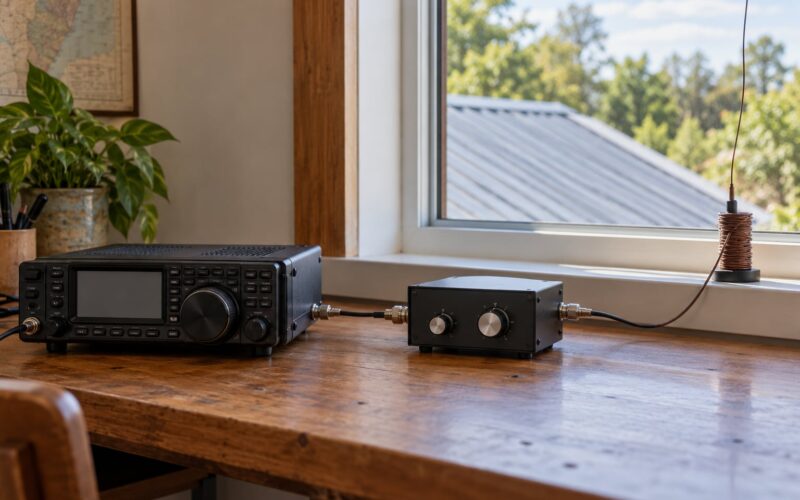
On antennas, a portable whip is honest work for 20 and 15 meters in daylight with reasonable height, and it is a compromise on 40. Below 40 meters, a full-size wire with a decent height and a low noise floor is what separates hearing a station from working one. Details on getting the most from limited setups are worth a look in our portable operating coverage.
Modes shift the timing. SSB is the first to disappear when absorption rises, so voice paths thin out an hour or two before CW does. CW holds longer. FT8 and FT4 sit at the bottom of the bands and will still copy stations you cannot hear on voice, which makes them useful for confirming whether a path is open before you waste time on SSB. FT4 transmits longer, so a slot spanning 15 seconds tells you more than FT8 does in the same wait.
Before you transmit, spend two minutes on verification instead of guessing. A DX cluster or watch site shows where DXpeditions are announcing, PSK Reporter shows who is decoding whom right now, Reverse Beacon shows real CW paths, and a solar-terrestrial data panel gives you the A-index and flux numbers behind the conditions. Forum regulars consistently point to those three reporting tools over generic band-condition ratings, and they are right: a global rating cannot see your local noise floor or your antenna.
If you want a primer on what your radio and antenna are actually doing during these windows, start with the basics in our ham radio fundamentals coverage.
Frequently Asked Questions
Is early morning better than late evening for HF DX?
Usually yes for most paths, and the reason is noise. Dawn gray-line operating happens before local thunderstorm activity peaks, so the noise floor on 80 and 40 meters is typically lower than during the evening hours. Dawn also favors east-to-west paths, while the dusk window often opens the same paths in the other direction. The exception is high-latitude targets that stay dark around the clock, where the night window between both gray lines wins.
When is the best time to work DX on 10 or 15 meters?
Both bands peak around local midday at the path midpoint, so from the US that is roughly 16:00 to 21:00 UTC for 15 meters and a narrower 16:00 to 21:00 band for 10 meters. Neither will open at all if solar flux is too low: 15 meters wants roughly SFI 100 or better, and 10 meters generally needs 120 to 130. Check the flux number before you sit waiting on a band that cannot support the path.
Is sunset always the best time for HF DX?
No. Sunset matters because it is when the D layer stops absorbing while the F2 layer is still decaying, and that overlap is at its widest for 30 to 60 minutes. But for the highest bands, midday is better, and for the lowest bands, full dark an hour later is better. Sunset is simply the transition point that opens the low bands while the high bands still work. Treat it as a handoff, not a destination.
How do I convert my local time to UTC for gray-line operating?
In standard time, US zones run from UTC-8 on the Pacific to UTC-5 on the Eastern, with Mountain at UTC-7 and Central at UTC-6. During daylight saving every US zone shifts up one hour, giving Pacific UTC-7, Mountain UTC-6, Central UTC-5 and Eastern UTC-4. UTC never observes daylight saving, so the same local sunset converts to a different UTC in March than in January. Recalculate after the November change as well.
Can a poor antenna prevent me from hearing DX at the right time?
Yes, and it is one of the most common reasons operators blame propagation when the real problem is their station. On 160 and 80 meters, a low whip loses most of the ground-wave reach those bands depend on for local and regional contacts. On higher bands, height and a low-noise feedline matter more than amplifier power. Confirm your setup by listening to strong shortwave broadcast stations, then compare against a reverse beacon before blaming the ionosphere.
Conclusion
Start with the order of operations. Check current conditions first, flux and A-index plus what PSK Reporter or a reverse beacon is actually showing, so you know which bands are worth your time. Then work out the gray-line overlap between your twilight and the target’s daylight in UTC, remembering your offset changes in March and November.
Once the window is open, monitor the lower band you expect to be open before touching anything higher. If 80 meters should be open, sit there first. A strong station on 10 meters at the wrong hour is not better DX than a weak one on 80 at the right one, and the difference in cost is zero.