Radio interference across the property line is usually a solvable equipment problem, not a feud. The right move is to confirm the source, write down what you observed, pick a calm moment, explain the problem in plain language, and ask the neighbor to help run one simple test. Most of these conversations end well because the person next door had no idea their gear was involved.
People searching for how to talk to a neighbor about radio interference usually fall into one of two camps. Some have a hunch they can never prove, and some are dealing with hashes across a TV or humming in an audio amp that makes daily life genuinely unpleasant. Both need the same groundwork, and both benefit from approaching the conversation as a shared diagnostic problem rather than a complaint.
This guide walks through the whole sequence: what to gather, how to confirm the interference is real and external, six steps for the conversation itself, the mistakes that turn a fixable issue into a feud, and when to bring in a club, a landlord or a regulator. It takes about an hour of documentation and twenty minutes of conversation, and it needs almost no technical skill.
A note on safety before anything else. If the interference is affecting a medical device, a garage door opener, an aircraft or amateur band reception, stop experimenting and deal with the safety angle first. Radio transmitters are federally regulated, so never ask a neighbor to modify or disable an antenna or alter a licensed station; you can ask them to participate in a test.
Table of Contents
- 1What You Need Before You Knock
- 2A simple interference log
- 3A control test on your own side
- 4Contact details and a reasonable window
- 5Optional technical help
- 6Know the sound before you describe it
- 7Step-by-Step: How to Talk to a Neighbor About Radio Interference
- 81. Confirm the Interference Before You Approach Anyone
- 92. Choose a Private, Calm Time to Talk
- 103. Explain the Problem in Plain Language
- 114. Listen and Ask Questions Instead of Assigning Blame
- 125. Agree on a Specific Next Step
- 136. Follow Up Without Escalating the Conflict
- 14Common Mistakes to Avoid
- 15Tips for a Productive Conversation
- 16Frequently Asked Questions
- 17What if my neighbor denies their equipment is causing the interference?
- 18How can I quickly identify which device is causing interference?
- 19Can a local ham radio club help me talk to my neighbor?
- 20What if the neighbor is a licensed ham operator within legal power limits?
- 21What if the interference is dangerous or will not go away?
- 22Conclusion
What You Need Before You Knock
The difference between a productive conversation and an argument is preparation. Bring evidence, not accusations. You want a short written record that a skeptical person can look at and agree with.
A simple interference log
A notebook or spreadsheet with these columns is enough:
- Date and start and end time of the event
- The frequency or channel affected, or the band you were listening on
- What the interference sounds like (see the signature list below)
- What it affected: one TV, every TV, the radio, headphones, the phone
- What you were doing at the time (transmitting, receiving, both, or nothing)
- Whether the neighbor was home, based on anything you can observe
- What changed when you switched something off
Ten entries beat one long memory. Times matter most, because a repeating pattern is what lets you and the neighbor run the same test on the same day.
A control test on your own side
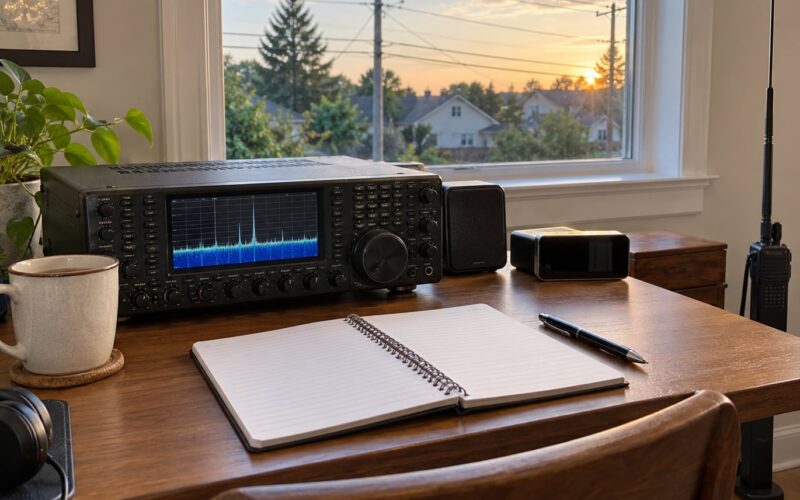
Before you point a finger across the fence, rule out your own equipment. Unplug everything on your side that could radiate or couple: computer towers, monitors, switched-mode power supplies, LED lighting, Wi-Fi routers, HDMI splitters, cheap wall-wart chargers, routers and modems. Then power your receiver back up and listen.
If the noise is still there with your own electronics unplugged, it came from outside. If it vanished, you just saved an awkward conversation and fixed the real problem. Also check your own antenna feed line for a loose or corroded connector, because a bad connection on your end mimics almost every external fault.
Contact details and a reasonable window
Know when the neighbor is usually home, whether they work nights, and which mode of contact they respond to. A text or short note asking for ten minutes is far less confrontational than a door knock at seven on a Sunday evening.
Optional technical help
A local radio club, an experienced operator, or a noise-tracking group can listen to a recording and tell you whether the signature matches a known device. This costs nothing and keeps you from guessing wrong in front of a skeptical person.
Know the sound before you describe it
Listeners describe the same noise differently, which leads to arguments about whose equipment it is. A quick reference:
- A steady tone that does not move when you tune: switching power supply or LED driver
- Broadband hiss or static that rises and falls with motors starting: electric motor or light dimmer
- Voice-like speech, several syllables repeating: switching device, often a wall-wart supply
- A rhythmic clicking or buzzing at a fixed rate: fluorescent lamp, microwave oven, or appliance control board
- Your own voice coming back on SSB, distorted or over-modulated: transmitter overload, which can look like interference but is a power and audio problem on your side
- Noise that stops the moment the neighbor’s power is off: the strongest clue you can get
Step-by-Step: How to Talk to a Neighbor About Radio Interference
1. Confirm the Interference Before You Approach Anyone
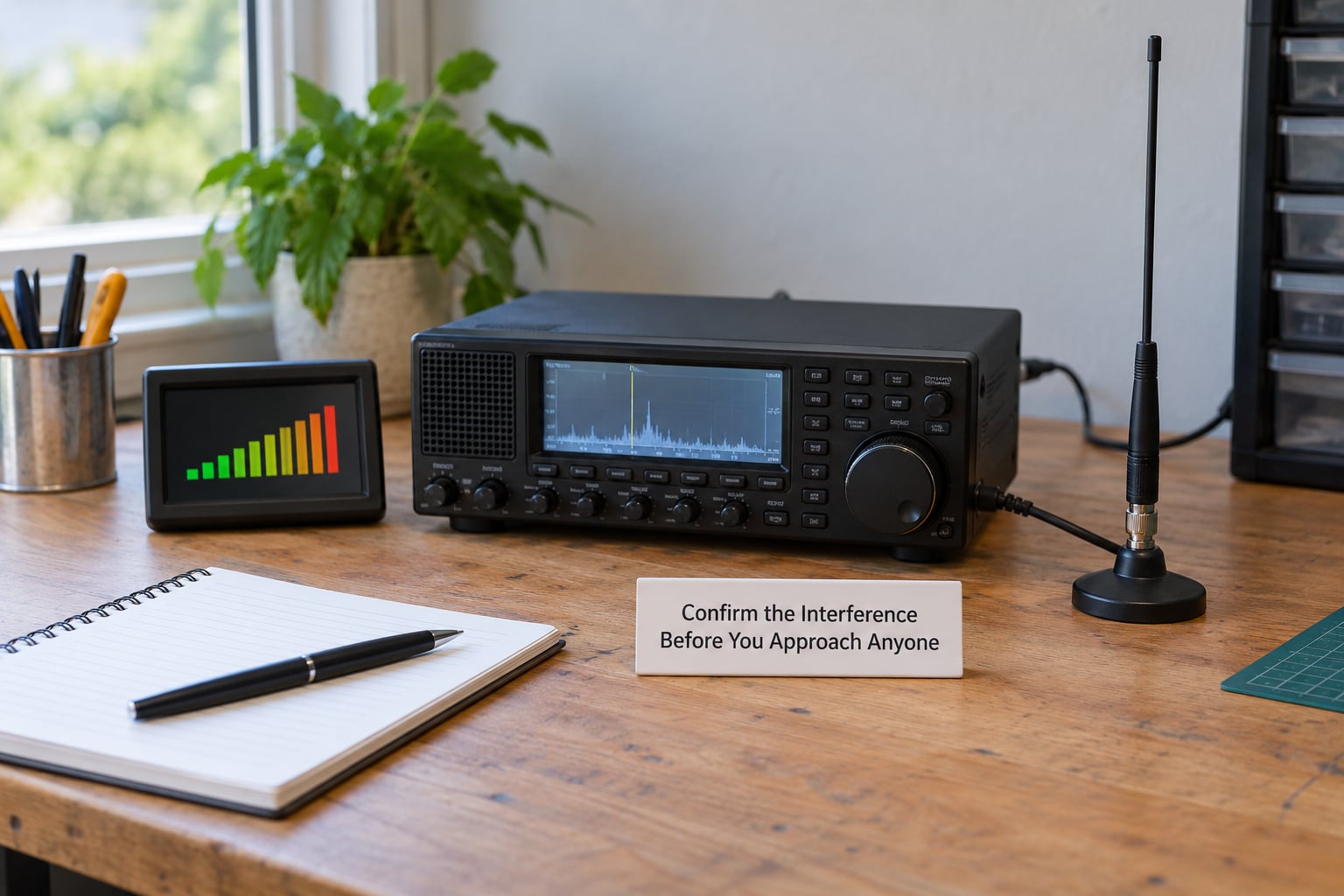
Most approaches that fail start here. You assume, you knock, and the neighbor hears the word interference and hears an accusation.
Instead, reproduce the problem on purpose. Run the receiver, note the frequency and the time, and record the audio if your equipment allows it. Then power-cycle your own gear and watch what changes. A setup that repeats the same noise on the same band at the same time of day is a source worth discussing; a one-off you cannot reproduce is not.
If you can, do a simple direction-finding check. Rotate a hand-held receiver with a small whip antenna and note where the signal peaks and where it drops. That narrows the search to a house, a utility pole, or an electrical service rather than an entire street. This is how to eliminate radio frequency interference before anyone gets defensive.
2. Choose a Private, Calm Time to Talk
Timing does more work than wording. Ask for a window when nobody is rushing: not during a meal, a workday morning scramble, or a football game. Weekday early evening usually works.
Send a short message first. Something like: I have a radio question about my setup, nothing urgent, could I pick five minutes of your time this week? No mention of interference yet, and no accusation implied. That single sentence removes most of the defensiveness before you reach the door.
When you go, go on foot and keep your own radio gear out of sight for the moment. You are a neighbor asking a question, not an inspector issuing findings.
3. Explain the Problem in Plain Language
Skip the technical vocabulary. Overlap, common mode, ingress and QRM all mean one thing to a non-radio neighbor: my stuff is buzzing and I need help finding the cause.
Here is a short script you can adapt:
I have noticed a buzz on my television, mostly in the evenings. It sounds like a device turning on and off. I checked my own equipment first and it is not coming from my house. I am not accusing anyone, and I know you would want to know if something of yours was doing it. Could we try turning off a few things at the same time for five minutes and see if the noise changes?
Notice what that script does. It reports what you observed, states the conclusion you reached, explicitly rules yourself out, gives the other person a graceful exit, and ends with a request rather than a demand. Forum advice from experienced operators lands on that last point hard: giving the person a way to say yes without losing face is what keeps the relationship intact.
Then ask whether anything changed recently. New router, new LED bulbs, new sound bar, new outdoor power supply, a recent move of the TV to another wall. Equipment changes are the most common trigger, and the neighbor may genuinely not connect their purchase to your problem.
4. Listen and Ask Questions Instead of Assigning Blame
The first instinct in this conversation is to prove you are right. Resist it. Your goal in the first ten minutes is information, not a confession.
Neutral questions that work:
- Do you hear anything odd on your own television or radio?
- Does it happen at a particular time of day, or when a certain appliance runs?
- Does the noise change at all when you switch something off?
- Has anything new been plugged in recently, inside or out?
If they hear the same noise on their end, the conversation changes shape completely. Two people with the same problem can work on it together, and a shared mystery is far easier than a one-sided complaint. On r/amateurradio, the standard advice is exactly this: describe the interference and ask whether the neighbor will conduct a test.
Watch the neighbor’s power state, not their face. When a device goes off and the noise goes with it, you both just found the source without a single accusation.
5. Agree on a Specific Next Step
Vague requests produce vague results. End the visit with one agreed action, scheduled for a specific time.
Power-cycle tests are the workhorse. Ask the neighbor to unplug one device or switch off one circuit for five minutes while you watch the receiver, then alternate. If isolating a group of circuits is not something you should do together, ask them to unplug everything in one room, then put it back one item at a time. That approach identifies the device without touching any wiring.
Common fixes you can offer to pay for or help with:
- A ferrite clamp, often sold as a snap-on common mode choke, placed on the shield of the affected cable where it enters the device
- Replacing cheap wall-wart power supplies with filtered or linear units
- Shorting unused F-type connectors on coax and cable runs, which stops ingress into a cable plant
- Moving a charger, switcher or lamp away from shared wall wiring
- Repositioning the neighbor’s antenna or your own, if geometry is the real cause
- A low-pass or high-pass filter, but only after the source is known, since a filter hides a symptom rather than removing a cause
Offer to cover the cost of anything you ask them to change. That sentence does more for the outcome than any piece of equipment. In cases documented on ham forums, paying for a filter or a replacement part frequently turned an argument into a solved problem.
6. Follow Up Without Escalating the Conflict
After the agreed test, do the same test again under the same conditions. Same band, same time window, same equipment positions. Write down what changed, including the case where nothing changed.
If it improved, thank them in writing. A short note confirming that the problem is resolved ends the interaction on a good note and means nobody has to have the awkward conversation twice.
If it did not improve, move up one step at a time. Club first, since a club can supply equipment, recording help and a neutral voice. Then landlord or property manager if you rent. Then your local noise or nuisance ordinance, keeping in mind many ordinances address sound rather than RF. Then a regulator such as the FCC, whose formal complaint form for interference is RICF-2, filed with a log, dates, times and recordings attached.
Know what that last step realistically delivers. A licensed amateur operating within the rules has done nothing wrong, and regulators are slow. Forum users are blunt about it: the onus sits with the person receiving the interference, and a regulatory route will not make your neighbor like you any more. Keep it in your pocket, not in your opening line.
Common Mistakes to Avoid
Knocking without evidence. A suspicion reads as an accusation. Bring the log, the recording and the times, and let the record do the work.
Threatening legal action in the first conversation. It guarantees a closed door and turns a repair problem into a legal one. Regulations come into play only when a cooperative approach has failed.
Discussing it publicly. Social posts, group chats and porch conversations all reach the neighbor faster than you think and kill any chance of a quiet fix.
Skipping the unplug test. Half of these problems disappear when one wall-wart supply comes out of a socket. Skipping the simplest test means you guess instead of know.
Treating a fixable fault as a character issue. Nobody sets out to disrupt their neighbor. Assume a switching supply is doing exactly what it was built to do, badly.
Buying a filter before you know the source. A filter in the wrong place costs money and hides the evidence you still need.
Going straight to the authorities. Formal complaints take weeks and rarely change a relationship. They are the last step, not the first.
Asking the neighbor to alter their antenna. That is the one request you should never make. You may ask for a test; you may not ask someone to modify or disable a licensed installation.
Tips for a Productive Conversation
Use the same time window for every test. If the noise appears around 8 p.m., do all your tests at 8 p.m. Otherwise you are comparing a bad evening with a good one and drawing the wrong conclusion.
Describe changes neutrally. Say the noise stopped, not that you proved it was their router. Neutral phrasing keeps a person from feeling cornered, and a cornered person stops cooperating.
Keep written records of every contact, even a text. Dates and agreed actions are what make a later complaint credible rather than emotional.
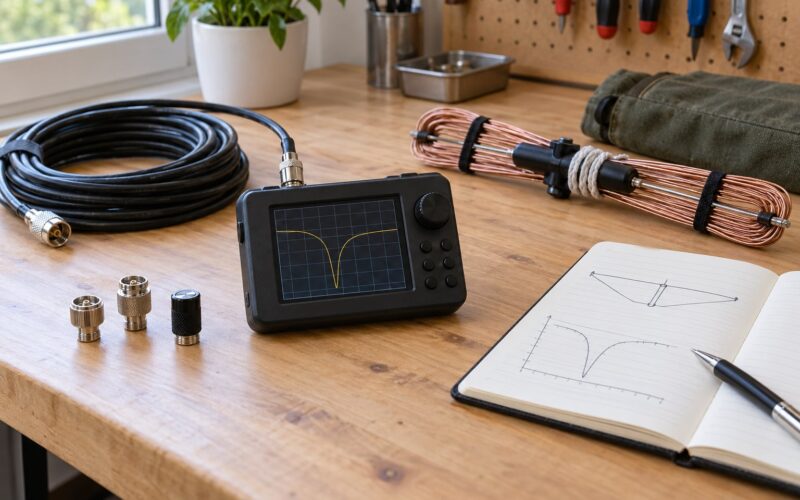
Make it easy to help. Bring your receiver, spare cables, ferrite clamps and a notebook. A neighbor who can see the problem on your equipment stops wondering whether you made it all up.
Ask the neighbor what they hear, and believe them if they hear something different. Two receivers in the same house sometimes disagree about what interference looks like, and that disagreement itself is data.
Leave the door open for a friendly outcome. End the visit with something like: if it gets worse, tell me and we will figure it out together. That line is the cheapest insurance you will ever buy.
Accept the graceful exit. If the neighbor offers any explanation, take it and ask for one simple confirmation test. Forum operators describe this as the move that keeps a relationship intact even when the guess turns out to be wrong.
Frequently Asked Questions
What if my neighbor denies their equipment is causing the interference?
Denial is common and rarely means bad faith. Most people cannot hear what you hear, and some genuinely have no noise-sensitive gear to test with. Do not argue. Ask them to try one specific test, such as unplugging everything in a single room for five minutes while you watch your receiver. If they decline that, say plainly that you would like to resolve it without anyone being blamed, and leave the door open. A refusal to test ends the conversation, not the problem, and you can continue logging the noise for a later attempt or for a formal complaint.
How can I quickly identify which device is causing interference?
Start with the pattern rather than the device. Noise that starts and stops with a display, a charger or a printer is almost always a switching power supply. Noise that appears only when an appliance motor runs points to a motor or dimmer. Noise that begins at exactly the same time every evening suggests a timer-controlled load such as a lamp or heating element. Unplug one circuit at a time, or one room at a time, and watch what changes. Direction finding with a small whip antenna narrows the search to a specific property before you ever speak to anyone.
Can a local ham radio club help me talk to my neighbor?
Yes, and it is one of the best moves available. Clubs often keep noise-tracking gear, recordings of common interference signatures and members willing to come along so the conversation has a neutral third party. A club representative is far less threatening than a stranger with a complaint, and the club can help separate a real interference problem from a fault in your own receiver. Reach out before you escalate to a landlord or a regulator, and ask whether they maintain an interference help desk or a known contact.
What if the neighbor is a licensed ham operator within legal power limits?
This is the hardest version of the problem. A licensed operator running within the rules has not violated anything, and regulators generally treat the responsibility for eliminating interference as resting with the person receiving it. Start with your own side: filters, better connections, common mode chokes, a shielded feed line, and moving your antenna if geometry is the issue. Then make a friendly request to try lower power or a different operating schedule, and offer to test together. If that fails, a formal complaint is possible but slow, and it rarely improves the relationship.
What if the interference is dangerous or will not go away?
Treat dangerous situations separately from annoyance. If noise affects a medical device, a garage door opener, an aircraft band or hearing protection, stop experimenting and contact the manufacturer or the relevant authority right away rather than waiting on a neighborly conversation. For interference that simply persists, keep logging dates, times and recordings, keep making polite requests, and involve your club or landlord. A documented record is what turns a recurring nuisance into something a landlord, an ordinance officer or a regulator will act on.
Conclusion
Start with documentation and isolation, not with the conversation. Log the times, rule out your own equipment with a power-cycle test, and identify the sound. Then have one short, respectful talk: explain what you are hearing, make clear you have checked your own side, and ask for a specific five-minute test at a specific time.
Offer to help pay for whatever fix comes out of it. Most people want to be good neighbors and will cooperate with someone who comes prepared and asks for help rather than delivering a verdict. If nothing changes, escalate slowly through your club, your landlord or a local ordinance, and keep a formal regulatory complaint as a last resort.