Because a handheld radio’s rubber duck is tuned to work against the radio chassis and your own body as its ground plane, and a building fills that space with metal, wiring and reinforced concrete that detune it. The same radio outdoors may be excellent and unusable indoors. It is almost never the radio at fault.
That is the short version, and it explains most of the frustration that shows up on ham, GMRS and public safety forums. A new handheld gets two blocks from the house, hears a repeater clearly on the driveway, then turns to hiss the moment you walk through the front door. Owners usually respond by buying another antenna. The antenna is rarely the problem.
The rest of this guide breaks down what actually happens to the signal indoors, how to tell a hardware fault from a location limit in about five minutes, and which changes pay off first. Figures for building materials are given as indicative ranges because they move with thickness, angle and frequency, and the only measurement that settles it is the one you take in your own building.
Table of Contents
- 1What Happens to a Handheld Radio Signal Indoors?
- 2Why Your Handheld Radio Antenna Performs Poorly Indoors
- 3Why Do Walls, Wiring, and Furniture Make Reception Worse?
- 4Why Does Holding or Touching the Antenna Change the Signal?
- 5Frequency Choice: VHF and UHF Indoors
- 6How to Tell Whether the Problem Is the Radio or the Location
- 7What Can You Do to Improve Indoor Reception?
- 8Do Longer Antennas Always Work Better Indoors?
- 9A Quick Troubleshooting Checklist
- 10Frequently Asked Questions
- 11Why does my handheld radio work outside but not inside?
- 12Does a longer antenna always improve indoor reception?
- 13Is a window a good place to use a handheld radio?
- 14Can walls block shortwave signals completely?
- 15How do I know if my radio antenna is damaged?
- 16Will an external antenna always solve poor indoor reception?
- 17Conclusion
What Happens to a Handheld Radio Signal Indoors?
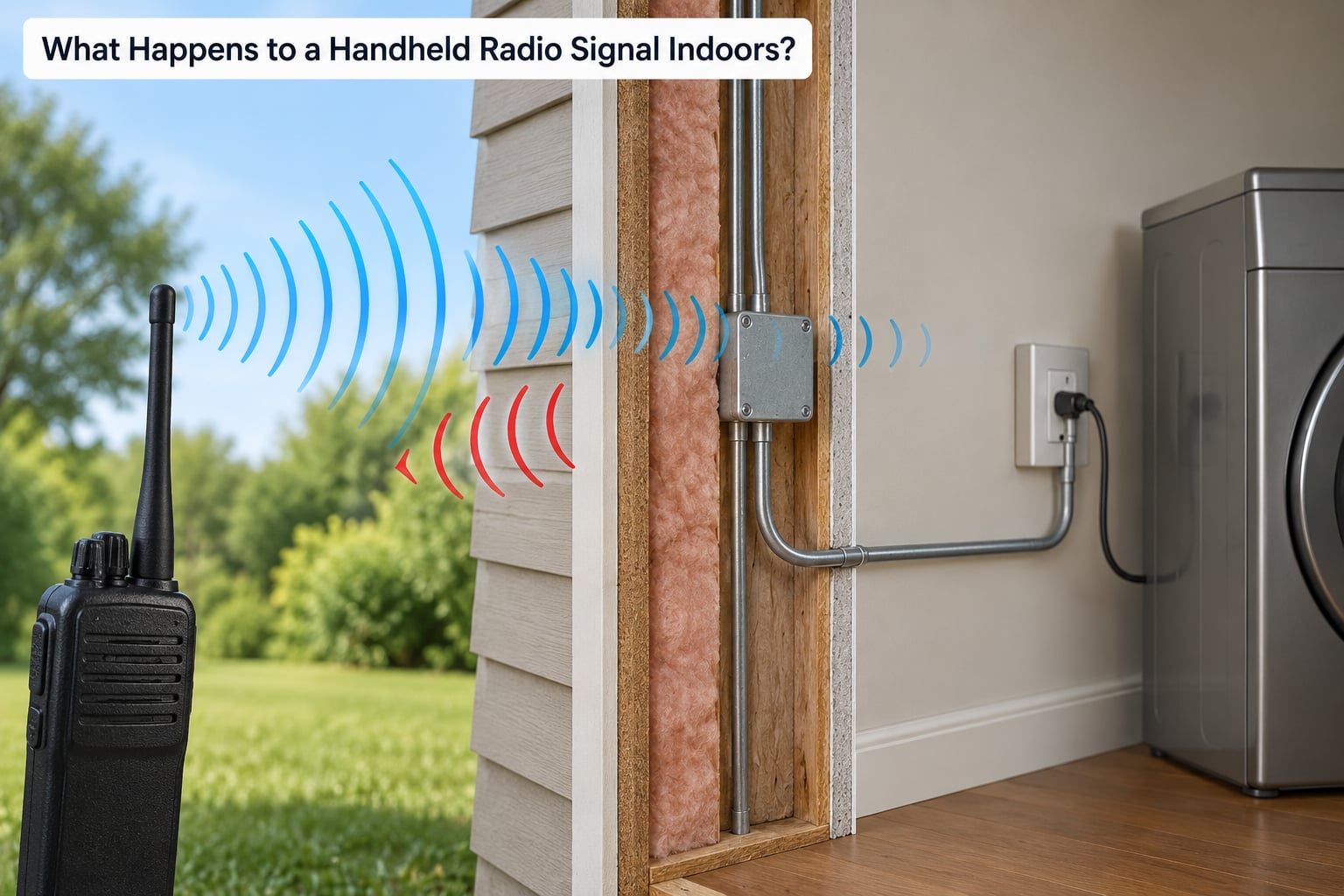
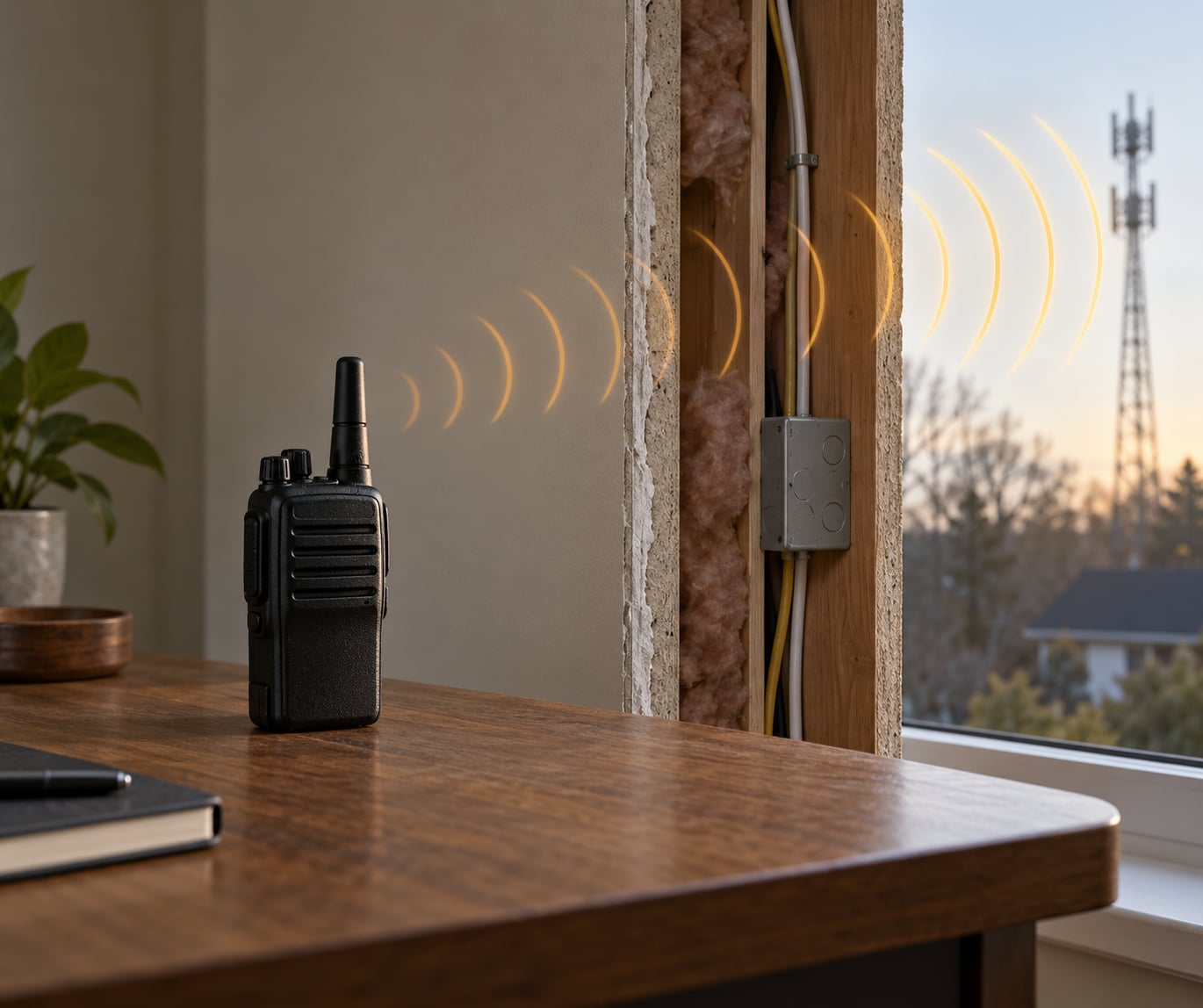
Outdoors, a handheld hears a mostly direct signal: the repeater or base station, the line of sight between you, and not much else. Indoors, the direct path is usually gone. What reaches the antenna instead is a handful of weaker reflected paths bouncing off floors, ceilings, furniture and walls, arriving from different directions at different delays.
That combination has two effects. The signal gets weaker because energy is absorbed by conductive and damp materials on the way in. It also gets noisier because the receiver is trying to decode a moving sum of reflections rather than one clean path, and because everything inside the building is generating interference of its own.
Line of sight, the phrase that dominates outdoor antenna talk, stops being the deciding factor once you step indoors. Diffraction around obstacles and multipath reflections take over, along with the much simpler question of how much material stands between the transmitter and your whip.
Shortwave is a different animal again. Below 30 MHz the ionosphere does much of the work, and ordinary walls are far less of an obstacle relative to the wavelength. Doors, floors and multiple floors of a building rarely block a shortwave signal completely, though interior electrical wiring and metal plumbing still take their toll on reception quality and noise.
Why Your Handheld Radio Antenna Performs Poorly Indoors
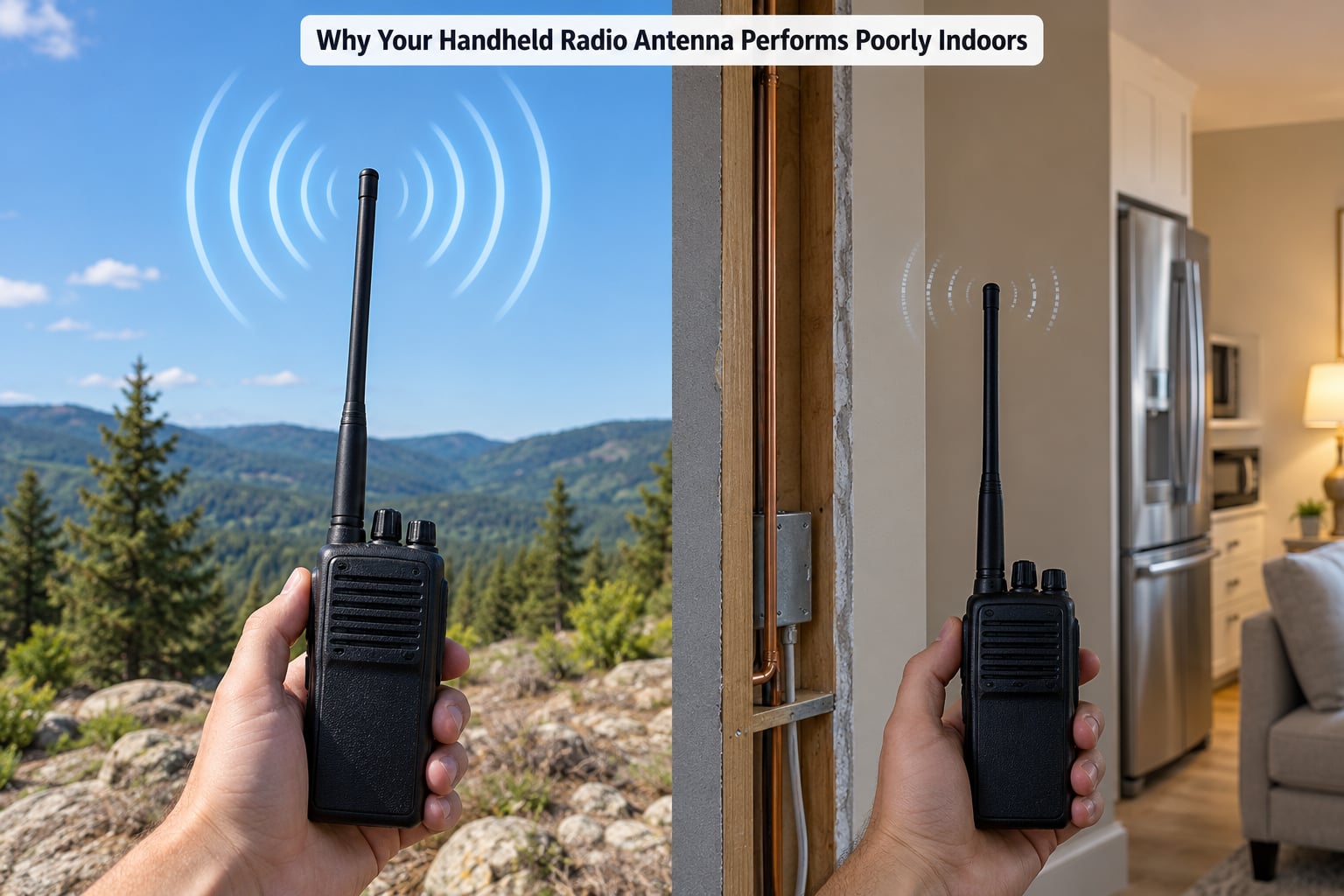
A rubber duck antenna is a shortened quarter-wave element with a loading coil that lets a quarter-wave resonance fit into a stubby whip. It only works efficiently because something conductive sits beneath it. Indoors, that something is distorted, and the whip is detuned before the signal ever reaches the receiver’s front end.
Why Do Walls, Wiring, and Furniture Make Reception Worse?
Every layer between you and the station costs signal, and the cost is wildly different by material. Wood and drywall are close to transparent at these frequencies. Reinforced concrete, metal cladding and coated glass are not, and the gap between those two groups is where indoor coverage gets decided.
| Building material | Typical loss per barrier |
|---|---|
| Wood-framed wall with drywall | 2 to 6 dB |
| Single-pane window glass | 3 to 6 dB |
| Low-E or laminated coated window | 10 to 25 dB |
| Brick veneer or concrete block wall | 6 to 15 dB |
| Poured concrete wall or floor slab | 10 to 20 dB |
| Reinforced concrete with rebar, or steel framing | 20 to 40 dB |
| Metal-clad wall, steel door, elevator shaft | 20 to 40 dB |
| Foil-backed insulation or radiant barrier | 20 to 30 dB |
| Mirrored or full-glass partition | 10 to 20 dB |
These are ranges, not constants. A single stud wall costs you a few dB, which is nothing. Five of them stacked between you and a repeater is the difference between full quieting and a noisy floor. Add the loss of a coated window and a metal back door and you can lose 40 dB without leaving the room, and 40 dB is a factor of 100 in power.
Two indoor materials catch people out. Electrical wiring looks harmless until you remember it is a grid of conductors at exactly the scale of the wavelength. Plasma and LED lighting, dimmers, switching power supplies and variable-speed fans add broadband interference that raises the noise floor under the whole band rather than blocking a single channel. That noise is why the radio sounds static even on a frequency where a nearby outdoor receiver hears a clean signal.
Your body adds a third layer. Holding the radio against your chest, clipping it to a belt inside a case, or setting it on a metal desk changes the antenna environment every time you move. Operators describe hearing a station clearly at the kitchen table and losing it from the same spot with the radio in a pocket.
Why Does Holding or Touching the Antenna Change the Signal?
Contacting the whip adds capacitance and a larger conductive surface to the antenna system, which partly restores the ground plane it lost. That is why people notice a radio improves when they touch the antenna, and it is a reliable sign the original problem was body and chassis loading rather than a dead radio.
The effect is also why a handheld held at an odd angle performs worse than one held upright. A vertical whip needs a roughly vertical incoming wave to avoid polarization mismatch. Tilt it 45 degrees toward a window and several dB disappear before any building material is considered. Holding the radio at chest height with the antenna near your shoulder is one of the worst positions available.
There is a second reason to keep clear of the antenna: RF burns. On higher power handhelds, a finger bridging the whip and the ground contact can create a small RF current through the skin. Not dangerous in normal use, but a good reminder that the whip belongs above the hand, not between the fingers.
Frequency Choice: VHF and UHF Indoors
VHF is the better penetrator of heavy masonry, while UHF copes better with clutter, small obstacles and reflective indoor spaces. Neither wins everywhere, which is why band choice is a decision to test rather than an answer to memorize.
| Factor | VHF around 146 MHz | UHF around 446 MHz |
|---|---|---|
| Wavelength | About 2.0 m | About 0.7 m |
| Heavy masonry and rebar | Lower loss | Higher loss |
| Clutter and small obstacles | More shadowing | Better tolerance |
| Multipath indoors | Smoother reflections | Richer reflections, more fading |
| Noise behaviour | More affected by impulse noise from electronics | Higher internal noise floor, wider usable bandwidth |
| Quarter-wave whip length | 43 to 55 cm | 16 to 19 cm |
| Best indoor fit | Simplex across open floors, rural weak-signal work | Campus and in-building talkgroups, repeater access |
A practical note from the field: if a talkgroup or repeater group exists in your building on one band and not the other, choose the band your operators are actually on. A marginal 70 cm signal to a station you use daily beats a strong 2 m signal to a channel nobody monitors.
How to Tell Whether the Problem Is the Radio or the Location
Run these six checks in order before spending a cent. They separate a broken antenna system from a building that simply will not pass the signal.
- Go outside. Stand in the yard or the parking area with the same battery and the same antenna. A radio that works out there but not in the room has a location problem, not a hardware problem. This single test resolves the majority of cases.
- Change position in place. Walk to a window, then to the hallway nearest an exterior wall, then one floor up or down. Note which spot is best. If reception changes sharply with position, propagation is your limit.
- Compare heights. Put the radio on a table, a shelf, and the top of a filing cabinet. If raising it 1.5 m changes the reading, antenna height was part of the problem all along.
- Watch the S-meter while talking. Note the reading with the whip vertical, tilted 45 degrees, and held against your chest. A large swing between positions confirms body loading.
- Try a second antenna or a second radio. A borrowed whip costs nothing and answers the antenna question immediately. If a different antenna behaves identically, the antenna is not the issue.
- Check power and the battery. A tired pack sags under transmit current and drags the supply down, which reduces power output and can corrupt receive audio. Charge it fully and retest before anything else.
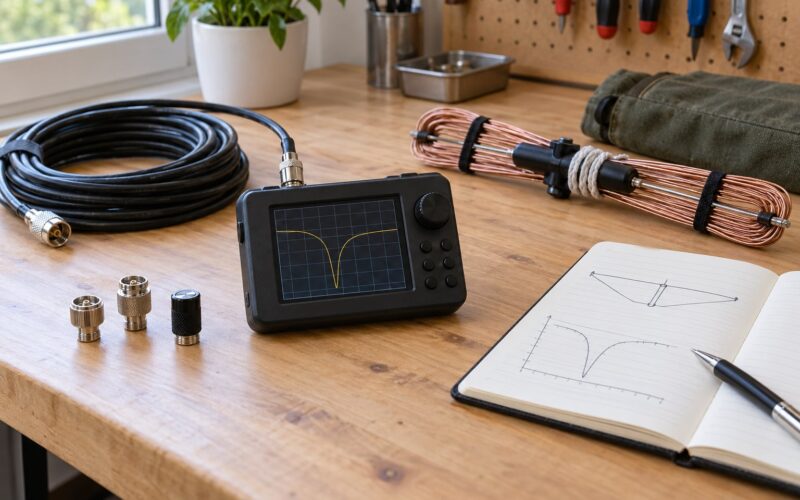
For the hardware side, a standing wave ratio check separates a mismatched antenna from a healthy one. Most inexpensive handhelds do not report SWR accurately, so use a dedicated SWR meter or a vector network analyser if you want a number you can trust.
| Reading | What it means | What to do |
|---|---|---|
| 1.0 to 1.5 | Close match, nearly all power radiated | Nothing |
| 1.5 to 2.0 | Usable, and typical for a stock rubber duck | Acceptable |
| 2.0 to 3.0 | Meaningful reflected power, reduced range and receive sensitivity | Fit a tuned whip and recheck with an external meter |
| Above 3.0 | Likely fault: bent whip, corroded connector, damaged coax | Stop transmitting and replace the element or connector |
A whip bent 15 degrees is enough to move it off resonance, and operators in ham and GMRS forums regularly report restoring reception simply by straightening one. Look also for a connector turned slightly loose, a case that presses on the antenna base, or a coax run pinched in a door. On a handheld the whole antenna system is usually one part, so a visual check covers most fault finding.
What Can You Do to Improve Indoor Reception?
Position first, equipment second. In almost every building, the free changes outperform an antenna purchase.
- Move to a window on the side facing the station. Even a coated window beats a solid interior wall, because it replaces a large lossy barrier with a smaller and partly transparent one.
- Keep the whip vertical and away from your body. Sit or stand where the antenna is above shoulder level, clear of the torso, and do not clip the radio to a belt inside a case.
- Get the antenna higher within the room. A shelf near the ceiling can beat waist height by a large margin, particularly in a single-storey building.
- Pick a room with an exterior wall. Hallways and stairwells are often better than the middle of a building because they have fewer layers on one side.
- Move a floor. In multi-storey buildings, one floor up or down frequently changes results more than any antenna change. So does the top of a stairwell.
- Switch off nearby noise sources. Dimmer switches, LED lamps, plasma televisions, switched-mode power supplies and motors are quick to test by unplugging them one at a time.
- Use the lowest power that still gets through. Full power on transmit drains the battery fast and heats the radio, and it adds nothing to a receive problem. Low power plus a working repeater usually beats high power simplex indoors.
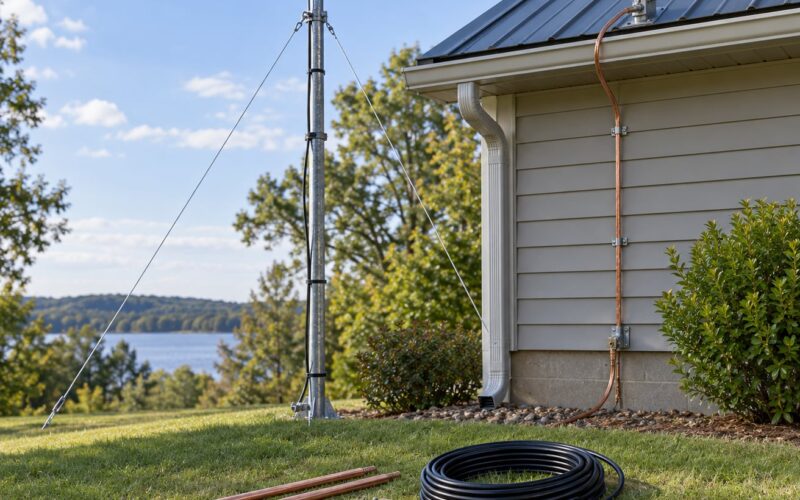
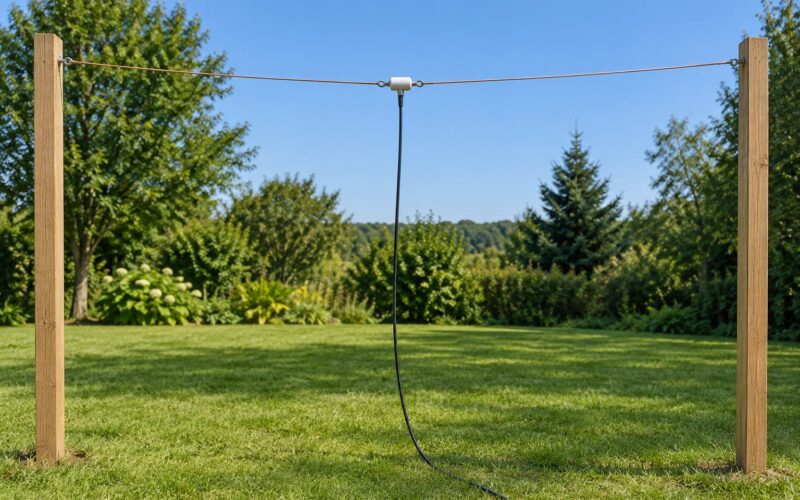
When free changes run out, the middle tier between a handheld whip and a repeater is a small indoor antenna system: one ceiling or wall-mounted omnidirectional fed by low-loss coaxial cable such as LMR-400, with the radio connected through an adapter. It lifts the antenna to a fixed height away from the building’s worst material and gives a clean vertical polarization. Public safety departments have long used simple two-antenna indoor arrangements, one outside and one inside, fed by a booster, to get handheld coverage inside buildings where nothing portable works.
Beyond that, the answer is infrastructure rather than antenna: a local repeater, a cross-band repeater that lets you reach VHF talkgroups with a UHF handheld, or a club station someone on the group can reach from a rooftop.
Do Longer Antennas Always Work Better Indoors?
No, and the reason is length rather than gain. A quarter-wave monopole is resonant at a specific frequency, so a longer whip only adds gain if it is near a new resonance or is made a dual-band element. At 146 MHz, 10 extra centimeters is more than 20 percent of the required length.
| Frequency | Wavelength | Quarter-wave |
|---|---|---|
| 136 MHz | 2.21 m | 55 cm |
| 146 MHz | 2.05 m | 51 cm |
| 150 MHz | 2.00 m | 50 cm |
| 174 MHz | 1.72 m | 43 cm |
| 400 MHz | 0.75 m | 19 cm |
| 446 MHz | 0.67 m | 17 cm |
| 470 MHz | 0.64 m | 16 cm |
Shortening an antenna raises its resonant frequency, and trimming by roughly 2 percent tunes up a VHF whip, about 5 percent on UHF. That is the difference between a long flexible antenna that has been made to resonate correctly and a long flexible antenna that is simply too long, which can be worse than a well-matched stubby.
Operators report that replacing a short stock stubby with a longer band-specific whip is often the single biggest improvement available, frequently the difference between unusable and reliable. That result appears most often when the original stubby is a compromise wideband element. Such an element is stretched to cover a wide range with a single coil, which costs gain and bandwidth and makes it more sensitive to detuning from body loading. A band-specific whip restores the resonance and the gain.
Two cautions. A whip longer than the radio is tall reverses the polarization balance and can put the antenna closer to your head than you want. And no whip of any length adds back the dB that reinforced concrete took away. Longer helps when the fault is resonance or available gain. It does nothing when the fault is the building.
A Quick Troubleshooting Checklist
- Test the same radio and antenna outdoors. Different result means location, not hardware.
- Inspect the whip for bends, cracks or a kinked base, and tighten the connector by hand only.
- Hold the antenna vertical, above shoulder height, and away from your torso. Listen for the difference.
- Move to a window facing the station, then one floor up or down.
- Unplug nearby electronics one at a time and watch the noise floor.
- Borrow a different antenna or radio and compare. Identical behaviour points away from the antenna.
- Fully charge the battery and retest before buying anything.
- Write down what you changed and what happened. After five tests, memory stops being reliable.
That last step is the one people skip. Two minutes of notes tells you which change actually moved the needle, and saves you buying a second antenna for a problem you never had.
Frequently Asked Questions
Why does my handheld radio work outside but not inside?
Because the building, not the radio, is the variable. Outdoors the whip has clear space and a clean ground plane formed by the chassis and your body. Indoors, walls, wiring, appliances and reinforced concrete absorb the signal and detune the antenna at the same time. If the same radio and battery work outside and fail inside, the antenna is almost certainly healthy and the location is the limit.
Does a longer antenna always improve indoor reception?
Not always. A quarter-wave whip is resonant at one frequency, so extra length adds gain only near a new resonance. Shortening tunes upward, roughly 2 percent on VHF and 5 percent on UHF. A longer band-specific whip often helps a lot against a short compromise stubby, but no length restores the dB that reinforced concrete removed, and a very long whip can sit uncomfortably close to your head.
Is a window a good place to use a handheld radio?
Usually yes, and it is the first thing to try. A window replaces a large lossy barrier with a smaller, partly transparent one, so you recover much of the loss that wall caused. Coated and laminated low-E glass is far more resistant than single-pane glass, so position matters as well as the window itself. Stand close to the pane on the side facing the station and keep the antenna vertical.
Can walls block shortwave signals completely?
Rarely. At shortwave frequencies the wavelength is long compared with ordinary building materials, so walls, doors and floors take relatively little of the signal. The ionosphere does most of the work in that band. Interior electrical wiring, metal plumbing and foil-backed insulation still hurt reception quality and raise the noise floor, so shortwave listeners indoors usually get a workable but noisier signal rather than nothing at all.
How do I know if my radio antenna is damaged?
Look first at the whip. A bend of 15 degrees, a crack near the base or a kinked element is enough to move it off resonance and operators regularly recover reception by straightening a whip. Check that the connector is tight and the coax or adapter is not pinched. For a number, use an external SWR meter: readings above 3.0 point to a real fault, while 1.5 to 2.0 is normal for a stock rubber duck.
Will an external antenna always solve poor indoor reception?
No. An external antenna only helps if it is mounted in a better location than the handheld already is. One on the roof or a mast outside the building does help far more than a whip indoors, but a poor feedline or a badly placed indoor distribution antenna can lose everything it gains. Check that the coax is low loss, the run is short, and the antenna sits away from the building metal before buying anything.
Conclusion
Start by taking the same radio and the same antenna outside. If it works there, your handheld radio antenna is fine and the building is the limit. Next, move to a window facing the station, hold the whip vertical and clear of your body, and raise it as high as the room allows. Only after that is it worth spending money, and the right spend is usually a band-specific whip or a repeater rather than a longer mystery accessory.