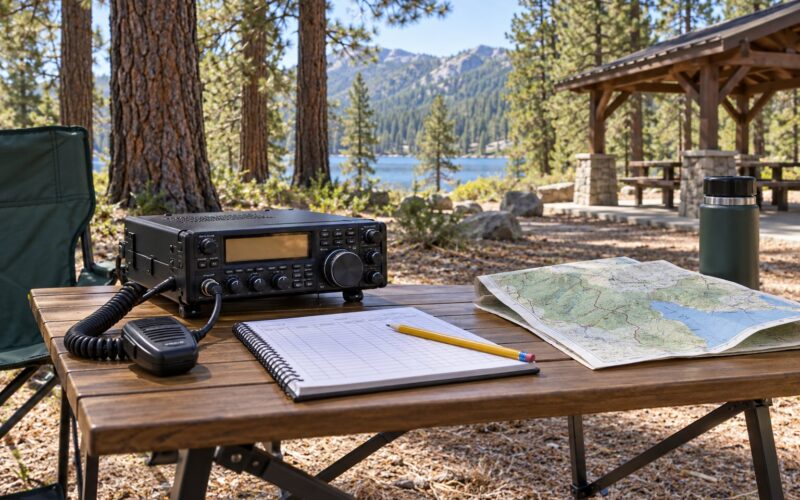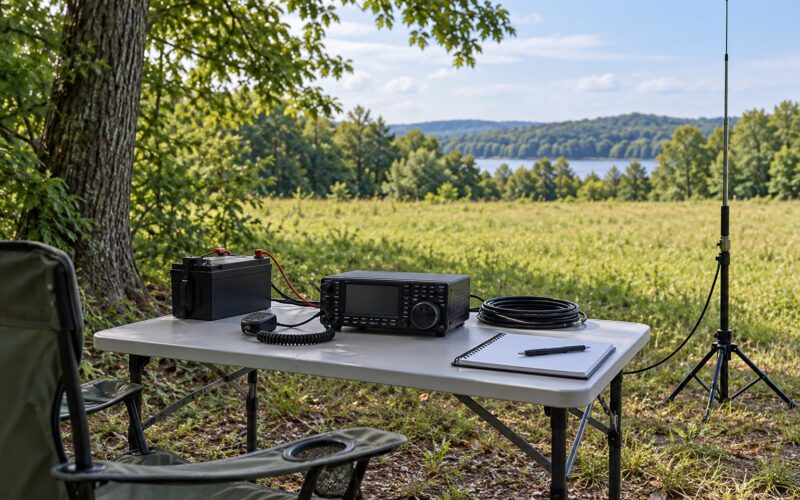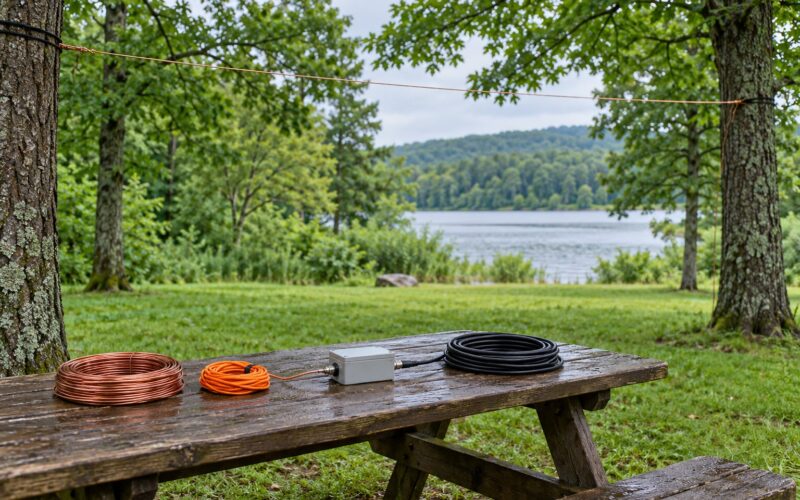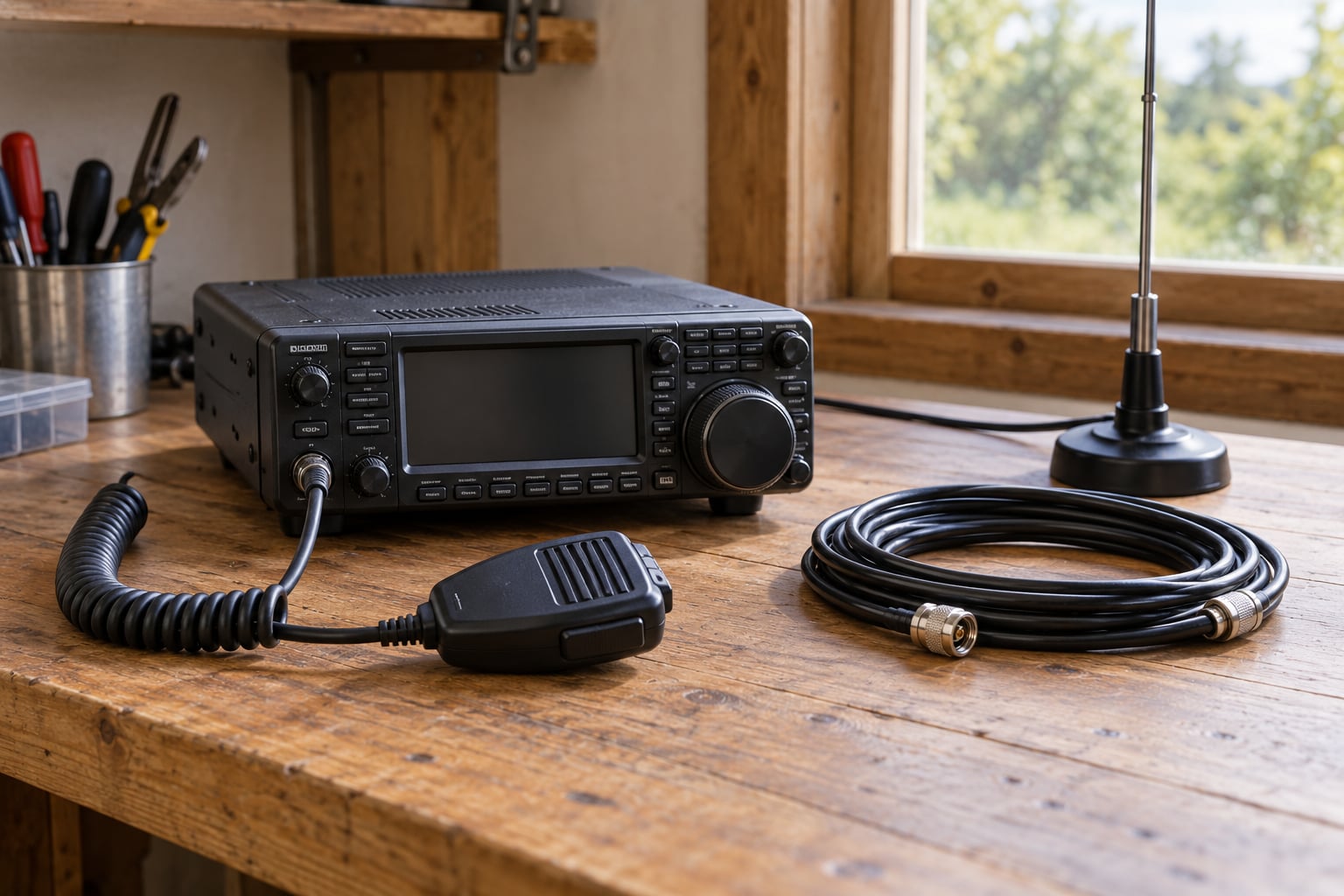
Getting on 6 meters is easier than most new operators expect. The band runs 50.000 to 54.000 MHz in the US, a Technician-class license already covers every watt you can legally transmit there, and listening costs nothing at all — so you can learn the band before you spend a dollar on gear. This guide walks through how to get started on 6 meters: what gear you actually need, which frequencies carry the action, how to hang an antenna, and how to make your first contact without wasting a weekend.
Spend about an hour reading this and the rest of your first month on the air.
Table of Contents
- 1What You Need to Get Started on 6 Meters
- 2The radio
- 3The antenna
- 4The supporting gear
- 5Step-by-Step
- 6How to Get Started on 6 Meters Without a Big Radio
- 7Which Frequencies Should You Listen On?
- 8Set Up an Antenna That Suits Your Location
- 9Learn the Modes and Make Your First Contact
- 10Understand 6-Meter Propagation and Timing
- 11Common Mistakes
- 12Buying a big antenna before you know what you need
- 13Expecting the band to be busy all the time
- 14Ignoring polarization
- 15Trying to overpower the band
- 16Transmitting without listening first
- 17Forgetting identification
- 18Frequently Asked Questions
- 19Do I need a special license to operate on 6 meters?
- 20What is the best antenna for getting started on 6 meters?
- 21Why is the 6-meter band quiet even though other bands are active?
- 22Can I use a handheld radio on 6 meters?
- 23What is the best time to listen for 6-meter signals?
- 24How much power do I need for portable 6-meter operation?
- 25Conclusion
What You Need to Get Started on 6 Meters
Six meters rewards beginners more than any other VHF band, mainly because a simple setup performs well. Here is the honest minimum list, and what you can skip for now.
The radio
Any receiver or transceiver that covers 50.000–54.000 MHz will do for receiving. Most modern HF transceivers include a 6-meter section, so if you already own an HF rig, look at the spec sheet before buying anything — you may already have the band and not know it. That radio also gives you SSB and CW, which is where the interesting weak-signal and DX work lives.
6-meter-capable handhelds are genuinely rare, and that trips up a lot of newcomers. Most VHF/UHF handhelds stop at 2 meters. Check the frequency range printed on the radio, not the marketing on the box.
A transverter is the third option: it converts 6-meter signals down to an HF frequency your existing rig can transmit and receive. It works well, it adds complexity, and it is rarely the right first purchase.
The antenna
You need exactly one antenna, and it needs to be resonant near 50 MHz. A single half-wave dipole cut for 6 meters is about 9 feet 4 inches (142.5 cm) end to end. That is a short wire, easy to hang from a porch rail, a tree branch you have permission to use, or a fiberglass whip over a car roof.
Frequency coverage matters more than brand. Anything that works around 50.1 to 51 MHz will hear FM repeater traffic; something broadband enough to reach 53 MHz will not miss the SSB and CW segments.
The supporting gear
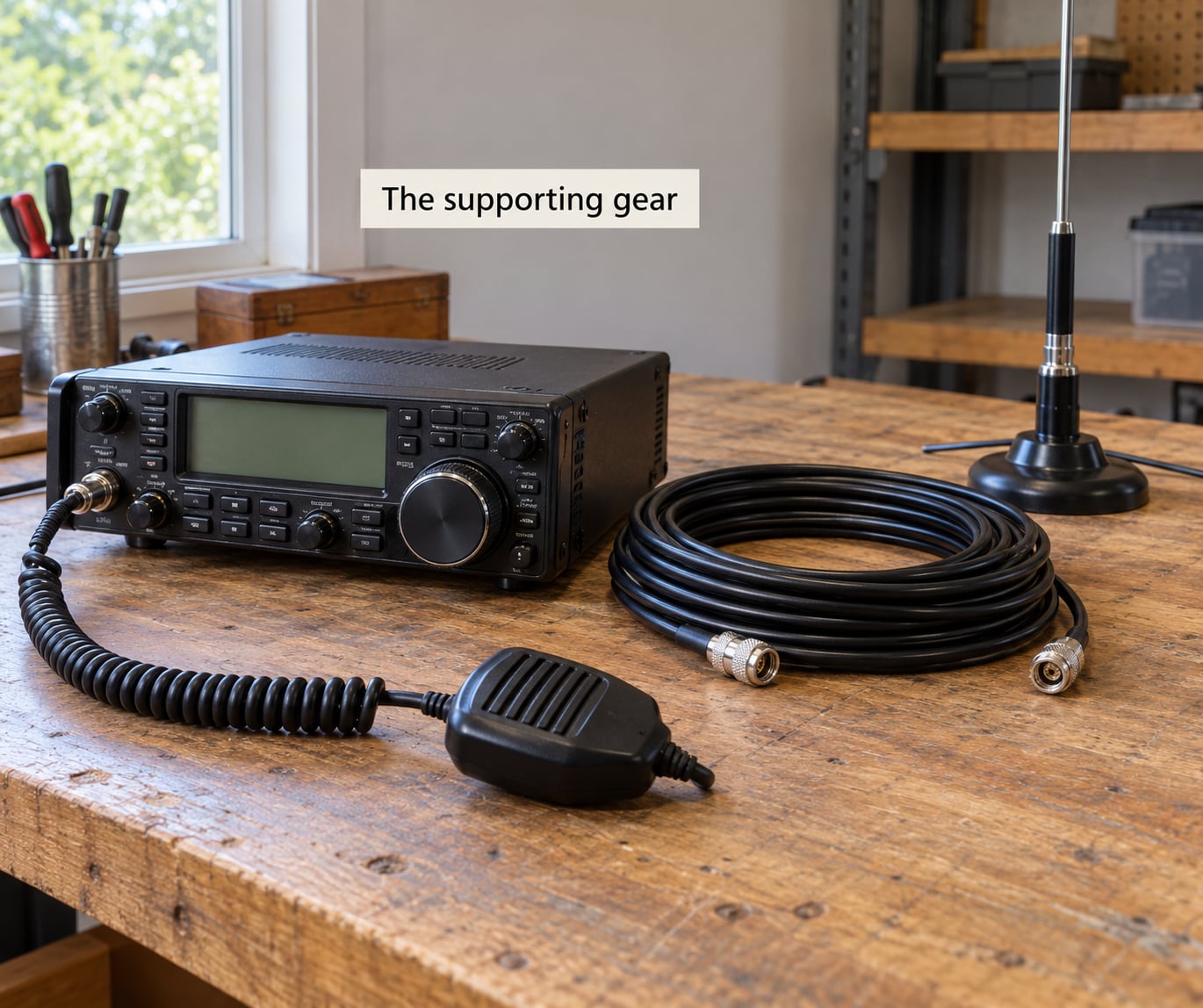
RG-8X or RG-213 coax, a feedpoint choke or common-mode choke if you are using a vertical, and a low-loss connector. Keep the run short. At 6 meters, feedline loss is not forgiving, and a 100-foot cable with a mediocre match on a 10-watt signal is a real loss of signal.
Not needed yet: an antenna tuner, an amplifier, a rotator, and any specialty 6-meter hardware. A tuner helps if your antenna is badly matched, but it works best at the feedpoint rather than at the radio, and the better answer is usually to fix the antenna.
The one thing worth buying early is a signal reference. A 6-meter FM simplex frequency or a local repeater lets you test your receiver, and if you hear nothing there, your antenna or coax is the problem, not the band.
Step-by-Step
Work through these in order. Skipping ahead to step four before your antenna is resonant is the single most common beginner mistake.
How to Get Started on 6 Meters Without a Big Radio
Start by listening. A wideband receiver, an SDR dongle that covers VHF, or any HF transceiver with a 6-meter section will show you what the band is doing right now.
Tune the FM segment and note the strongest signals, then write down the frequency and whether you heard a call sign. Those notes tell you three things: whether your antenna works, whether your receiver works, and whether the band is active today.
If you have no receiver at all, a used 6-meter FM handheld is the low-cost way in, though availability is patchy. A dual-band 2m/6m mobile or base radio covers the same ground and usually doubles as a good 2-meter rig. Either way, listening first tells you whether you would enjoy the band before you commit to a station.
Which Frequencies Should You Listen On?
Here is the 6-meter band plan for US operators, the part that confuses new arrivals most.
| Frequency | Mode | What you will find |
|---|---|---|
| 50.000–50.100 MHz | CW | Morse code, including weak-signal and moonbounce activity |
| 50.100–50.300 MHz | SSB (USB) | Long-distance phone, often called the DX window |
| 50.300–50.800 MHz | Mixed | FM simplex, beacons, ATV, ISS and satellite voice downlink |
| 50.790–50.990 MHz | RC control | Radio-control model aircraft sub-band, not for amateur use |
| 51.000–54.000 MHz | FM | Repeaters and local FM voice |
The US FM calling frequency, where operators look for anyone to talk to when nobody is calling CQ, is 50.313 MHz. It is a small slice of a wide band, so park there when you want company.
For repeaters, find your local club’s repeater list or use a national directory, then check that a machine actually exists before you transmit on it. Repeaters have tone requirements and offsets that differ by region. Learn the plan from your national society — ARRL in the US, RSGB in the UK — rather than trusting a forum post, and remember that Region 1 operators use a narrower 50.000–52.000 MHz allocation than the US and Canada.
Set Up an Antenna That Suits Your Location
Pick the antenna to match what you want to do, not what looks impressive on a roof.
For local FM and repeaters, a vertical works. A ground-plane vertical with a couple of radials, or a J-pole, gives you omnidirectional coverage and steep radiation, which matches how repeater stations radiate.
For SSB and CW, a horizontal dipole or a small Yagi wins. Horizontal polarization is what long-distance paths use, and the height above ground matters more than the antenna design. A dipole strung at 30 feet on a quiet roof will beat an expensive beam at 12 feet over a noisy roof.
For portable operating, a flexible whip or a small OCFD-style antenna on a mast gives you something that works in any direction without a rotator. One radioreference forum regular noted that an omnidirectional beat a beam for portable work, because you rarely know where the station you want is.
One antenna cannot cover 6 meters and 2 meters properly. The wavelengths differ by a factor of three, so the same boom is a resonant 6-meter element and a long, useless 2-meter element. Separate antennas is the answer, and that point comes up in every antenna forum.
Polarization is the trap that catches beginners. A vertical ground plane talking to a local vertical repeater is a matched pair. Point it at regional SSB stations running horizontal antennas and you lose signal to cross-polarization loss, which can approach 20 dB — a factor of 100 in received power. Matching polarization is free; correcting it afterward is not.
Learn the Modes and Make Your First Contact
FM voice is where you make your first contact. It sounds like your local VHF/UHF repeater, and the procedure is simple.
- Tune a repeater or the calling frequency and listen for two full minutes before keying anything.
- Note the callsign of anyone you hear, so you can call them by name later.
- Press the PTT, give your call sign and the station’s call sign, and keep it short.
- Say your name, city, and rig in one breath. That is enough for a first exchange.
- Ask how the signal is, and release the PTT promptly so others can key up.
- Log it: date, time in UTC, both call signs, mode, frequency, and signal report.
SSB and CW come after that. On SSB you transmit only when you can hear the other station, you lower the frequency to find their natural voice pitch, and you do not use a PTT switch. On CW, the lower end of the band fills with high-speed operators working weak signals, and a straight key plus a few weeks of practice gets you on the air there too.
Digital modes like FT8 run through software such as WSJT-X and can pull up signals that would be inaudible by voice. They also need accurate time, so a GPS-disciplined clock matters more than people expect.
Identify your transmission the way you would on any band: call sign, and in US practice station identification at least every ten minutes during a transmission or series of transmissions.
Understand 6-Meter Propagation and Timing
Understanding propagation is what turns 6 meters from a disappointment into the best hobby in radio. For local work, 6 meters behaves like 2 meters: line-of-sight and repeaters. Beyond that, the ionosphere does things no other VHF band does.
Sporadic E — often called Eskip — is the big one. Ionized patches in the E layer of the ionosphere, which form about 60 miles up, reflect signals that should bounce straight back into the ground. When it works, a 10-watt station can work 1,000 miles or more. It peaks near the solstices, so late May through July is the main season, with a smaller window around the winter solstice.
F2 layer paths, the same mechanism that carries HF around the world, occasionally work on 6 meters during high solar activity, and when they do the distances become continental.
Tropo, short for tropospheric ducting, is a temperature inversion that traps radio waves near the ground. It is most common along the US coasts in late spring and summer, and it regularly delivers 200- to 300-mile contacts that feel like magic until you learn the mechanism.
Aurora and Earth-Moon-Earth moonbounce are real on this band too, but treat them as later goals rather than a first-week plan.
So the quiet weeks are normal. If the band has been silent, check a known-good signal before you blame propagation — and remember daytime behavior differs sharply from evening conditions, when absorption drops and the band often sounds more alive.
Common Mistakes
Nearly every beginner error on 6 meters has a cheap fix.
Buying a big antenna before you know what you need
The advice in the r/amateurradio 6-meter microthread was consistent: build something simple first. One operator put it plainly — “A simple six meter dipole isn’t too hard to construct.” A dipole or a single vertical will carry you for months. Revisit hardware once you know whether your interest is FM, weak signal, or DX.
Expecting the band to be busy all the time
Newcomers read about the magic band and still don’t know what to expect day to day. It is quiet far more often than not. Judge the band on a good June weekend, not on a random Tuesday in February.
Ignoring polarization
Vertical for FM and repeaters, horizontal for SSB and CW. Using the wrong one on purpose or by accident is the most common reason a setup that works fine on FM sounds dead on SSB.
Trying to overpower the band
Forum consensus is that 10 watts is plenty when the band is open. Extra power does not open a closed band, and it does not fix a mismatched antenna. Add gain and height before you add watts.
Transmitting without listening first
Two minutes of listening tells you the band conditions, the offsets, and whether the frequency is already in use. It costs nothing and it prevents most on-air embarrassments.
Forgetting identification
Transmit your call sign at the start of a transmission and at least every ten minutes in US practice. It is required, and it is what other operators key on when they want to know who is calling.
Two habits will speed everything up. Keep a paper or digital log with UTC times, because the value of a DX contact depends on when it happened. And check the band before you sit down: DX-cluster software and contest logs show real-time spots, so if Spain is being worked into New England, you already know the band is open.
Frequently Asked Questions
Do I need a special license to operate on 6 meters?
No. The 6-meter band at 50.000 to 54.000 MHz falls entirely within US Technician-class privileges, so passing the entry-level exam gives you every frequency and all modes on it, with no upgrade required. You do need a license before you transmit at all, and you must identify your station the way you would on any other band. You can receive without a license.
What is the best antenna for getting started on 6 meters?
A single half-wave dipole cut to about 9 feet 4 inches is the best starting point for most people. It is cheap, easy to match, and works for both FM and SSB. Choose a vertical ground plane instead if you mostly want local repeater coverage, since it matches how repeaters radiate. Put the antenna as high as you reasonably can; height beats gain at this frequency.
Why is the 6-meter band quiet even though other bands are active?
Because HF bands mostly rely on the F2 layer, which is active around the clock, while 6 meters depends on shorter-lived conditions such as sporadic E. Sporadic E forms in unpredictable patches and peaks near the solstices, so the band is quiet for weeks at a time and then suddenly busy for a few days. Tropo along a coastline can open it at any time. Silence is the normal state.
Can I use a handheld radio on 6 meters?
Yes, but options are limited. Most handheld VHF/UHF radios cover only 2 meters and 70 centimeters, so check the printed frequency range before buying. 6-meter-capable handhelds exist and are generally FM-only, which is fine for local work but not for SSB or CW. Many of your 6-meter SSB contacts will come later, from an HF transceiver with a 6-meter section.
What is the best time to listen for 6-meter signals?
Listen in the late afternoon and evening, when ionospheric absorption is lower and more paths open. Sporadic E season runs roughly from late May through July, with a smaller window near the winter solstice. For tropo, watch coastal areas during stable, humid summer weather. Weekend mornings during the June VHF QSO Party are reliably busy if you want a band that is guaranteed to be alive.
How much power do I need for portable 6-meter operation?
Five to ten watts is plenty for portable work, especially from a hilltop with a clear line of sight. Because 6 meters is line-of-sight, height and a clear horizon do more for your signal than extra power does. When sporadic E is open, a modest setup works paths that a heavier station would struggle with. Spend your effort on the antenna site rather than the amplifier.
Conclusion
Start by listening. Put up one antenna — a 9-foot-4-inch dipole or a simple vertical — and check 50.313 MHz and a local repeater to confirm your station hears known signals. When you are ready to transmit, identify yourself, keep it short, and log the contact.
That is genuinely all it takes to get started on 6 meters in 2026. Everything else, beams, amplifiers, moonbounce, is something you add once the band has hooked you.