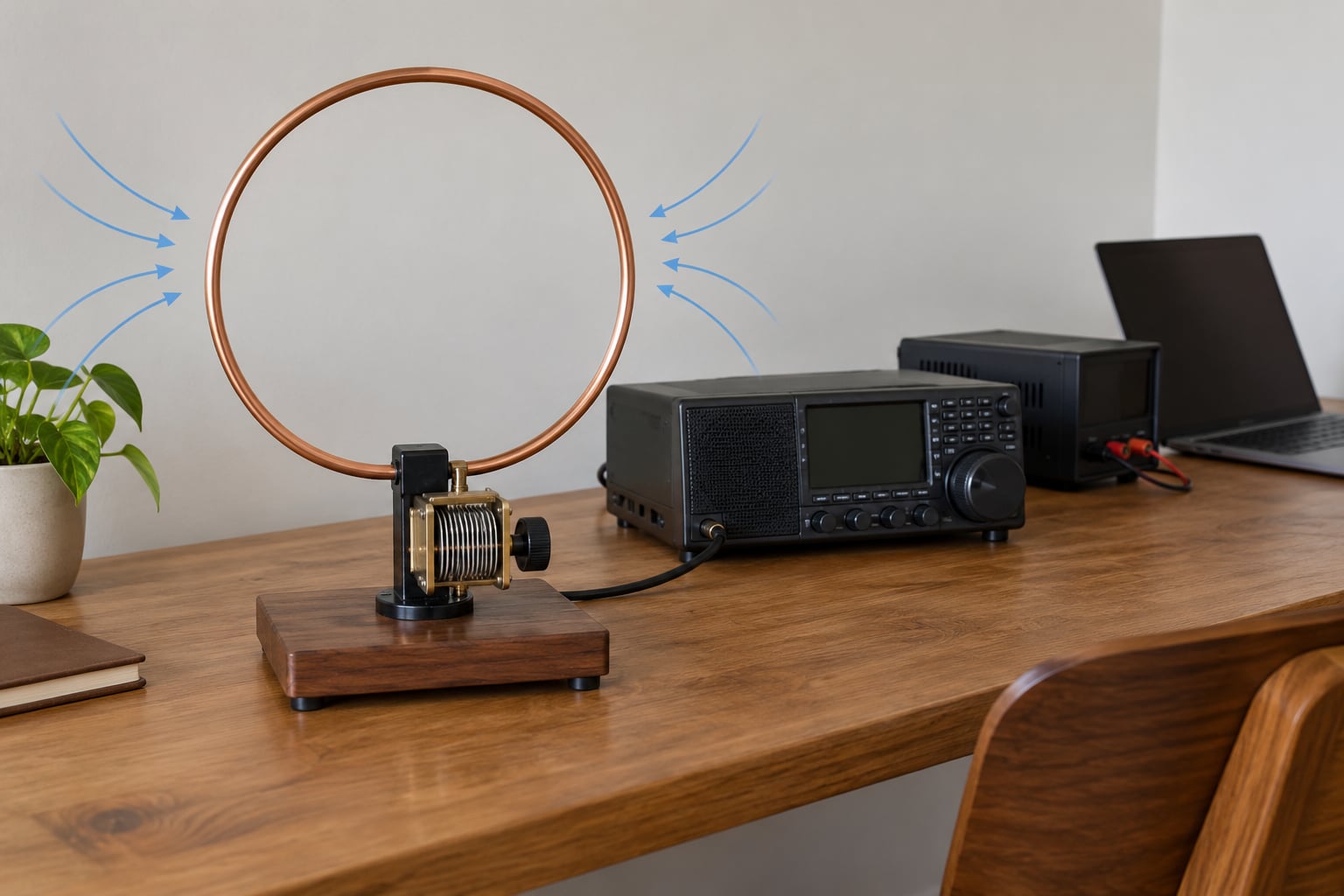
A magnetic loop antenna reduces noise because it responds to the magnetic field of an incoming wave while an electrostatic shield blocks the electric field, and most local interference radiates almost entirely as an electric field. Add a sharply tuned, high-Q response and a rotatable null, and the noise floor drops without touching the receiver.
That is worth more than it sounds. In an apartment, a dense city block or a portable setup, the limit on weak-signal reception is usually the noise underneath the station, not the station itself. Getting a clean band can turn an unreadable signal into a workable one.
What follows is the mechanism, honestly stated — including where the magic stops, because a loop that gets credited with eliminating QRM it never touched is how people end up disappointed.
Table of Contents
- 1Why a Magnetic Loop Antenna Reduces Noise
- 2How the loop turns radio waves into a signal
- 3How the electrostatic shield keeps working
- 4How bandwidth limits the noise a loop receives
- 5How directional nulls reject local interference
- 6What kinds of noise can a magnetic loop reduce?
- 7What actually improves the signal-to-noise ratio?
- 8Common-mode current: the thing that undoes the advantage
- 9Why a quiet bearing does not always sound clearer
- 10How to get the most noise reduction in practice
- 11Move the loop away from the electronics first
- 12Tune on the station you actually want
- 13Rotate the loop and watch the meters, not your feelings
- 14Then choke the feedline
- 15Do not reach for a loop amplifier to fix noise
- 16When a magnetic loop is the wrong antenna
- 17Frequently Asked Questions
- 18Does a magnetic loop antenna reduce all types of interference?
- 19Why can a weak station still sound noisy on a magnetic loop?
- 20Does a magnetic loop work across the entire shortwave band?
- 21Can a magnetic loop replace a long-wire antenna?
- 22Do I need an antenna tuner to use a magnetic loop?
- 23Conclusion
Why a Magnetic Loop Antenna Reduces Noise
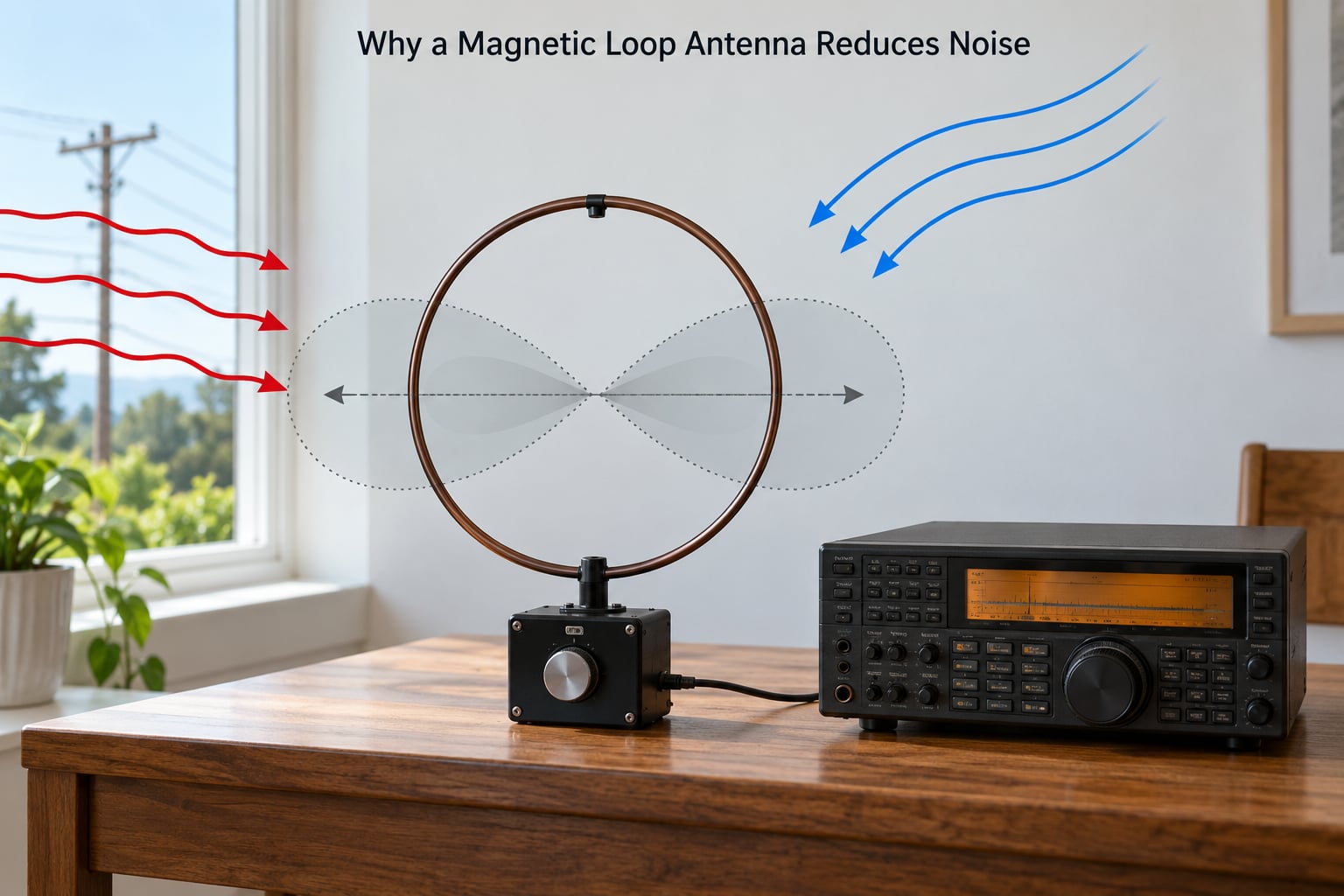
Four things stack up. The loop senses magnetic flux instead of electric voltage, a shield keeps most of the electric field out, the resonant circuit rejects energy far from its operating frequency, and the figure-eight pattern can be aimed so its null points at the offending source.
How the loop turns radio waves into a signal
A transmitting loop is a single turn of conductor, usually far smaller than a wavelength across, with a variable capacitor across it. Incoming radio waves push magnetic flux through the loop, and that changing flux induces a voltage around the turn.
Electrically, that makes the loop look like the secondary winding of a transformer with a one-turn primary: the whole antenna is a step-down transformer that turns a small induced voltage into something a receiver can use. The capacitor forms a resonant circuit with the loop’s inductance, and it works hardest right near that resonant frequency. Tune to 7.05 MHz and you get maximum coupling there; move to 3.6 MHz without retuning and the same loop is largely deaf.
How the electrostatic shield keeps working
Wrap the loop in a continuous conducting screen, with the screen itself electrically isolated from the loop, and something odd happens: the screen carries away the electric field while magnetic flux passes straight through it. A static electric field cannot drive current through a closed shield. The loop still receives, because magnetic field is not blocked by a Faraday screen in that way.
This is the reason a shielded loop is not a compromised antenna. It is a shorted turn as far as E-field current is concerned, and a transformer secondary as far as the signal is concerned. The best installations run the shield to ground and to the receiver chassis so that induced current has somewhere safe to go instead of into the feedline.
How bandwidth limits the noise a loop receives
Small loops are electrically small, which means low radiation resistance — often around 0.1 ohm — against losses measured in single-digit ohms. That mismatch produces a very high Q, and high Q means a narrow passband. Published designs land anywhere from a few kilohertz on the low bands to about 20 kHz at 14 MHz, which is a fraction of a typical SSB slice.
That narrow passband is a filter. Signals and noise well away from resonance are attenuated by the ratio of frequencies rather than picked up broadly. It does not delete noise inside the passband, and out-of-band rejection falls off gradually rather than at a brick wall, but it does mean the loop stops acting as a broadband pickup for everything happening on the band.
How directional nulls reject local interference
Because the loop is small compared with a wavelength, it does not behave like a point source. It behaves like an electrically short loop with a figure-eight pattern: maximum pickup broadside to the plane of the loop, near-zero pickup edge-on.
That gives you two nulls 180 degrees apart, and rotating the loop on its mount sweeps them around the compass. Point one at a noisy neighbour, a power line, or a building full of switch-mode supplies. Forum consensus keeps landing on the same advice: rotating the loop until the null covers the local noise source is the single biggest practical win most operators find.
One catch worth knowing: nearby objects change the pattern. Metal railings, rebar, a roof and the walls of a building all couple to the loop and shift the best angle, so the null you found last night may need finding again after a small reposition.
What kinds of noise can a magnetic loop reduce?
The honest answer is that a loop is selective about its victims. It goes after locally generated, electrically radiated interference, and it leaves alone noise that arrives as a genuine radio wave from far away.
| Noise source | Typical behaviour with a shielded magnetic loop |
|---|---|
| Switch-mode supplies, computers, LED drivers | Strong improvement. These radiate mainly as E-field and the shield plus null handles them well. |
| Motors, dimmers, fluorescent ballasts | Good improvement, especially with a null aimed at the device. |
| Nearby power lines and appliances | Good improvement at close range; less dramatic as distance grows. |
| RF leakage from local transmitters and building wiring | Often improved if it arrives by a different direction than the wanted signal. |
| Several broadcast carriers crowding one frequency | Partly helped. Selectivity helps, but strong carriers sit inside the passband too. |
| Atmospheric static (QSB, distant crashes) | Little change. It is a real arriving wave with both field components present. |
| QRM from other stations on the same frequency | No help. It is the desired signal mode, arriving from the same place. |
| Ground-wave and sky-wave fading | No help. Propagation effects are not antenna problems. |
Read that last group carefully. When listeners describe “the loop did not fix my noise,” the noise was usually atmospheric, was arriving from the same direction as the station they wanted, or was getting into the receiver by the feedline instead of the antenna.
What actually improves the signal-to-noise ratio?
The gain is relative. A loop does not destroy noise; it raises your wanted signal relative to whatever the receiver hears at that moment. That is why the same loop can be a huge win on one frequency and a disappointment on the next.
| Factor | What a tuned magnetic loop does | Why it changes your listening |
|---|---|---|
| Desired-signal coupling | Strong near resonance, weak off resonance | Tuning accuracy matters more than with a broadband antenna |
| E-field noise rejection | Shield blocks the dominant local noise mechanism | Largest single improvement in an apartment or noisy building |
| Bandwidth | Narrow; retune between bands and across a band | Only helps if your listening stays near the tuned frequency |
| Selectivity | High Q attenuates off-resonance energy | Improves crowding, but adds a tuning burden |
| Usable listening area | Broad nulls, sharp nulls | Pattern is broadside to the loop plane; rotate to hunt noise |
| Tuning requirement | Capacitor must be adjusted per frequency | Plan for remote tuning if you want to work a station |
One field report worth knowing: a listener comparing a 200 m loop on ground against a 100 ft version, using two common-mode chokes and a 3:1 balun, measured about 7 dB better signal-to-noise ratio averaged from 100 kHz to 30 MHz. Real numbers like that are more persuasive than any general claim.
Common-mode current: the thing that undoes the advantage
A coax shield is a ready-made antenna for every piece of noise in the building. If current flows on the outside of the coax, your beautifully shielded loop is connected to the receiver through a noisy wire, and all the theory stops mattering.
Two habits fix most of this. First, run a common-mode choke at the feedpoint, right where the coax leaves the loop, so any current on the shield is stopped before it can reach the cable run. Second, keep the coax short, or give it its own choke at the far end too, so the run through the building is not acting as an antenna of its own.
Forum advice on the balun that feeds the loop is genuinely mixed — 3:1, 4:1, 6:1, 9:1 and no balun all turn up in reports, and some operators insist the balun mattered little while the common-mode choke was everything. Treat that as your cue to experiment rather than to trust a ratio.
Why a quiet bearing does not always sound clearer
Sometimes you swap antennas, the noise drops, and the station still sounds rough. A few things cause that.
Receiver noise floor: if the receiver’s own noise is well above the antenna noise, a quieter antenna changes nothing. A modest improvement in antenna noise only shows up when the antenna noise is the dominant term.
Dynamic range: if a very strong local station sits on the same frequency, even a small amount of it drives the AGC and squashes everything else. That is overload, not noise, and the fix is filtering or distance rather than antenna choice.
Listening bandwidth: narrow bandwidth means more noise-free signal, and a loop’s sharp selectivity tempts you to narrow the receiver filter. A narrower filter can also clip or distort weak signals when it is too aggressive, which sounds worse rather than cleaner.
A useful distinction: a genuinely better signal-to-noise ratio makes weak stations readable. A narrower or quieter receiver setting simply removes audio frequencies that contained noise. If the station was marginal, one improves it and the other only changes the character of the noise you hear.
How to get the most noise reduction in practice
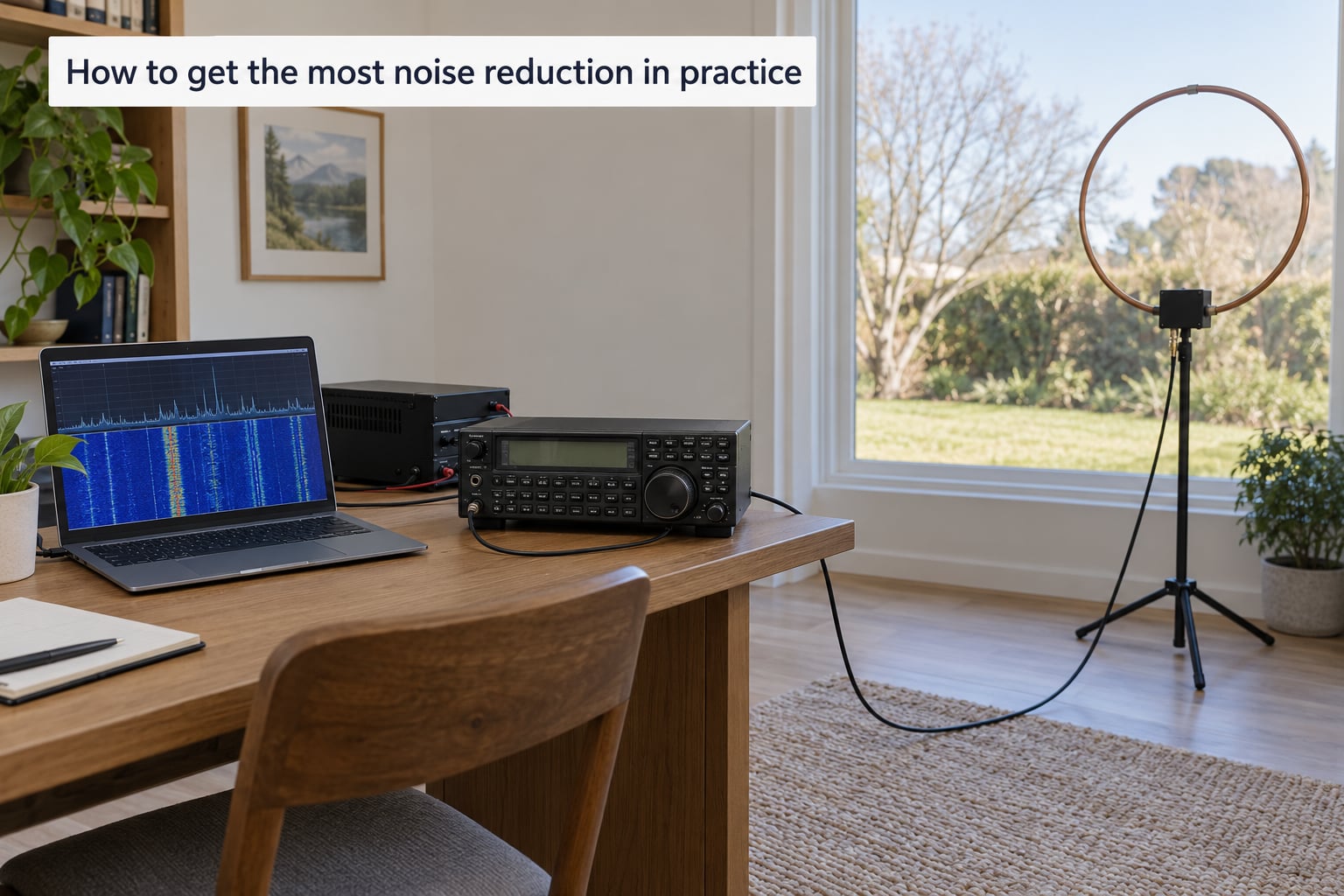
Order matters here. Work through it in this sequence and you will learn more in an hour than from a week of reading.
Move the loop away from the electronics first
Distance is free attenuation. Put the loop as far as you can manage from computers, monitor power supplies, LED lighting and any wall with a lot of mains wiring behind it. A balcony, a garden wall, or a spare room beats a desk.
Tune on the station you actually want
Set the capacitor for the desired frequency and confirm resonance, either from a tuning indicator or with a vector network analyser. Then verify the receiver sees a clean, strong signal. If you skip this step, a poor match can imitate every other problem in this article.
Rotate the loop and watch the meters, not your feelings
Note the noise level with no receiver signal present, then note signal strength on a station you care about. Now rotate the loop in 15-degree steps through a full turn and write both numbers down at each position. The best angle is the one that keeps the station high while the background drops.
Then choke the feedline
Only after the loop itself is behaving should you chase the coax. Fit a choke at the feedpoint, re-run the rotation test, and see whether the noise drops further. If it does not, the coax was not your problem and you have learned something useful cheaply.
Do not reach for a loop amplifier to fix noise
An amplifier raises the level of signal and noise together. If the antenna is small enough that its aperture is the limiting factor, adding gain pushes more of the receiver’s own noise into the band and the signal-to-noise ratio can get worse, not better. Treat an amplifier as a way to drive a long cable or a second receiver, not as noise control.
When a magnetic loop is the wrong antenna
A loop has honest limits, and choosing it for the wrong reason wastes your weekend.
Narrow bandwidth is the first one. If you want to work one band while monitoring another, or you want a wideband receiving antenna for general shortwave listening, a long wire or a discone will serve you better without constant retuning.
Nearby objects matter more than most people expect. A loop close to a metal roof, a balcony rail or a reinforced wall couples to those objects and changes both efficiency and pattern. That is not necessarily a problem, but it makes results less predictable.
Interference can also reach the receiver by routes that have nothing to do with the antenna — through the mains wiring, through building steel acting as a waveguide, or along the feedline. No antenna design fixes that, and adding gain to the antenna just makes the noise louder.
For broad coverage, a long-wire antenna, a dipole, or a compact wideband vertical is the honest choice. For a specific frequency in a noisy building, the loop is hard to beat.
Frequently Asked Questions
Does a magnetic loop antenna reduce all types of interference?
No. It targets locally generated, electrically radiated noise: switch-mode supplies, computers, motors, dimmers, power lines and nearby wiring. Atmospheric static, interference from distant stations on the same frequency, and fading are arriving radio waves rather than local electrical radiation, so a loop does very little for them.
Why can a weak station still sound noisy on a magnetic loop?
Most often the receiver, not the antenna. If the set’s own noise floor is above the antenna noise, a quieter antenna changes nothing. Strong local signals can also overload the front end, and an overly narrow filter can distort weak stations. Check receiver gain, filter width and overload before blaming the loop.
Does a magnetic loop work across the entire shortwave band?
One fixed loop is useful over roughly a small fraction of the band at a time, because it is resonant only near its tuned frequency. Published designs measure from a few kilohertz of bandwidth on the low bands to about 20 kHz at 14 MHz. A multi-band design needs switching or a remote-tunable capacitor, and constant retuning is part of the bargain.
Can a magnetic loop replace a long-wire antenna?
It depends on your goal. For a specific frequency in a noisy apartment or dense city, a loop often beats a long wire because it rejects local electrical noise. For wideband listening across many bands without retuning, a long wire or wideband vertical is more practical and more sensitive overall.
Do I need an antenna tuner to use a magnetic loop?
Not always, and it is not the first thing to reach for. Loop matching networks are designed to transform the very low loop resistance to 50 ohms at a chosen frequency, and many commercial loops are pre-matched. Tune the loop to resonance first, then judge whether a tuner solves a real impedance problem rather than a noise problem.
Conclusion
A magnetic loop antenna reduces noise for a specific and understandable reason: it senses magnetic flux, its shield rejects the electric field that carries most local interference, its high Q filters energy away from resonance, and its null can be aimed at the source. It is not a cure for atmospheric static, same-frequency interference or propagation loss.
Start here: build or borrow a resonant loop for the one frequency you want, place it as far from your electronics as practical, tune it, then rotate it in steps while recording noise and signal levels. Fix the feedline choke afterwards if you still need to. When the noise drops and the station gets readable, you have answered the question for yourself rather than taking anyone’s word for it.