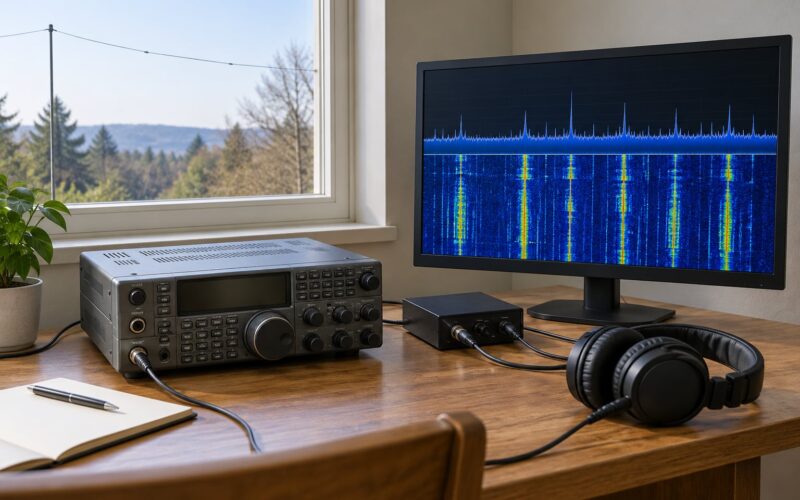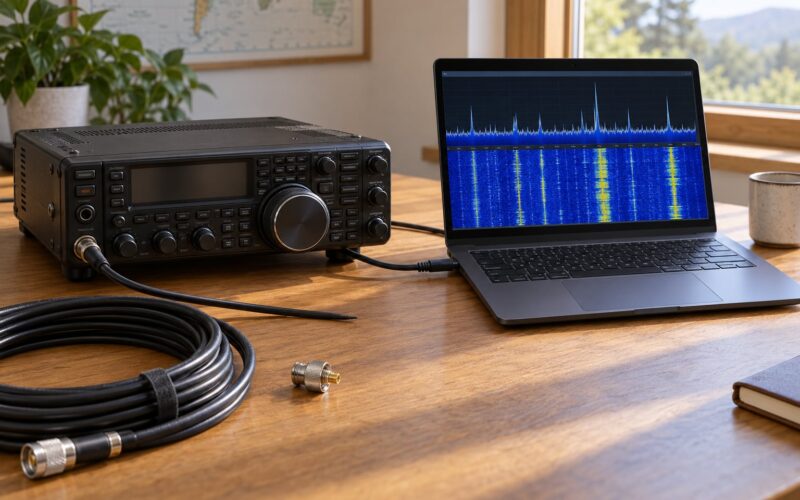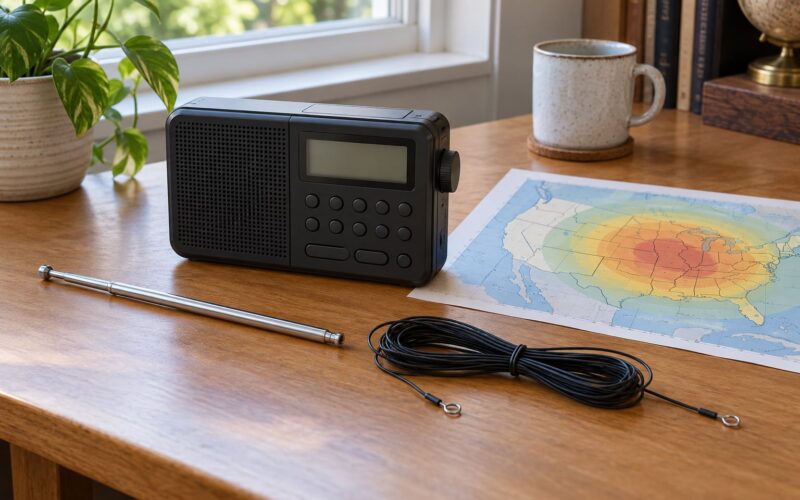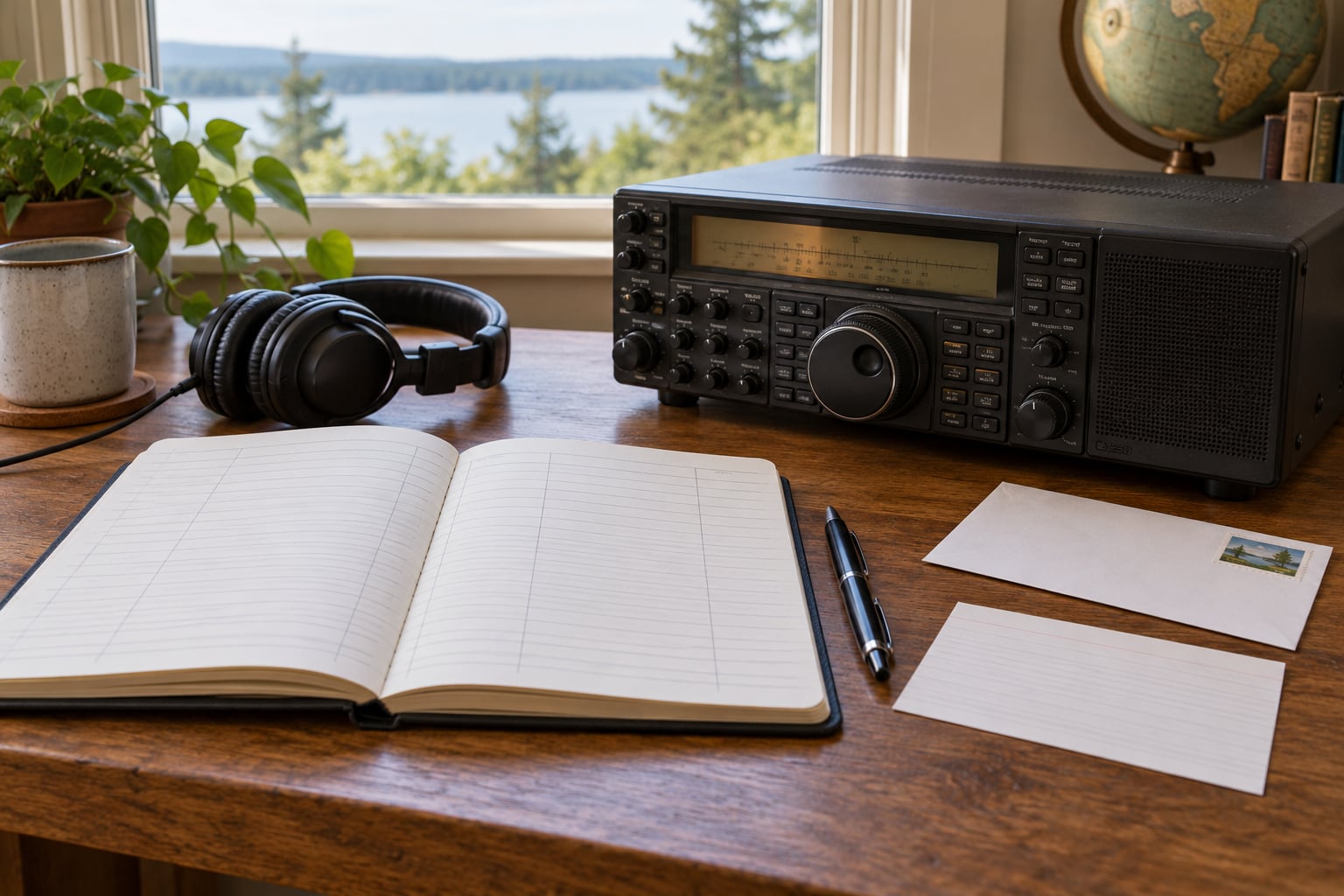
A QSL card comes back when your reception report is accurate, specific, and sent to the address the station actually uses. The whole process boils down to five moves: confirm exactly what you heard, find the station’s QSL instructions, write the report, send it with the return postage it asks for, then track it and follow up once. Ten minutes of preparation separates a reply from silence.
What is a QSL card? A QSL card is a postcard-sized confirmation of a radio contact. The name comes from the Q-code QSL, meaning “I acknowledge receipt.” In amateur radio it confirms a two-way contact between two stations. For a shortwave listener it confirms that a broadcaster accepted your reception report. It normally lists the station, the date, the time in UTC, the frequency, the band or mode, and the signal report you gave.
A few facts worth knowing before you start:
- Most major international broadcasters reply promptly to a well-written report, because listener reports are the only reception data they get from outside their own network.
- The card is mostly station promotion and a thank-you now. Engineers rarely read it.
- Many stations rely on professional remote monitoring receivers, which cuts both ways: they verify reports against those receivers, and they no longer need listener reports as much as they once did.
- Nobody is obligated to answer you. That is normal, and it is not a judgement on your writing.
Table of Contents
- 1What You Need
- 2Step-by-Step
- 3Step 1: Confirm What You Heard
- 4Step 2: Find the Station’s QSL Information
- 5Step 3: Create a Complete Reception Report
- 6Step 4: Send It to the Correct Address
- 7Step 5: Track and Follow Up
- 8Common Mistakes
- 9Frequently Asked Questions
- 10What counts as a reception report?
- 11Is a QSL card verification of two-way communication?
- 12How long does it take to get a QSL card?
- 13What should I do if the station offers eQSL?
- 14Should my reception report include a return envelope?
- 15Can you still get QSL cards, and can I make my own?
- 16Conclusion
What You Need
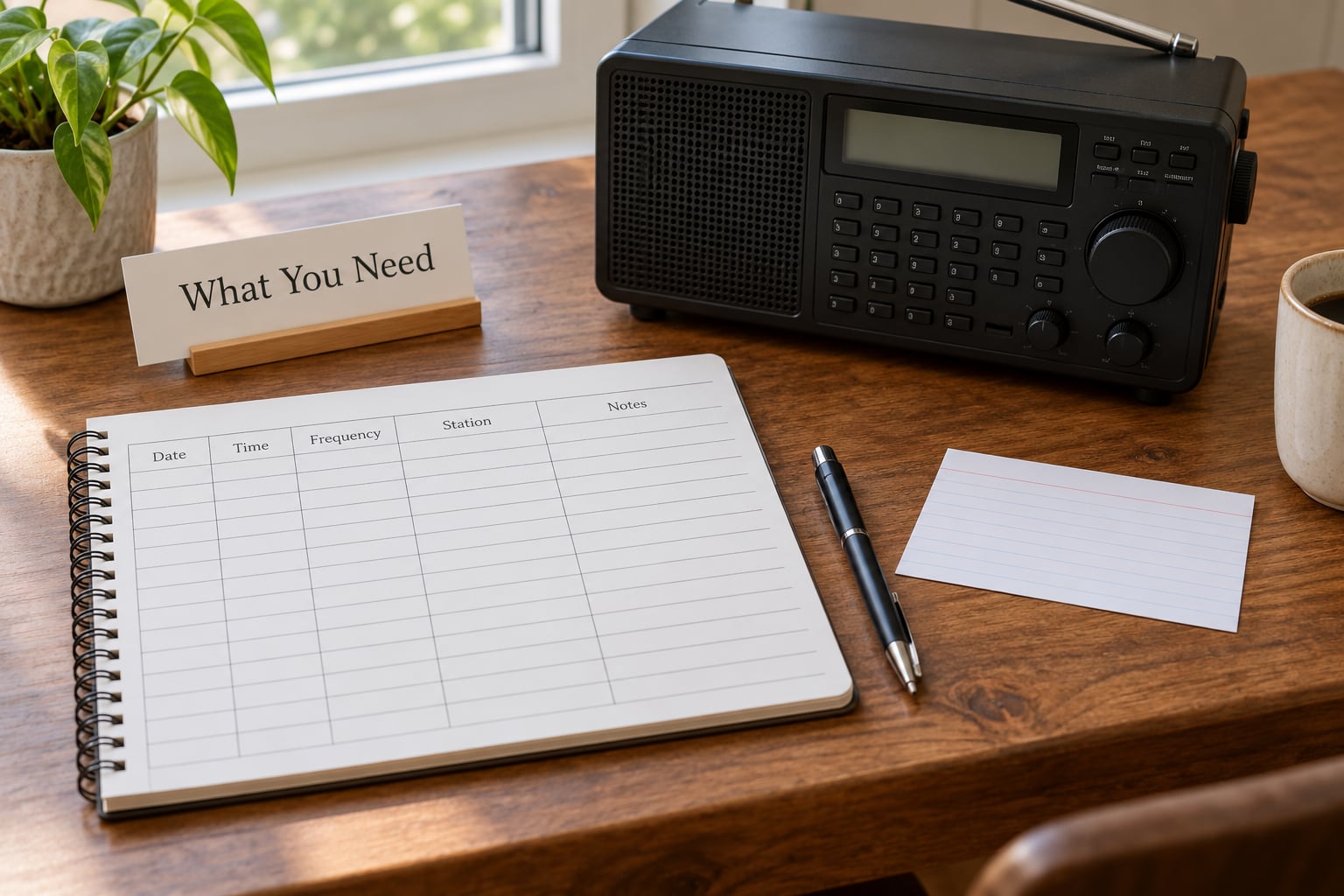
Before you write a word, gather five things. Anything missing from this list will end up missing from the report, and a report missing something is a report that goes in a drawer.
- A listening log with real timestamps. Note the frequency in kHz, the date, and the time on a 24-hour clock in UTC. If you write “about 8 pm,” an engineer in another country cannot use it.
- Receiver details. Make, model, and whether it is a dual-conversion superheterodyne, a communications receiver, or a portable set. Pull the exact model string from the manual rather than guessing.
- Antenna details. What it is, roughly how long, how it is mounted, and whether it is directional. “Random longwire” is a perfectly acceptable answer.
- Program details. The announcer names you heard, the programme title, the news items, the music tracks, and the station ID and time pips. This is the part that proves you listened.
- The station’s QSL address or electronic route, plus return postage. A self-addressed stamped envelope, a set of greenstamps, or an International Reply Coupon, depending on what the station asks for.
Add a pen and a copy of your own address, written out in a block that is easy for a non-native English speaker at the station to read. I write mine in capitals, one word per line, on the envelope and inside the letter.
Step-by-Step
Step 1: Confirm What You Heard
Start by pinning down the facts while the memory is fresh. Most rejected reports fail here, not later.
Write down the call sign or station name exactly as it identifies itself, the frequency in kHz, the date, the time in UTC on a 24-hour clock, and the mode. Then describe what the transmission actually was: AM with a carrier under music, single-sideband on a ham net, DRM, or plain AM voice from a utility station.
UTC is the whole ballgame. Local time plus a note of your offset works, but plain UTC is better, and a 24-hour clock removes the morning-versus-evening ambiguity entirely.
Listen for at least 20 minutes, not 3. The Shortwave Facebook groups are blunt about this: a report built on a five-minute skim of a long broadcast reads as a drive-by, and listeners on r/shortwave say the same thing about padded reports. A longer listen gives you real programme content to describe, which is exactly what the station wants to read.
Step 2: Find the Station’s QSL Information
Check the station’s own website first. Look for a page labelled QSL, Reception Reports, or Verification. Many broadcasters now run a report form here, and some return an electronic QSL by email within about a week with no postage at all.
If the website is thin, these are the places that work:
- World Radio and TV Handbook — the station listing usually states its QSL policy, including whether it wants postage and whether it answers by email.
- The station’s schedule or programme PDF — technical services pages frequently carry a correspondence address and a c/o language service.
- QRZ.com — best for amateur stations and for finding a named QSL manager.
- DX clubs and mailing lists — a club bulletin often carries the current correct address for a station that has recently moved.
- Electronic confirmation services — eQSL, the Logbook of the World, and Club Log’s OQRS cover ham-radio confirmations; individual station forms cover many broadcasters.
Read the stated policy carefully before you write. If it says QSL via BURO, that is the only route that counts. If it names a language service, address the letter c/o that service. Ignoring a published instruction is the fastest way to get no reply.
Step 3: Create a Complete Reception Report
Choose a signal-reporting code next. SINPO is the standard five-digit form that broadcast stations expect. SIO is the shorter three-digit alternative that professional monitoring stations tend to prefer, and it is easier to judge honestly.
SINPO codes Signal, Interference, Noise, Propagation, and Overall, each rated 1 to 5. Work backwards: decide your Overall score first, then make the other four support it.
| Code | Rating | What it means |
|---|---|---|
| SINPO | 5 | 5 = very good, 4 = good, 3 = fair, 2 = poor, 1 = very poor. S is signal strength, I is interference, N is natural noise such as static, P is propagation, O is overall merit. |
| SIO | 3 | S is signal strength, I is interference, O is overall quality. Same 1 to 5 scale, three digits instead of five. |
Here is what each figure actually describes, and where the number goes.
| Digit | 5 | 4 | 3 | 2 | 1 |
|---|---|---|---|---|---|
| Signal (S) | Very strong, no receiver noise | Strong, slight noise | Moderate, workable | Weak, fading | Barely readable |
| Interference (I) | None | Slight other station | Noticeable other station | Strong other station | Dominant other station |
| Noise (N) | None | Slight | Moderate static | Heavy static | Continuous crashes |
| Propagation (P) | Stable, no fading | Minor fading | Noticeable fading | Severe fading | Signal drops out |
| Overall (O) | Studio quality, would use for a listener comment | Good, clear programme | Fair, usable | Poor, partly intelligible | Not worth listening to |
A report reading SINPO 55445 means a strong, clearly readable signal with slight noise and minor fading. That is a report a station can act on. For reference, 55555 is the highest possible score and most real shortwave receptions sit somewhere around 45333.
On interference, the descriptions matter. Co-channel interference is another station on the same frequency. Adjacent-channel interference sits on a neighbouring channel. Man-made noise is electrical buzz, usually from switching power supplies or computers. Jamming is deliberate, and hearing it is worth noting plainly without speculating on who did it.
Then write the report. Copy this block and fill in the blanks.
To: [Station name], c/o [Language Service if stated]
[Station postal address]
[Country]
Reception report
Date of reception: [DD Month YYYY]
Time: [0000-2359 UTC]
Frequency: [00000 kHz]
SINPO code: [00000] or SIO: [000]
Receiver: [Make and model]
Antenna: [Description, length, mounting]
Location: [City, region, country]
Programme details: I listened from [0000] to [0000] UTC on [date]. I heard [announcer names] presenting [programme title]. Items included [news items, interviews, music]. Station identification and time signal heard at [0000] UTC.
Comments: [Signal behaviour over the period, interference heard, anything the station might want to know about reception in this area.]
I would be grateful for a QSL card or electronic confirmation of this reception.
Thank you for your time.
[Your name]
[Your full postal return address]
Keep it to one page. Engineers sort these fast, and a wall of text gets skimmed.
Step 4: Send It to the Correct Address
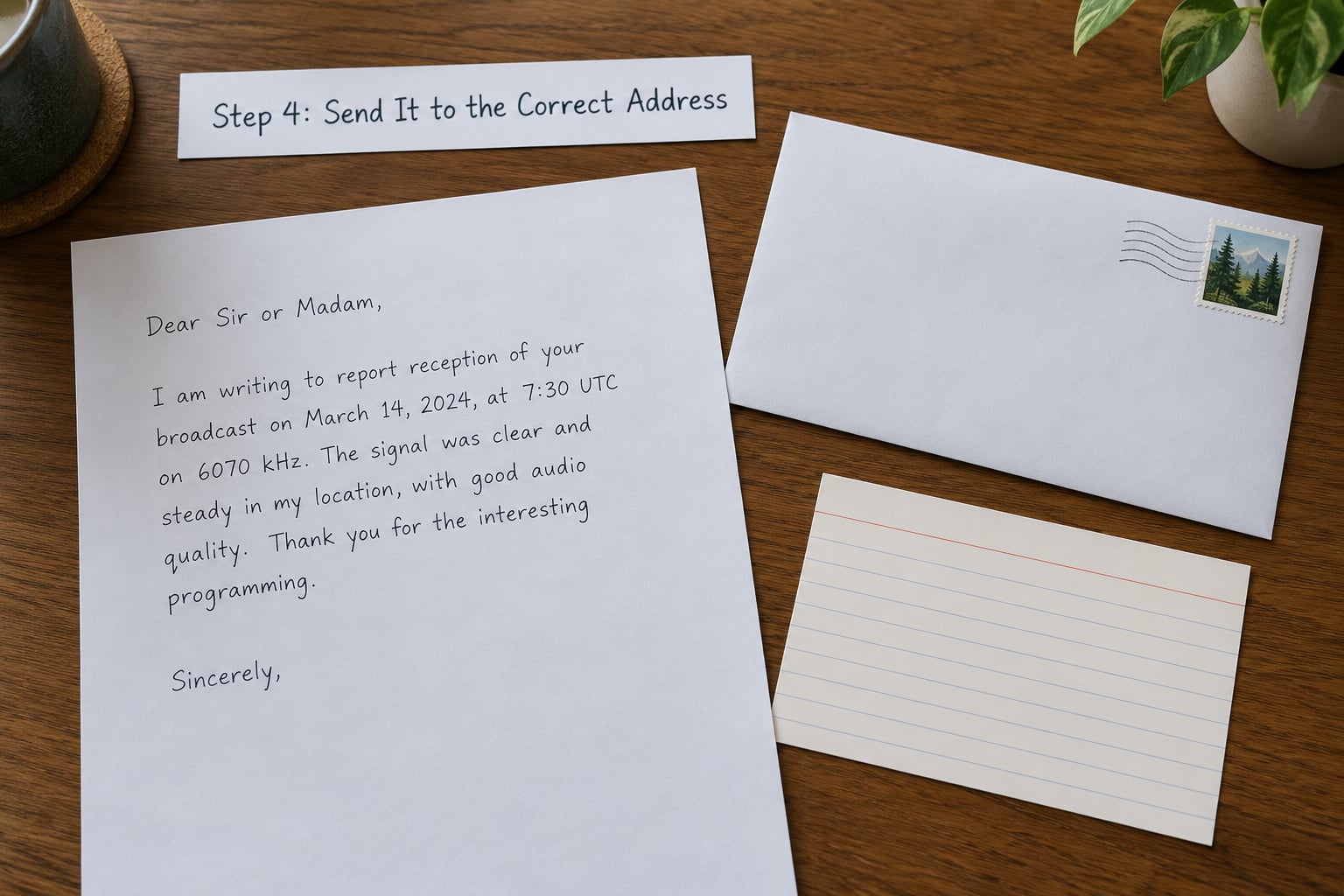
For paper reports, use a plain envelope. Write the sender’s name, full street address, and country in capitals, and add a return address in the upper right corner. Where postal handling is unreliable, skip the callsign on the envelope. A stolen QSL is a nuisance; a stolen identity is worse.
Handle return postage according to what the station asks for.
| Method | When it applies | Notes |
|---|---|---|
| None | Most major broadcasters | They pay the return postage themselves |
| SASE | Stations that accept US returns | Self-addressed stamped envelope |
| Greenstamps | Stations that ask for return postage | US postage stamps sold in sheets; write the denomination in the corner of a blank card |
| International Reply Coupon | Overseas destinations | Buy at the post office, attach it inside, and note the coupon number |
| Airmail | Long-haul destinations | Use airmail labels and Par Avion stickers |
Mark airmail clearly. A letter that sits for six weeks in a sorting office helps nobody.
Here is a finished example of the addressing side, for a station that takes US returns:
Radio Example International
Technical Services Department
PO Box 4321
Central City, ST 10000
UNITED STATES
Send it now rather than next month. A report that reaches a station months after a broadcast has little engineering value, and stations notice and reward prompt senders.
Step 5: Track and Follow Up
Log the outgoing report the same day. Record the date, the address, the postage attached, and the frequency and time heard. Write “QSL OUT” in your logbook entry so you never chase a duplicate.
Keep the envelope or a photo of the posted report. If someone asks, you can show exactly what you sent and when.
Expect different windows depending on the route:
- A station website form can return an electronic confirmation inside about a week. Radio New Zealand International is the example listeners cite most often.
- Email reports to broadcasters typically land anywhere from one to six weeks.
- Paper mail to a large international broadcaster usually takes four to twelve weeks.
- Amateur radio confirmations through the QSL bureau can take months, because they travel in batches.
If nothing arrives after two months by post, send one short follow-up, quoting the date and frequency of the original report. One follow-up is courteous. A stream of them is not.
Tell a QSL card apart from a general thank-you letter. A card repeats the verification data: station, date, time, frequency, and your signal report, usually with the station’s signature or stamp. A thank-you letter confirms the receipt but does not verify the reception, so do not log it as a QSL.
When no reply comes, work out which of these applies. The report went to the transmitter rather than the technical services desk. The report was too generic to match against monitoring records. The station uses remote monitoring and simply replies to nobody. Or the station no longer exists at that address. All four are common, and only the first one is your fault.
Common Mistakes
Missing or vague dates and times. “Around 0200 UTC” cannot be matched to a log. Give exact times to the nearest five minutes on a 24-hour clock, and confirm your offset if you are using local time.
Wrong frequency. Give the frequency in kHz and stay within 5 kHz of the carrier. Rounding to the nearest 100 kHz looks careless.
Generic programme details. Repeating the published schedule instead of describing what you actually heard is the most common reason a report gets filed unread.
No return postage when it was required. The report arrives, sits in a tray, and dies. Check the station’s policy and include the IRC, greenstamps, or SASE it asks for.
Sending to the wrong desk. Aimed at a studio in the wrong country instead of the technical services or correspondence address, your report simply never reaches the person who can match it.
Ignoring a QSL manager or bureau instruction. If the station says QSL via BURO or manager only, going direct guarantees nothing.
Using an unverified electronic route. A random email address found in a forum thread is not the station’s QSL desk. Go through the station’s own site or a recognised confirmation service.
Sending a report from a WebSDR you never heard locally. Listeners call this out, and engineers can spot it because the conditions will not match. Report only what you received on your own equipment, or state plainly that you monitored a remote receiver.
Reporting a QSO that never happened. A reception report is a claim about what you heard. If you did not hear it, do not report it.
Two habits do more for your reply rate than anything else on this list: write while the programme is still fresh in your head, and send within a couple of weeks.
Frequently Asked Questions
What counts as a reception report?
A reception report is a written record of a broadcast you actually received: frequency in kHz, date, time in UTC, signal strength, receiver and antenna details, and what the programme contained. It goes to the station or its QSL manager so engineers can compare your reception against their own monitoring. A one-line note that a station was audible is not a report and will not earn a card.
Is a QSL card verification of two-way communication?
Not for a shortwave listener. A QSL card from a broadcaster confirms one thing: the station accepted your reception report and recorded that you heard it. Two-way verification applies to amateur radio, where an operator confirms a QSO with another operator. If you work hams, your confirmation path runs through a QSL manager, the QSL bureau, or electronic services such as LoTW and Club Log OQRS instead of a reception report.
How long does it take to get a QSL card?
It depends entirely on the route. A website form or emailed report to a station that still answers listeners can return confirmation in about a week. Email reports commonly take one to six weeks. Paper mail to a large international broadcaster usually takes four to twelve weeks, and amateur bureau confirmations can take months because they travel in batches. If you have waited two months on a paper report, one short follow-up is reasonable.
What should I do if the station offers eQSL?
Use it. An electronic confirmation costs no postage, arrives far faster than paper, and most broadcasters now consider it a full QSL. Some stations return a printable card if you ask, which is worth doing if you collect paper. Make sure the electronic route is the station’s own or a recognised service, and copy any text or image confirming the reception into your logbook so you are not relying on an inbox that may be cleared.
Should my reception report include a return envelope?
Only when the station says so. Most major international broadcasters pay their own return postage and prefer plain envelopes, so an unsolicited stamped envelope can simply complicate things. Stations that ask for return postage want a self-addressed stamped envelope if they are in the United States, greenstamps, or an International Reply Coupon for overseas destinations. Always read the published QSL policy before adding postage.
Can you still get QSL cards, and can I make my own?
Yes, plenty come back, though fewer than in past decades because many broadcasters now rely on professional remote monitoring. More and more of them answer by email or through a website form. This guide covers requesting a card rather than printing one. If you want to design your own QSL card for a ham-radio operation, that is a separate process, usually handled through the amateur radio QSL card printers and cards services rather than through broadcast reception reports.
Conclusion
Pick the station you heard most recently and read its QSL instructions before anything else. That single page tells you the address, the postage requirement, and whether a website form replaces paper. Then log the reception while it is fresh, write the report using the template above, and mail it the same week.
That is how to send a reception report and get a QSL card. Everything after this is patience, plus one polite follow-up if a couple of months pass with no reply.