If you want to know what frequencies to scan for international broadcasts, start wide across the HF range between roughly 3 and 30 MHz, then slow down inside the eight allocated shortwave meter bands: 16m, 19m, 22m, 25m, 31m, 41m, 49m and 60m. The highest frequency allotted to shortwave broadcasting is 26.100 MHz, so anything above that is a different service.
That is the short version. The useful version is knowing which band suits the hour, the season and the country you want to hear, because the ionosphere decides what reaches your antenna rather than the station schedule alone.
I have spent more weekends than I care to admit parked in front of receivers doing exactly this, and the disappointing truth is that a static list of kHz values goes stale within months. Broadcaster schedules shift between seasons, services migrate to a different transmitter site, and the same frequency can carry three different languages at three different hours. Learn the bands and the timing, and you never need the list again.
Last verified October 2026. Band limits below are fixed by international allocation; individual services inside them change, so treat every specific frequency as a starting point to check rather than a promise.
Table of Contents
- 1What Frequencies to Scan for International Broadcasts?
- 2Which Shortwave Bands Should You Scan First?
- 3The bands in order of how much programming you will actually find
- 4The frequency regions to skip while scanning for broadcasts
- 5How the order changes with season and solar activity
- 6How Do You Find the Most Active Frequencies?
- 71. Get the antenna right before you touch the dial</
- 82. Sweep each band slowly, in 1 kHz steps
- 93. Apply a stopping rule so sessions end on their own
- 104. Peak the signal, then note the exact dial reading
- 115. Park unknowns in a scratch memory slot
- 126. Log it and come back at a different hour
- 13Separating stations from everything else
- 14What Frequencies Work Best by Region?
- 15Why Do the Best Frequencies Change by Time of Day?
- 16How Do You Tune and Identify a Broadcast Station?
- 17How to scan for international broadcasts without losing the weak signals
- 18What Tools Make a Shortwave Scan More Productive?
- 19Frequently Asked Questions
- 20What is the best shortwave frequency range for beginners?
- 21How do I scan the entire shortwave band?
- 22Why does a station disappear after I find it?
- 23Are all signals within a shortwave broadcast band international stations?
- 24What is the best antenna for scanning international broadcasts?
- 25Should I use AM or single-sideband mode?
- 26The Shortwave Bottom Line
What Frequencies to Scan for International Broadcasts?
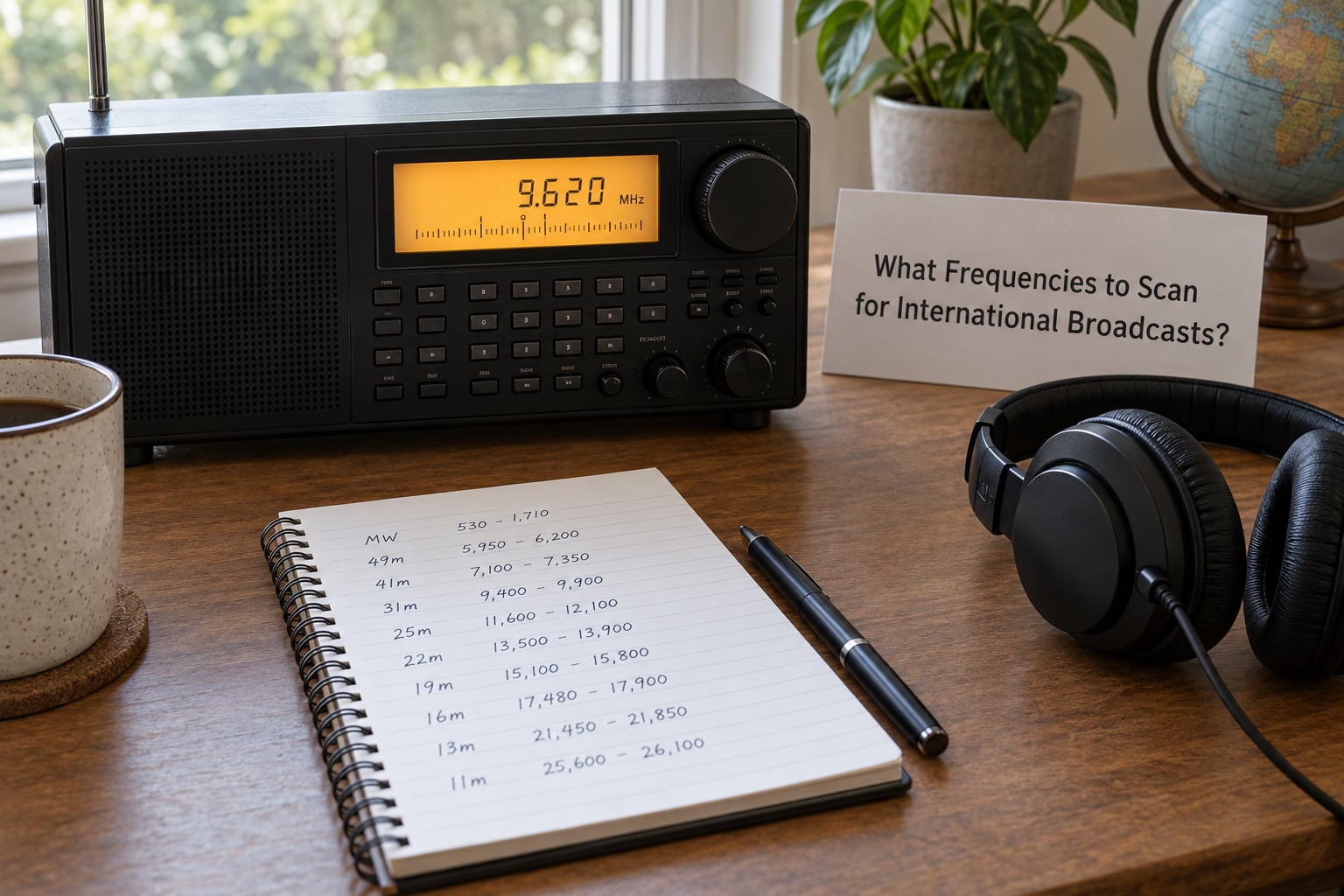
The answer is the eight broadcast bands between 4.75 and 26.1 MHz, scanned in roughly this order of usefulness: 19m, 16m, 25m, 31m, 41m, 49m, 22m, then 60m. Order changes with the hour, and this table is the single most useful thing you can print out.
| Meter band | Frequency range | In MHz | Best window | What you typically hear |
|---|---|---|---|---|
| 60m | 4.750 – 5.060 MHz | 4.75 – 5.06 | Night, tropical regions | Tropical-band regional broadcasters, mostly Americas and Southeast Asia |
| 49m | 5.850 – 6.200 MHz | 5.85 – 6.20 | Night | Dense jungle band, Europe and Asia at night, shared with amateur use |
| 41m | 7.100 – 7.300 MHz | 7.10 – 7.30 | Late afternoon and night | Regional relays, clear after dark, less crowded than 31m |
| 31m | 9.500 – 9.900 MHz | 9.50 – 9.90 | Day and dusk | The workhorse. Europe by day, Asia and the Pacific toward evening |
| 25m | 11.600 – 12.100 MHz | 11.60 – 12.10 | Day | Reliable mid-day path to Europe, Asia and the Middle East |
| 22m | 13.600 – 13.800 MHz | 13.60 – 13.80 | Day and early evening | Narrow band, mixed international relays, very useful around sunset |
| 19m | 15.100 – 15.600 MHz | 15.10 – 15.60 | Day, dawn and dusk | The busiest band on shortwave, crowded with major international services |
| 16m | 17.480 – 17.900 MHz | 17.48 – 17.90 | Dawn and dusk | The long-distance band, strongest during the grey-line window |
| 13m | 21.850 – 21.950 MHz | 21.85 – 21.95 | Summer daytime, variable | At the top of the HF range, spotty and highly solar-cycle dependent |
Two things stand out. The 19m band is congested, which is a good problem: many stations means more chances to catch something. The 16m band is the opposite, quieter and cleaner, which is exactly why it carries the long paths.
Scanning 4 to 22 MHz before you narrow in does take a while. It is also the only way to learn what your local noise floor looks like, because a receiver that tells you nothing is on air is useless when a station fades out mid-sentence.
Which Shortwave Bands Should You Scan First?
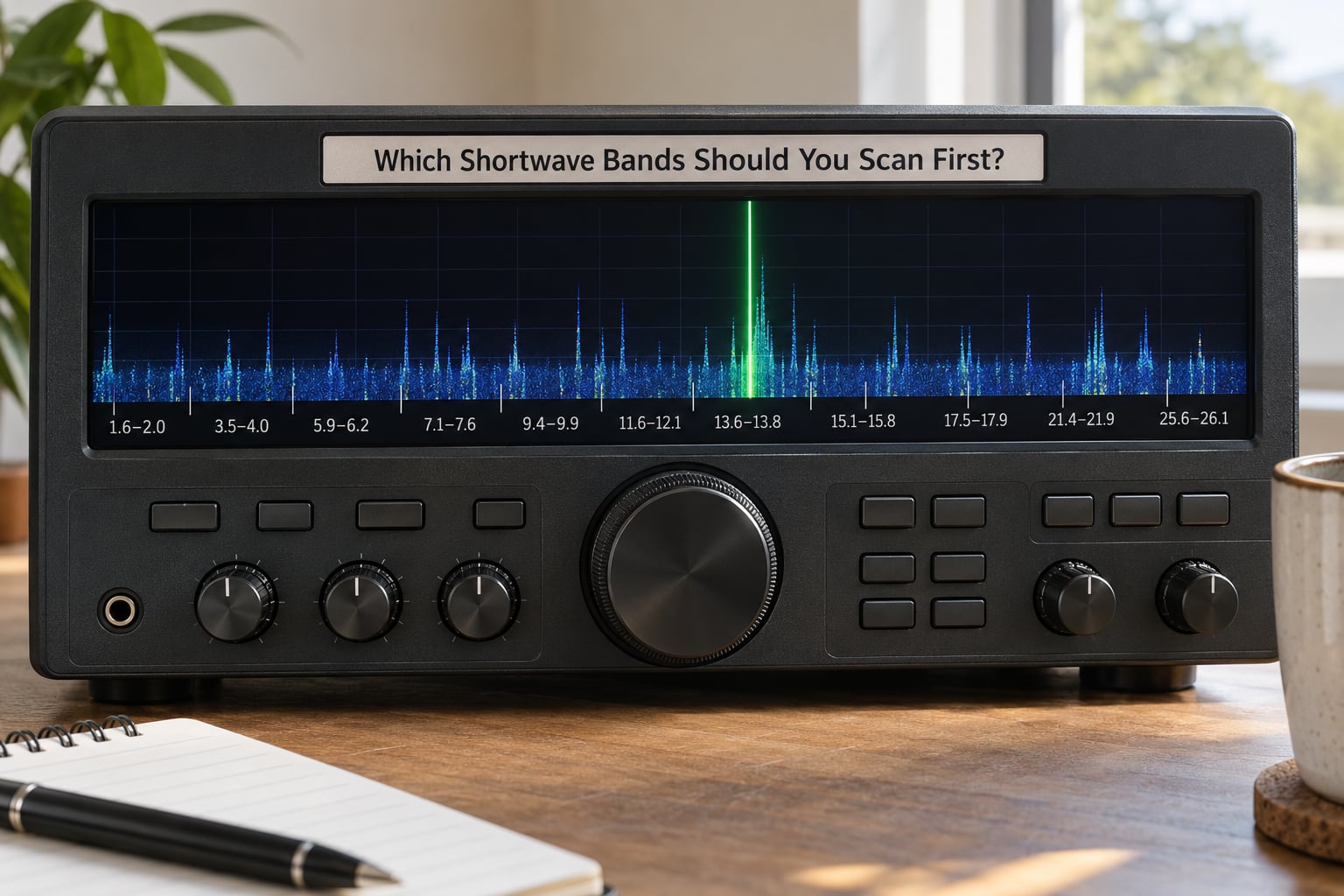
Scan 19m first, then 31m, then 16m. Those three bands between them cover the overwhelming majority of the international programming you will ever hear, and they behave predictably across the day.
The bands in order of how much programming you will actually find
19m (15.100 – 15.600 MHz) is the busiest by a wide margin. Major international services have used it for decades, and on any given day you can usually find three or four stations without hunting. The cost is crowding, so expect heterodyne whistles from two carriers sitting close together.
31m (9.500 – 9.900 MHz) is the all-rounder. It works in daylight for paths into Europe and Asia, and it stays alive well after sunset for South America and the Pacific. Experienced listeners on r/shortwave treat it as the first band to touch when conditions are uncertain.
16m (17.480 – 17.900 MHz) rewards patience. It opens at dawn and dusk and often closes an hour later, and when it is open it carries paths that other bands cannot reach. Miss the window and you will think the band is dead.
25m (11.600 – 12.100 MHz) and 22m (13.600 – 13.800 MHz) are solid daytime bands with fewer stations. They are the ones to work when you want to hear a specific region and the lower bands are dominated by your own hemisphere.
41m (7.100 – 7.300 MHz) and 49m (5.850 – 6.200 MHz) come alive after dark. 49m is the most crowded band after sunset and shares space with amateur operators, so it rewards patient tuning. 60m (4.750 – 5.060 MHz) is regional and tropical rather than truly international, but it is a reliable night band inside the tropics.
The frequency regions to skip while scanning for broadcasts
Scanning the whole 3 to 30 MHz range means sweeping through a lot of spectrum that has nothing to do with broadcasting. Roughly 26.960 to 27.440 MHz is the 11m CB segment in the US, and the amateur allocations sit at 3.5 to 4.0, 7.0 to 7.3, 14.0 to 14.35, 21.0 to 21.45 and 28.0 to 29.7 MHz.
You will hear plenty of hams, marine traffic and aircraft control. They are fun, and they are not what the query is asking about, so skip past them unless you decide you want to learn that side of the hobby.
How the order changes with season and solar activity
The community advice that keeps repeating is simple: when your memorized frequencies stop working in summer, move up a band or two. The higher bands need sunlight to ionise properly, so they strengthen during the long summer days and weaken in winter when the usable layers sit lower.
Solar activity matters too. Higher sunspot numbers mean a sunnier ionosphere, more MUF on the high bands and more surprises on 16m and 13m. During a quiet period the low bands carry more of the traffic and the top of the range goes quiet. Check a space weather report before you conclude that your antenna has failed.
How Do You Find the Most Active Frequencies?
Scanning works better as a habit with rules than as a slow dial sweep with headphones on. Here is the sequence I use, and it takes about fifteen minutes once you have a log going.
1. Get the antenna right before you touch the dial</
The built-in whip on a portable is a liability at these frequencies. Run a wire to a near-vertical antenna as long as the space allows, or clamp a loop to a window frame or a fence. Reception on 7 and 15 MHz is very sensitive to antenna length and orientation, and a bad one costs you more than any receiver setting.
2. Sweep each band slowly, in 1 kHz steps
Set the receiver to AM and use a wide bandwidth first. Move up and down the band in small steps with a stop of a second or two at each position. You are listening for anything that changes in pitch, level or rhythm as you pass the carrier.
Auto-scan is fast and it is exactly wrong for this job. Because it stops at a preset threshold, it steps over the quiet, weak signals that DX listening depends on. Use auto-scan to gauge whether a band is open, then switch to manual for the actual hunt.
3. Apply a stopping rule so sessions end on their own
Stop when you have logged three stations with clear programme audio on a band, or after five minutes of nothing, whichever comes first. Without that rule you can sit on an open band for an hour and feel busy while learning nothing.
4. Peak the signal, then note the exact dial reading
Once you find something, back the tuning off until the audio drops, then come forward slowly until it comes back at maximum. That point is the carrier. Write down what the dial reads, because cheap portables have frequency errors of a few kHz and the number you tune to is not always the number the station transmits on.
5. Park unknowns in a scratch memory slot
Keep one memory channel empty and unlabelled for unidentified signals. Whatever you hear will normally identify itself at the top of the hour, and that announcement tells you the country, the language and the service. Listeners recommend this constantly because guessing from the programming is unreliable.
6. Log it and come back at a different hour
A log with columns for frequency, band, date, time, station and signal quality turns out to be the most valuable shortwave tool you own. Weak signals that fade are often back an hour later under completely different propagation.
Separating stations from everything else
A bare carrier with no audio is usually a telegraph or navigation beacon rather than a dead broadcast. A second voice appearing between a broadcaster’s programmes is most likely a harmonic of another station, because transmitters produce multiples of their carrier frequency. Unintelligible speech or a slow repeating pattern may be a numbers station, and rapid beeping at the top of the hour is often a time signal station rather than a broadcast.
Flat, rhythmic speech you cannot follow is a common first experience. Only about 18 percent of international services broadcast in English at any one time, so do not assume a fault in your radio when the language is unfamiliar.
What Frequencies Work Best by Region?
The best frequency depends on three things at once: where you are sitting, where you want to hear from, and what time it is where you are. No band guarantees reception from everywhere. What the table below does is describe which bands tend to carry which targets for a listener in North America or Europe.
| Target region | Most productive bands | Typical window | Why |
|---|---|---|---|
| Europe | 16m, 19m, 31m, 25m | 16m and 19m by day; 31m and 49m at night | Many high-powered transmitters and a well-developed relay network aimed at this region |
| Asia and the Middle East | 25m, 31m, 22m | Late morning to late afternoon, 19m in the evening | The ionospheric path to Asia is longest at low angles, which favours the mid bands in daylight |
| Africa | 31m, 25m, 19m | Daytime for the north, evening for southern Africa | Wide coverage requirements mean high-powered services spread across several mid bands |
| Latin America | 49m, 41m, 60m, 31m | Night and early morning | The lowest bands stay open longest, and many regional broadcasters are built for domestic tropical coverage |
| Oceania and the Pacific | 19m, 31m, 25m | Early evening and pre-dawn | Long east-west paths work on the bands with high maximum usable frequency during daylight |
| North America | 41m, 49m, 31m | Night, plus 19m around dawn | Local services dominate the lower bands by day, so the interesting signal appears after dark |
One real example illustrates the pattern. 9580 kHz has been heard carrying content from several different directions, including relays of Chinese and Vatican programming plus US services, because transmitters on different paths share that channel and take turns as their schedules rotate. If you judge a frequency by what you heard once, you will reach the wrong conclusion.
Radio hobbyists also note that some of the most reliable international services appear outside the usual bands altogether. BBC World Service content has been reported around 400 kHz on longwave, which is a different band with different propagation and different hardware requirements.
Why Do the Best Frequencies Change by Time of Day?
The ionosphere is built of layers that respond to sunlight, and each one bends a different slice of the HF spectrum. During the day, a low layer called D absorbs almost everything below about 10 MHz, which is why your local medium-wave and lower shortwave stations dominate the dial and the distant signals vanish. At night that layer fades and signals below 10 MHz travel hundreds or thousands of kilometres.
A higher layer called F2 does the opposite. It needs sunlight to form properly, so it is strongest around local midday and supports the 15 to 22 MHz bands, which is why 19m and 16m work during the day and collapse at night.
At sunset and sunrise the two extremes meet. The low bands have not yet closed and the high bands have not yet opened, so the grey-line window is the best long-distance DX period in the day. Experienced listeners schedule their best listening around local dawn and dusk for exactly that reason.
The practical rule follows from this. Nearby and regional services tend to dominate the lower bands during the day, because nearby signals overpower anything arriving by skywave. Distant stations become the loudest occupants once local daylight fades and those lower bands open up.
Two other time factors matter. Broadcast seasons follow the transmitter sites’ local summer and winter, so a service that airs a north-path relay in winter may switch to a south-path target in summer. And the ionosphere occasionally absorbs an entire band for a day or two after a solar flare event, known as a sudden ionospheric disturbance, which is a useful thing to know before you blame your antenna.
How Do You Tune and Identify a Broadcast Station?
Tune in two stages. Use coarse tuning to get near a signal, then fine tuning at small steps to centre it. Most receivers with a digital display give you fine tuning, and portable sets often skip it entirely, which is a large part of why weak signals seem unfindable on a cheap radio.
How to scan for international broadcasts without losing the weak signals
Set the mode to AM with a wide bandwidth to locate carriers, and narrow the bandwidth once you have audio. If a nearby station is bleeding over a signal you want, switch to single sideband and try both the upper and lower sideband, a technique sometimes called ECSS, which lets you pick the cleaner half of the carrier. Turn automatic gain control off or slow if weak signals keep being pushed down by a strong neighbour, and use an attenuator when the front end is clearly overloaded.
Published station frequencies are starting points rather than exact dial readings. Transmitters drift, several stations share a channel in rotation, and some services broadcast on the same frequency from different sites at different hours, so always confirm what you are hearing against a current schedule.
Identification is mostly about patience. Nearly every major broadcaster runs an interval signal, a short piece of music or electronic motif, plus a spoken station identification at the top of the hour. National languages, time pips, the type of interval signal and the transmitter site named in the announcement together give you a confident answer within about an hour of finding the signal.
When a station seems to disappear mid-programme, check the hour and check the schedule. A transmitter aimed at another region has swapped in, a seasonal change has moved the service, or an ionospheric event has absorbed the band.
What Tools Make a Shortwave Scan More Productive?
A good antenna and a disciplined listening routine produce more than a bigger display. In roughly the order of practical return, here is what changes your results.
| Tool | What it changes | Worth it when |
|---|---|---|
| Antenna and feed line | Signal strength and noise floor across every band | Always. Nothing else you add matters as much. |
| Attenuator | Prevents overload from nearby broadcast fields | You live near high-power transmitters or strong local stations |
| Logging software or a notebook | Turns a listening session into a searchable record | Immediately. This is the cheapest useful upgrade there is. |
| Digital communications receiver | Accurate frequency, selectable sidebands, narrow filters, memory channels | You want to monitor specific services rather than browse |
| SDR receiver | Wide views of the band, ability to record and revisit weak signals | You already have a decent antenna and a computer |
| Portable analog set | Nothing, but it works anywhere instantly | Travel and first listening sessions |
Beginners often ask whether a first receiver needs to reach 30 MHz. It does not, because shortwave broadcasting stops at 26.100 MHz, and a set that covers to about 22 MHz will hear nearly everything of interest. Newcomers do report picking up distant broadcasts on inexpensive portables, which says more about the strength of shortwave signals than about any particular model.
On listening to broadcasts without HF reception, streaming services and directory tools map stations that broadcast over the internet and let you pick up the same programming by country. That is a reasonable fallback when your antenna situation is poor, though it removes the part of the hobby that makes it worth doing.
Frequently Asked Questions
What is the best shortwave frequency range for beginners?
Start with the 31m band at 9.500 to 9.900 MHz, then move to 19m at 15.100 to 15.600 MHz. Those two bands carry the largest number of international services across the widest range of times of day. A receiver covering roughly 7 to 22 MHz will reach every broadcast band except the tropical 60m and 49m segments, which is plenty for a first setup.
How do I scan the entire shortwave band?
Set the receiver to AM with a wide bandwidth and step upward in 1 kHz increments, pausing a second or two at each position. Write down anything that changes in pitch, level or rhythm. Auto-scan steps over weak signals because it only stops above a set threshold, so use it to judge band activity and then hunt manually.
Why does a station disappear after I find it?
Three causes account for most of it. Propagation changes, often when the D layer forms with local daylight and absorbs the lower bands. The broadcaster switched transmitter site or target region on a seasonal schedule. Or a solar flare event absorbed the band for a day or two. Check the time, then check a current schedule, before suspecting your equipment.
Are all signals within a shortwave broadcast band international stations?
No. Amateurs, maritime traffic, aircraft control, time signal beacons and numbers stations share these allocations. A bare carrier with no audio is usually a beacon or telegraph station, rapid beeping at the hour is often a time signal, and flat unreadable speech may be a numbers station. Amateur sub-bands sit near 7.0 to 7.3, 14.0 to 14.35 and 21.0 to 21.45 MHz.
What is the best antenna for scanning international broadcasts?
A long wire as close to vertical as you can manage, run as far from buildings and power cables as practical, will outperform most receiver upgrades. On lower bands such as 49m and 60m, where the wavelength is long, a full-length wire matters far more than a small whip. Window and balcony setups can work, but keep the feed line short and the connections solid.
Should I use AM or single-sideband mode?
Use AM to find stations, because that is how international broadcast services normally transmit. Once you have audio, switch to single sideband and try both upper and lower sideband to pull a clean signal out of interference, a method often called ECSS. Single sideband also handles crowded adjacent channels better, but a broadcast made for AM can sound thin or distorted in the wrong sideband.
The Shortwave Bottom Line
If you only do three things this month, scan 19m and 31m first, log anything you find with the exact dial reading and the time, then repeat the same scan an hour before dawn and again an hour after sunset. Those two windows and the two daytime bands will teach you more about propagation than any frequency list ever will.
Everything else, including the stations that migrate around you during the day, follows from there. Log the bands that work for you in your own area and in your own season, and check a current broadcast schedule before you assume anything has gone wrong.